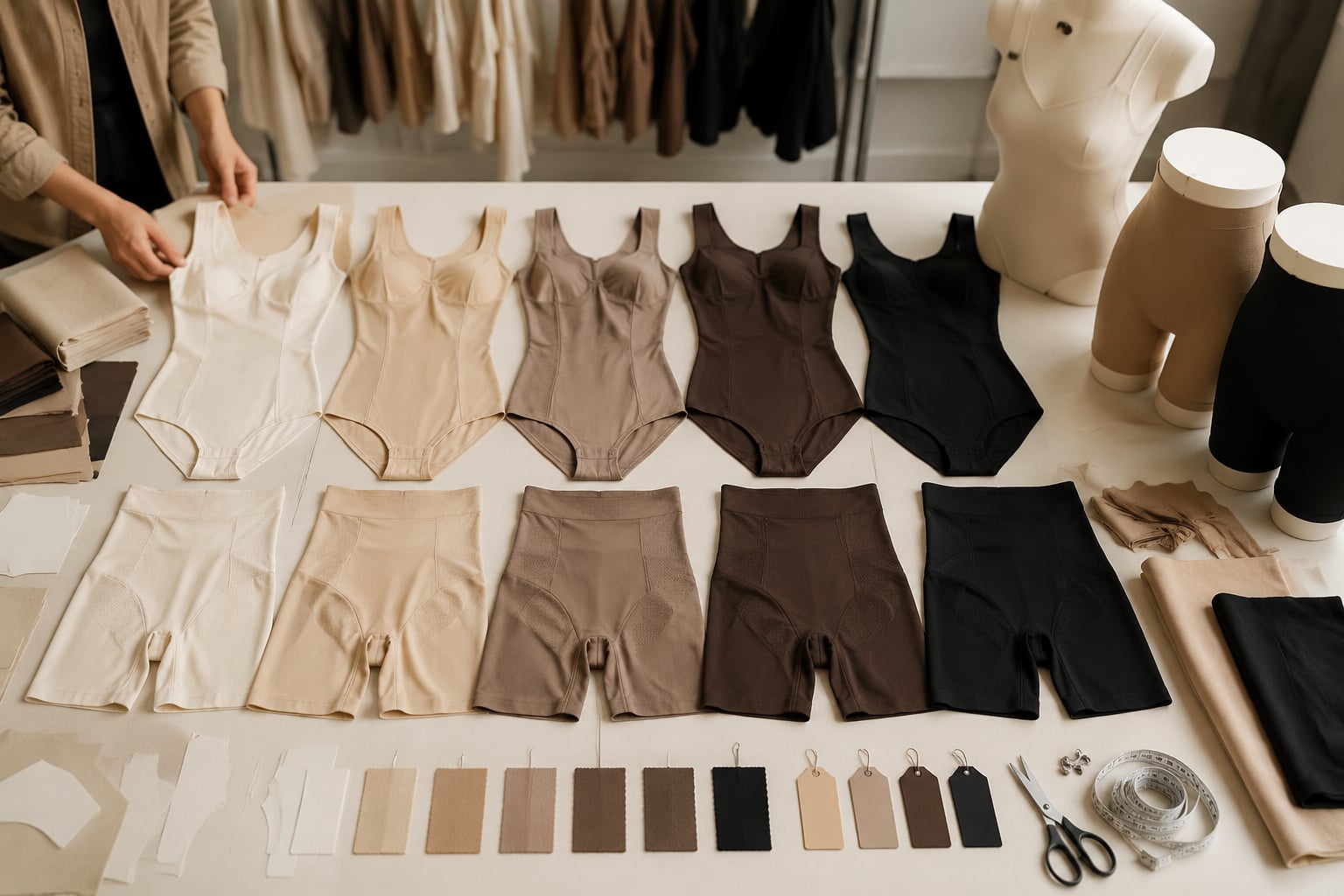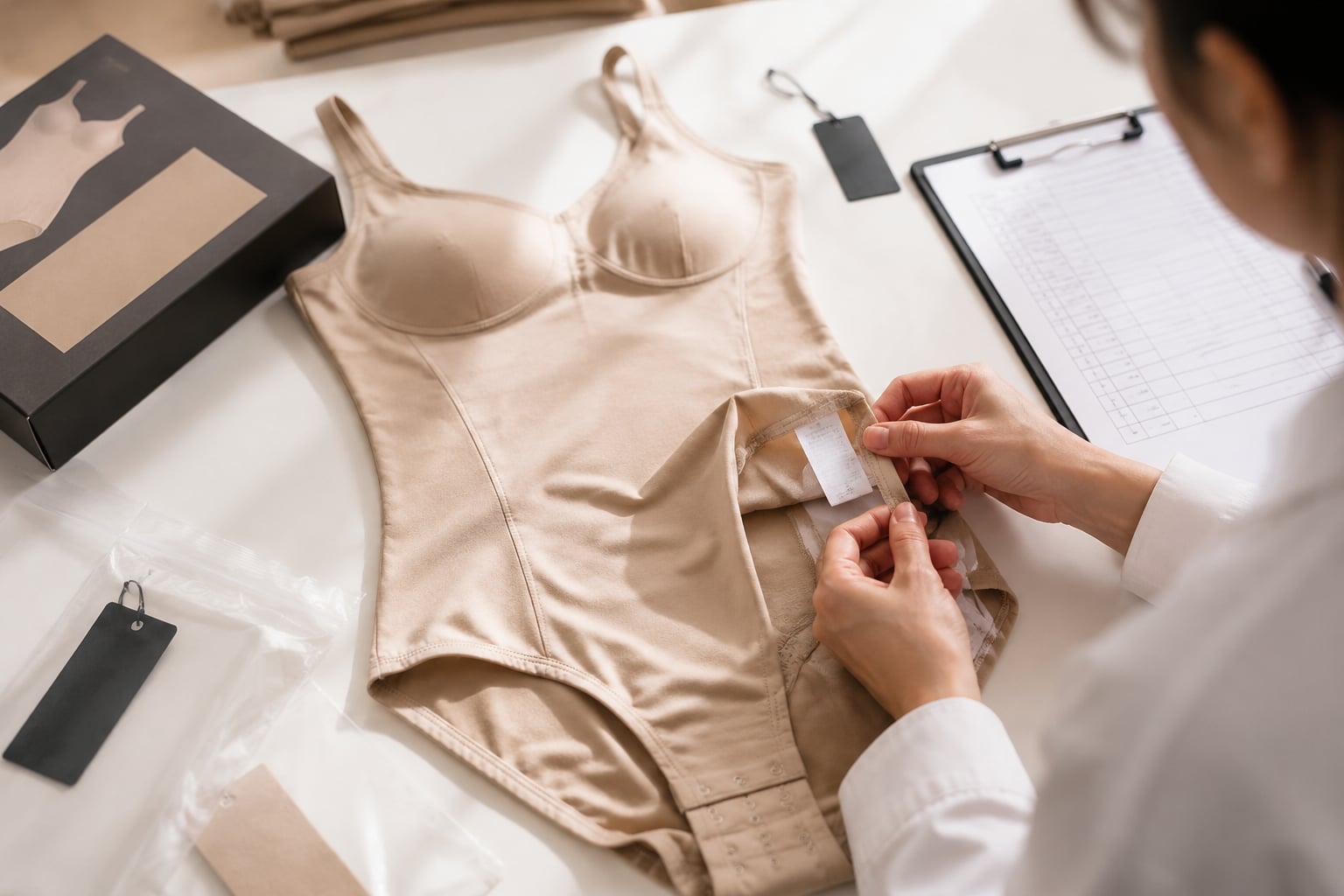

Most shapewear sold in Great Britain does not need one universal mandatory “certificate”. Instead, the business placing the product on the market must be able to demonstrate that it is safe, correctly labelled and supported by appropriate technical evidence. For an OEM, ODM or private-label project, this normally means a documented materials review, compliant fibre labelling, supplier declarations and risk-based laboratory testing.
When searching for Shapewear Zertifikate United Kingdom, separate legal evidence from voluntary textile certifications. A recognised certificate can be valuable, but it does not replace product-specific testing, accurate labels or a review of the finished garment and its components.
This guide is general information, not legal advice. Requirements can change, and brands should check current official UK guidance and obtain specialist advice for higher-risk products, unusual materials or health-related marketing.
Quick Answer: What Evidence Does Shapewear Need in the UK?
A shapewear brand selling in Great Britain should normally have the following before launch:
- Accurate fibre-composition labels using legally accepted fibre names.
- Evidence that the garment is safe under applicable UK product-safety and chemical rules.
- Material and component information for fabric, elastics, dyes, prints, hooks, zips, labels and packaging where relevant.
- Test reports proportionate to the garment’s intended use and risk profile.
- A documented review of any restricted substances relevant to the finished product.
- Clear, substantiated product claims that do not imply medical treatment or therapeutic effects.
- Traceable supplier documents, including the certificate scope, issue date and product/material reference where voluntary certification is used.
For basic fashion shapewear, there is generally no requirement to obtain a standalone government approval certificate before sale. However, a retailer, marketplace, distributor or customer may set additional conditions, such as OEKO-TEX STANDARD 100 certification, colour-fastness reports or specific restricted-substances testing.
Northern Ireland can follow a different product-regulatory route from Great Britain. Businesses selling there should check the current requirements separately rather than assuming a Great Britain compliance file automatically covers all obligations.
Separate Legal Duties From Voluntary Certifications
A practical compliance file has two distinct layers: legal duties that apply to the product, and voluntary schemes that help demonstrate control or meet commercial expectations.
| Evidence type | Is it usually legally required? | What it helps establish | Key limitation |
|---|---|---|---|
| Fibre-composition label | Yes, for most textile products | Honest, standardised fibre information for consumers | It does not prove chemical safety or performance |
| Product safety documentation | Yes, in substance rather than as one prescribed certificate | The product has been assessed and supported as safe | Must cover the actual finished item and foreseeable use |
| UK chemical compliance evidence | Yes, where substances and restrictions apply | Materials and components meet relevant UK restrictions | A generic declaration may not be enough for higher-risk inputs |
| Laboratory test reports | Risk-dependent | Performance, durability, colour fastness and safety indicators | A pass on one sample does not cover untested changes |
| OEKO-TEX STANDARD 100 | No, unless contractually required | Tested-textile confidence for harmful substances | Scope may exclude trims, prints or the finished garment |
| Social or environmental certification | No, unless a buyer requires it | Supply-chain or environmental claims | Does not prove product safety or legal label compliance |
The core question is not “Which badge should be printed on the packaging?” It is “What evidence supports this exact shapewear style, its materials, its claims and the market where it will be sold?”
For example, a bodysuit with silicone grippers, bonded seams, underwire, printed care labels and metal hook-and-eye fasteners has a wider risk profile than a seamless nylon-elastane brief. Its verification should account for those additional components.
Check UK Rules for Materials, Dyes and Components
In Great Britain, textile materials and components may be subject to chemical controls, including UK REACH and other applicable restrictions on hazardous substances. The responsible business should identify relevant substances and obtain reliable evidence from the supply chain.
For shapewear, review more than the main fabric. Common sources of risk include:
- Nylon, polyester, elastane and recycled-fibre yarns.
- Dyes, finishes and printing inks.
- Adhesives in bonded garments or silicone grip strips.
- Metal hooks, poppers, eyelets and decorative hardware.
- Foam cups, laminations and coatings.
- Rubber or latex-containing components.
- Care labels, heat transfers and elastic tapes.
A supplier declaration can be useful, but it should identify the product or material it covers, the legal framework it addresses, the issuer and the date. For products with close, prolonged skin contact, independent laboratory testing is often a stronger control than relying on a broad statement alone.
Do not assume that a fabric certificate covers the finished garment. Processing, dyeing, printing, sewing accessories and finishing can introduce substances or change performance after the base fabric has been approved.
Build a component list before testing
Create a bill of materials for every style and colourway. Record the supplier, composition, colour, finish, component purpose and any existing test evidence. This makes it easier to identify what has changed between development samples and bulk production.
Colour can matter. A black or deep-red style may use a different dye process from a neutral shade, so a report for one colourway should not automatically be treated as evidence for all colours.
Put OEKO-TEX STANDARD 100 in Context
OEKO-TEX STANDARD 100 is a voluntary certification for textiles tested for harmful substances. It is widely recognised and can be commercially useful for skin-contact shapewear, particularly where retailers or consumers ask for evidence beyond a basic supplier declaration.
It is not a blanket legal passport for a finished shapewear collection. Its value depends on the scope.
Before relying on an OEKO-TEX certificate, verify:
- The certificate number and current validity.
- The named certificate holder.
- The product class and whether it is suitable for close-to-skin garments.
- The material description, construction and colour range covered.
- Whether the fabric, elastic, silicone, print, lace, hardware and labels are within scope.
- Whether the certificate relates to the supplied material rather than an unrelated item.
A valid certificate for an elastane fabric may be highly relevant, but it does not automatically cover a garment once it has been combined with hooks, adhesives, prints or trims. Ask whether each meaningful component is certified or whether the finished product has separate supporting evidence.
Use claims carefully. Only state that a product is certified when the certification genuinely applies to that product or clearly identified component. Avoid wording that could lead a buyer to believe an entire garment is certified when only the main fabric is covered.
Secure Fibre Composition and UK Textile Labelling
Most textile products sold to consumers in Great Britain need a durable and accurate fibre-composition label. The fibre names and percentages must reflect the finished product, using permitted terminology and describing fibres in the appropriate order.
For shapewear, the label should normally account for the principal textile composition, such as polyamide and elastane. Some non-textile elements or small decorative components may be treated differently, but brands should not use exemptions casually. Where construction is complex, confirm the labelling treatment before artwork is finalised.
Good labelling control includes:
- Obtaining composition specifications from every fabric and textile-component supplier.
- Checking whether composition changes after bonding, lining or adding panels.
- Verifying the label against the approved bill of materials.
- Reviewing labels in the language and market context of sale.
- Keeping care instructions clear and consistent with the actual fabric and construction.
A percentage on a purchase order is not enough. The information on the consumer label should be traceable to supplier specifications and, where necessary, fibre analysis. A mismatch can create consumer-law, retailer and returns problems even if the garment performs well.
For a more detailed review of label content and development checks, see the guide to shapewear textile labelling.
Test Skin Contact, Colour Fastness, Stretch and Harmful Substances
Shapewear is worn close to the skin, often under tension and sometimes for extended periods. The testing plan should reflect that use rather than treating it as an ordinary loose-fitting fashion garment.
Core tests to consider
The appropriate selection depends on fabric, design and claims, but a typical plan may cover:
- Fibre composition verification.
- Dimensional change after care treatment.
- Colour fastness to washing, perspiration, rubbing and water where relevant.
- Bursting strength or seam strength, depending on the construction.
- Stretch and recovery for the main body fabric and elastics.
- Pilling, abrasion or snagging where the fabric is exposed to friction.
- Restricted-substances testing relevant to materials and components.
- Nickel release where metal parts create prolonged skin contact risk.
- Assessment of latex or natural-rubber content where present.
- Fastener security and sharp-edge checks for hooks, zips or other hardware.
Do not choose tests solely from a factory’s standard report package. A high-compression short with bonded edges needs focused evaluation of bond durability and edge recovery. A bodysuit with hooks needs fastening, corrosion and skin-contact consideration. A garment marketed for post-partum use may need especially careful claims review.
Test methods and acceptable results should be agreed before bulk production. “Pass” has little value without knowing the method, sample identity, conditioning, result, acceptance threshold and laboratory details.
Avoid Medical or Health Claims
Most shapewear is a fashion or comfort product, not a medical device. Product pages, packaging, influencer briefs and marketplace copy should not make claims that imply diagnosis, treatment, prevention or management of a medical condition unless the business has established that the product is regulated and supported for that purpose.
High-risk wording includes claims that shapewear:
- Treats back pain, oedema, varicose veins or lymphatic conditions.
- Speeds recovery after surgery or childbirth.
- Improves circulation.
- Corrects posture as a therapeutic intervention.
- Causes weight loss or permanent body reshaping.
- Provides medical-grade compression without substantiation and an appropriate regulatory assessment.
Safer fashion-focused descriptions can explain the garment’s design, provided they are accurate. Examples include “firm-feel support”, “smoothing construction”, “targeted shaping panels” or “designed to sit securely under occasionwear”. Even these should match the actual construction and wearer experience.
Claims also need to be fair and capable of substantiation under UK advertising and consumer-protection expectations. Keep substantiation in the product file, especially for quantified compression, performance or comfort statements.
Verify Supplier Reports, Validity and Scope
A compliance document should be reviewed, not merely collected. Many costly failures occur because the report is real but applies to a different fabric, older colourway, previous supplier or development-stage sample.
Use this review checklist for every report or certificate:
- Confirm who commissioned the test and who manufactured the tested item.
- Match the report’s material, composition, colour, finish and construction to the current specification.
- Check the sample date, report date and certificate expiry date.
- Read the scope, exclusions, product class and referenced standard.
- Confirm that test methods and pass criteria fit the intended use.
- Check that any corrective action from a failed result was retested.
- Store the report with the approved sample, bill of materials and production records.
Ask for original PDFs or verification through the issuing body where a certificate is material to a purchasing decision. Screenshots, cropped report pages and unsigned declarations are weak evidence because their scope and origin are difficult to validate.
A supplier should also be able to explain which production controls keep bulk goods aligned with the tested sample. This is particularly important when material mills, dye houses, trims or assembly sites change.
Create a Risk-Based Test Plan for Samples and Bulk Production
Testing should occur at more than one point. Development testing helps select materials and construction; pre-production testing confirms that the approved specification can be repeated; bulk checks help detect variation before shipment.
A proportionate plan can follow this sequence:
- Define intended use: Record compression level, body area, wear duration, care method, age group, skin-contact level and all marketing claims.
- Map materials and components: Create the bill of materials by style, colourway and size range.
- Identify risks: Consider chemicals, skin contact, stretch failure, colour transfer, seam failure, fastener safety and misleading claims.
- Set specifications: Agree test methods, acceptance criteria, sampling points and responsibility before ordering.
- Test development samples: Resolve fabric, fit, recovery and construction issues before bulk materials are committed.
- Approve pre-production samples: Confirm that labels, packaging, components and workmanship match the compliance file.
- Monitor production: Use inspection and targeted testing for higher-risk styles, material changes or previous failure points.
- Keep records: Retain supplier declarations, reports, approvals, inspection records, corrective actions and final artwork.
The level of testing should increase where risk increases. New suppliers, recycled or blended materials, deep colours, bonded construction, silicone applications, metal trims and unusually strong compression all justify more scrutiny.
S-SHAPER supports OEM, ODM and private-label shapewear development through scalable series production. For any project, brands should agree the evidence package, test responsibilities, required standards and approval points during quotation and sample development, rather than treating compliance as a final-shipment task. Its published project starting point is 500 units, while the final allocation by model, colour, size and packaging should be confirmed in the quotation.
A defined quality assurance process is useful when evaluating how samples, inspections and production records will be managed.
FAQ: Certificates and Testing for Shapewear
Is OEKO-TEX STANDARD 100 mandatory for shapewear in the UK?
No. It is a voluntary certification, although a retailer or commercial customer may require it. It can support confidence in harmful-substance controls, but it does not replace accurate labels, product-safety evidence or testing of components outside its scope.
Do I need a test report for every shapewear style?
Not necessarily every style requires an entirely separate test package, but evidence must be representative of the product sold. Styles using different fabrics, dyes, components, construction or finishes may need their own testing or a justified extension of existing evidence.
Can I use a fabric supplier’s test report for my finished garment?
Only if the report is relevant to the finished product risk and clearly covers the material supplied. Fabric-only results do not assess added trims, adhesive, printing, seams, fasteners or finished-garment performance.
Are compression claims regulated?
Claims must be accurate, supportable and not misleading. Medical, therapeutic or recovery claims can trigger additional regulatory issues. Describe ordinary shapewear in fashion and comfort terms unless specialist advice confirms a broader claim is appropriate.
What is the most common compliance mistake?
Treating a certificate as proof for an entire collection without checking its scope. Verify the exact material, colour, component, dates and finished-product relevance before using a certificate in buying decisions or marketing.
Before placing an order, turn the product specification into a written compliance checklist: materials, labels, claims, required reports, acceptance criteria and batch controls. Reviewing the proposed construction and manufacturing process against that checklist makes it easier to identify evidence gaps before production begins.