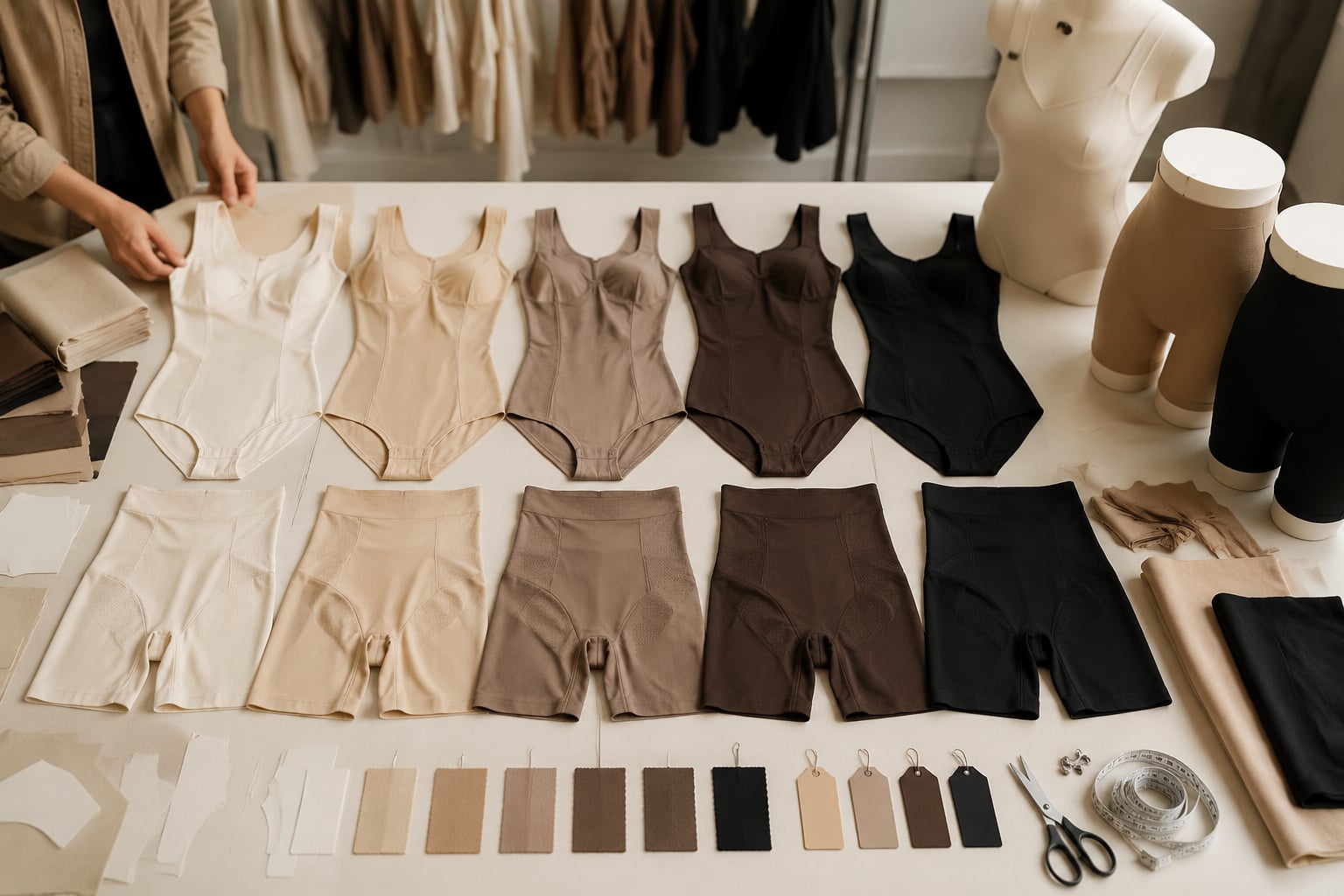
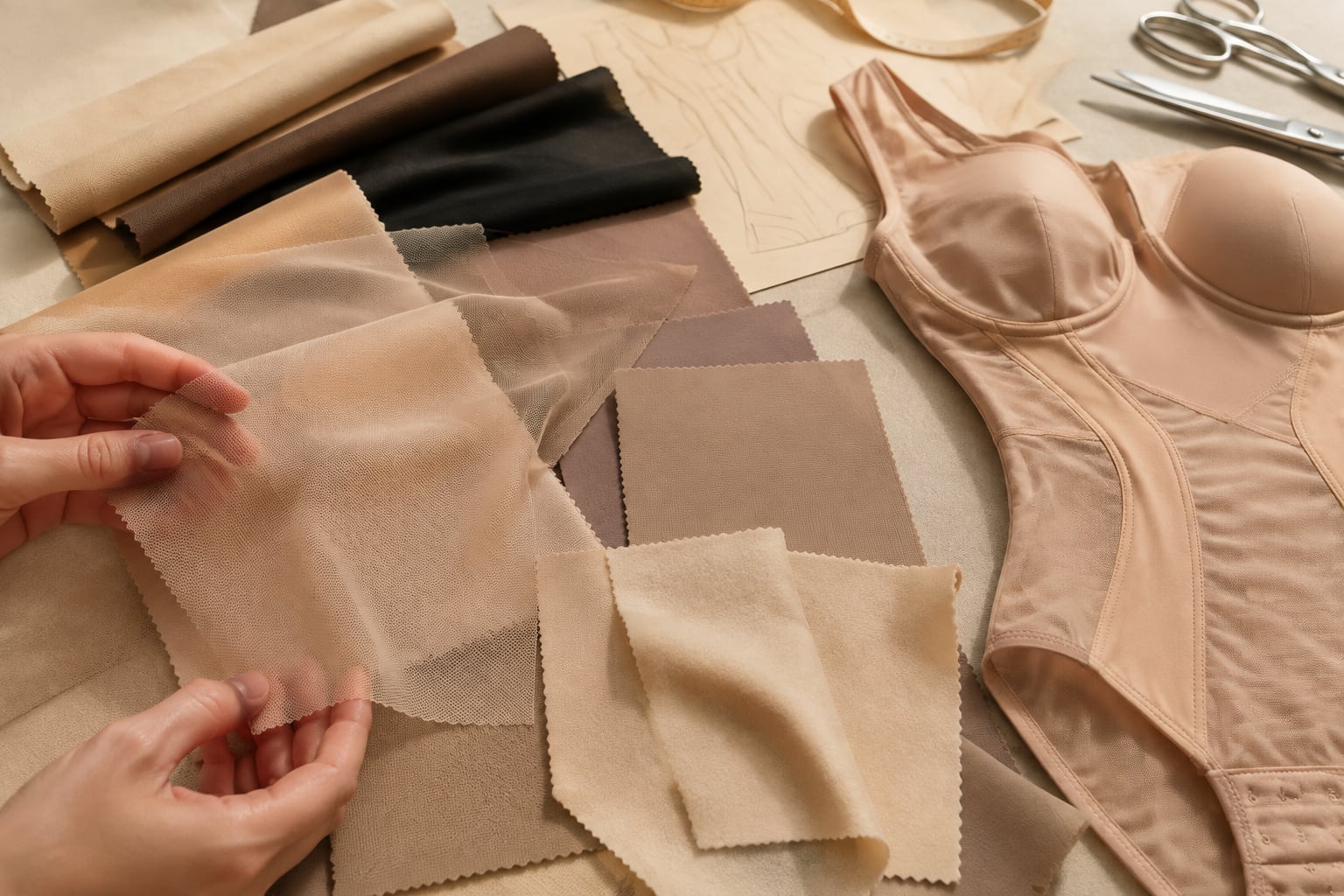
Shapewear material selection starts with the garment’s intended job, not with a preferred fibre name or fabric weight. A high-compression bodysuit, an everyday smoothing brief and a postural-support style need different levels of stretch, recovery, opacity, breathability and seam stability.
For most projects, the best result is a material system: a primary body fabric combined with purpose-specific components such as power mesh, bonded elastic, gusset fabric, silicone grip, closures or reinforcement panels. Evaluate the complete construction in the intended size range and laundering conditions before approving bulk production.
Start with the Product Role
Define what the shapewear must do on the body before requesting fabric swatches. “Firm control” alone is too vague for a development brief. It does not explain where compression belongs, whether the garment must remain invisible under clothing, or how much movement the wearer expects.
A practical product-role brief should specify:
- Target area: waist, abdomen, hips, thighs, back, bust or full body.
- Control profile: smoothing, moderate shaping, firm compression or zoned support.
- Wear occasion: daily wear, occasionwear, active use, recovery-oriented garments or bridal styling.
- Outerwear compatibility: fitted jersey, woven trousers, a dress with a light fabric, or more forgiving layered outfits.
- Desired silhouette: all-over smoothing, waist definition, lifted seat, controlled thigh line or posture-focused support.
- Wear duration: a garment worn for several hours needs a different comfort margin from a short-event piece.
- Product format: brief, short, high-waist panty, bodysuit, camisole, legging or bra-support style.
The material requirements follow from these decisions. For example, a high-waist short intended under a close-fitting dress generally needs stable, opaque fabric and carefully controlled leg-edge pressure. An everyday smoothing brief may prioritise a softer hand feel, lower bulk and easier donning.
Avoid asking for “the strongest available fabric” as a shortcut. Excessively rigid or heavy material can make dressing difficult, create edge rolling, amplify size-fit problems and reduce repeat wear. Effective shaping depends on balanced tension, panel placement and construction as much as nominal fabric strength.
Compare Stretch and Recovery
Stretch tells you how far a material extends under force. Recovery describes how well it returns towards its original dimensions after that force is removed. Both matter, but recovery is usually the more decisive factor for shapewear that should retain its fit through repeated wear and wash cycles.
Elastane is commonly blended with polyamide or polyester to provide stretch. The non-elastane fibre and knit structure substantially affect softness, moisture handling, opacity, durability and compression character. Two fabrics with similar fibre percentages can therefore perform very differently.
| Material characteristic | Why it matters in shapewear | What to assess |
|---|---|---|
| Lengthwise stretch | Affects body length, torso comfort and vertical mobility | Whether a bodysuit or high-waist style pulls at the shoulders or rolls down |
| Widthwise stretch | Influences ease of dressing, hip fit and circumferential shaping | Consistent tension from waist to thigh and ease of donning |
| Stretch power | Determines the force required to extend the fabric | Appropriate compression without excessive effort or discomfort |
| Elastic recovery | Helps the garment return after wear and laundering | Bagging at the seat, knees, waist or leg openings |
| Growth under repeated loading | Reveals long-term loss of shape | Fit after cyclic extension, not only a new-fabric measurement |
| Directional stability | Keeps panels and seams correctly positioned | Twisting, skewing and distortion during wear |
Choose a stretch balance, not a single number
Four-way stretch is useful in many shapewear designs because it allows the garment to conform around hips, waist and thighs. It is not automatically the right choice everywhere. A more directionally stable panel can be useful where a design needs controlled anchoring or stronger shaping in one direction.
A fabric with very high extension may feel comfortable during fitting but offer limited smoothing once worn. Conversely, a dense powernet can deliver strong support but may feel restrictive or show visibly beneath lightweight garments. Compare materials on a body or on representative fit forms, not only by hand stretch.
Review recovery after realistic handling
Initial recovery can look excellent in a supplier swatch. Ask to assess recovery after repeated extension and wash exposure, especially for waistbands, leg openings and high-tension panels. Also inspect whether the surface becomes shiny, distorted or uneven after loading.
Recovery must be considered with trims. A stable body fabric cannot compensate for a waistband elastic that lengthens, a weak bonding film, or leg-edge silicone that loses adhesion after care. Each component should recover in a way compatible with the adjacent material.
Review Weight, Hand Feel and Coverage
Fabric mass, commonly stated in g/m², offers a useful starting point but is not a standalone measure of compression, comfort or quality. Knit density, yarn type, elastane content, finishing and structure can change the performance of fabrics with a similar weight.
Assess material weight in relation to the garment’s role:
- Lighter constructions can reduce bulk and improve invisibility under clothing, but need careful checks for opacity, durability and edge stability.
- Midweight constructions often provide a versatile balance of smoothing, comfort and coverage for mainstream everyday shapewear.
- Heavier or denser constructions can support stronger shaping and improve coverage, but may retain more heat and feel less suitable for warm-weather or extended daily wear.
Hand feel affects perceived quality and repeat wear
The material should feel appropriate to the price position and the customer expectation. A soft, smooth hand can improve first impressions, while a dry, technical hand may suit performance-oriented product positioning. Neither is universally better.
Check for:
- Surface smoothness under fine outerwear
- Scratchiness from yarn, mesh structure or seam allowance
- Excessive sheen under flash photography or bright light
- Noise created by fabric movement
- Breathability and moisture sensation during sustained wear
- Whether the fabric clings to, grips or slides against outer garments
Do not judge softness only at the fabric supplier’s standard tension. When a garment is stretched on the body, the knit opens and its tactile character changes. Evaluate the material at the approximate extension expected in wear.
Coverage means opacity at extension
A fabric that looks opaque when relaxed may become transparent at the seat, abdomen or thigh when stretched. This is particularly important for light colours, nude shades and single-layer products.
Check opacity under strong, neutral light at the intended wearing extension. Test several sizes rather than assuming that a fabric suitable for a sample size will provide equivalent coverage at the upper end of the size range. Where needed, use double layers, lining, denser knit zones or revised panel geometry—but recognise that each adds heat, bulk and potentially different recovery behaviour.
Match Materials to Construction
The fabric and construction must be developed together. A suitable material can underperform if it is paired with an unsuitable seam type, cut direction, bonding process or trim.
Select panel fabrics by function
Many shapewear pieces benefit from zoned construction rather than one uniform material throughout the garment. Typical combinations include:
- A smoothing knit for the main body
- A firmer power mesh for targeted abdominal or back support
- A softer, breathable gusset material
- More stable waistband material to reduce roll-down
- Reinforced panels where seam tension or shaping demand is high
- Lower-pressure edge material at the thigh or underbust
Each transition needs assessment. If two fabrics have very different stretch and recovery, the seam can pucker, torque or create a visible line under clothing. Grading and sewing allowances must also reflect their behaviour.
Choose seams and bonds for the fabric, not the mood board
Flatlock, overlock, coverstitch, seamless knitting and bonded constructions each create different trade-offs in bulk, flexibility, production control and durability. Bonding can reduce visible seam lines, but it requires compatibility between fabric finish, adhesive film, pressure, temperature and laundering conditions.
Common construction risks include:
- Bonded hems lifting after wash or flexing
- Seam popping when the thread and fabric elongation do not match
- High bulk where multiple layers meet at the gusset or waistband
- Silicone placement that causes discomfort or visible lines
- Rolled edges caused by insufficient width, poor tension balance or an unstable fabric direction
- Decorative lace or mesh losing recovery faster than the main fabric
Prototype decisions should be made on garments built with production-representative methods. A hand-made development sample may not reveal the effects of automated bonding, different sewing tension or scalable cutting processes.
For projects requiring support across development and scalable production, review the manufacturer’s shapewear technology and innovation capabilities in addition to its fabric options. The key question is whether the intended material can be consistently processed, not simply whether it looks right on a first prototype.
Consider Size Range and Fit
Material selection is inseparable from grading. A shapewear fabric has to deliver a coherent experience across the full planned size range: it should not become too loose in smaller sizes, too sheer in larger sizes or disproportionately difficult to put on at either end.
Start by defining:
- The planned size chart and body measurements
- The intended negative ease by area
- Control level for each size, rather than just for the fit sample
- Any cup, torso-length or petite/tall variations
- The acceptable change in fabric extension across sizes
- Whether the product must accommodate a broad hip-to-waist ratio
Fit on more than one representative size
Approving only a mid-range sample is a frequent mistake. At minimum, assess a lower, middle and upper sample size, with wearers or fit forms that reflect intended body proportions. Review the garment standing, sitting, walking, bending and raising the arms where relevant.
Look for:
- Waistband roll-down or migration
- Leg openings that cut in, flare or ride up
- Excessive pressure at the abdomen, ribs or inner thigh
- Body-panel displacement during movement
- Shoulder strain in bodysuits
- Gusset placement and comfort
- Fabric transparency at high-stretch areas
- Uneven shaping or visible compression lines
A broad size range may need more than simple proportional grading. Panel geometry, elastic length, strap placement or material zoning can require adjustment to preserve the product’s intended performance. Confirm how the chosen material behaves when graded before locking the final pattern.
Plan Colour and Branding Requirements
Colour is not only an aesthetic decision. Dyeing and finishing can affect stretch, recovery, shade consistency, hand feel, rub fastness and opacity. Lighter shades may require a denser construction to maintain coverage, while dark shades can expose uneven sheen or abrasion marks.
Plan the colour range early, especially if the line includes multiple skin-tone-inspired shades. A shade that works in a small lab dip may shift in perceived warmth or depth when applied to a large, stretched garment. Evaluate colour on the actual fabric and beside the intended outerwear where invisibility is part of the product promise.
Confirm the following with the material and manufacturing partners:
- Shade approval process and acceptable variation between lots
- Colour consistency across body fabric, mesh, elastic, thread, labels and silicone
- Wash and rub fastness requirements relevant to use
- Whether the fabric finish changes after dyeing
- Minimum order requirements and lead-time implications for custom shades
- Visibility of labels, heat transfers, logos or care marks after stretch and washing
Branding should not undermine comfort or performance. A raised logo print can become uncomfortable in a high-pressure zone, and a rigid heat transfer may crack on a highly extensible fabric. Position branding in areas with controlled extension and assess it after repeated stretch and care.
If a brand is building a differentiated range, an OEM, ODM and private-label shapewear development approach can help clarify which elements are standardisable and which require custom material, construction or branding decisions.
Define Relevant Tests
Testing should reflect the product’s actual use and risk profile. There is no universal test list that proves every shapewear product is suitable. The relevant standards, methods, acceptance criteria and laboratory arrangements should be agreed for the material, components and finished garment.
A useful quality plan often covers the following areas.
| Test area | Purpose | Typical risk identified |
|---|---|---|
| Dimensional stability after care | Checks change in size and shape following washing | Shrinkage, growth, twisting or altered fit |
| Stretch and recovery | Assesses extension and return after loading | Bagging, weak shaping or inconsistent pressure |
| Bursting strength and seam strength | Evaluates resistance under multidirectional and seam stress | Holes, seam failure or fabric rupture |
| Pilling and abrasion resistance | Reviews surface durability | Fuzzing, pills or worn appearance |
| Colour fastness to washing, perspiration and rubbing | Checks colour durability in realistic contact conditions | Staining, fading or colour transfer |
| Appearance after laundering | Reviews finished-garment presentation | Curling edges, lifted bonds, distortion or trim failure |
| Chemical and restricted-substance review | Supports material compliance planning | Unwanted substances in textile, print, dye or trim inputs |
| Wear and fit assessment | Examines comfort and function in movement | Roll-down, chafing, migration or inadequate support |
Set pass/fail criteria before testing
Do not simply request “testing” without defining what acceptable results look like. The expected level should take account of product type, intended care instructions, market positioning and any customer or retailer requirements.
For the German and wider European market, clarify applicable product safety, textile labelling and chemical-compliance responsibilities with the responsible economic operators and qualified advisors. Requirements can differ according to the product, materials used and route to market. A test report does not replace a complete compliance process.
It is also important to test the finished garment. Fabric test results alone cannot demonstrate the durability of a bonded hem, printed logo, silicone gripper, closure, seam or multi-panel construction.
Approve Material on the Reference Sample
A material should be approved on a reference sample that represents the intended product as closely as possible. A cut swatch is useful for initial selection; it is not sufficient to approve bulk material for shapewear.
The reference sample should use the proposed:
- Body fabric and all contrast materials
- Colour and finish
- Thread, elastic, mesh, lining and gusset components
- Seams, bonds, labels, logo applications and trims
- Pattern and grading approach
- Care method and expected wash cycle
- Production-representative construction wherever feasible
Use a structured approval checklist
Before releasing material for bulk production, record decisions and observations rather than relying on general approval comments.
- Confirm the approved material identity. Record composition, construction, weight tolerance, colour reference, finish and supplier lot reference where available.
- Compare the sample against the product brief. Check shaping, comfort, coverage, appearance and ease of dressing.
- Review fit across selected sizes. Include areas of high extension and movement.
- Check construction compatibility. Inspect seams, bonding, trims and panel transitions before and after care.
- Review test results against agreed criteria. Investigate any marginal or inconsistent outcome instead of accepting it without a corrective action.
- Agree controlled tolerances. Define what may vary in bulk, including shade, width, weight, stretch and finished-garment measurements.
- Retain approved references. Keep a sealed or clearly identified material swatch and final reference garment for production comparison.
The most common error is approving a fabric because it feels impressive in isolation. The better decision is to approve the material only after it proves the intended balance of support, recovery, comfort, coverage and durability in the complete garment.
For teams comparing product formats before starting development, reviewing a shapewear product range can help translate the product role into a suitable base construction. S-SHAPER supports OEM, ODM and private-label shapewear projects from development through series production, but the material brief, reference sample and test criteria should remain the foundation of any well-controlled project.