Shapewear fabric GSM, stretch and recovery must be specified together. GSM describes fabric mass per square metre, but it does not, on its own, determine compression, opacity, durability or comfort. A lighter fabric with a high elastane content and firm knit construction can provide more control than a heavier, softer fabric.
For product development, the most useful approach is to define a measurable fabric brief: target GSM range, stretch in each direction, recovery after a defined extension, opacity when stretched, hand feel, breathability and compatibility with linings, elastics and trims. These criteria give suppliers and internal teams a common basis for sampling and bulk approval.
Understand What GSM Does and Does Not Tell You
GSM means grams per square metre. It measures fabric weight, allowing teams to compare fabric constructions without being misled by roll width or length. In shapewear, it is a useful starting point for discussing coverage, perceived substance and garment handling.
However, GSM is not a compression rating. Two fabrics with the same GSM can behave very differently because of differences in:
- Fibre composition, particularly the proportion and type of elastane
- Knit or woven construction
- Yarn count, yarn twist and plating arrangement
- Gauge and stitch density
- Finishing processes
- Direction of stretch
- Fabric width and relaxation after finishing
For example, a compact, high-density nylon-elastane circular knit may feel firmer and offer greater support than a heavier fabric with a more open construction. Equally, a heavy fabric may feel substantial but become uncomfortable if it has insufficient moisture transfer or recovery.
Use GSM as a development tolerance, not a single promise
Set a target GSM and an agreed tolerance rather than requiring an unrealistic exact figure. The appropriate tolerance depends on construction, dyeing, finishing and the degree of variation acceptable to the garment’s fit and support.
Record whether GSM is measured:
- Before or after washing
- In a relaxed state or according to an agreed conditioning procedure
- On dyed production fabric rather than an undyed development sample
- With or without bonded films, coatings or laminated layers
This matters because finishing and dyeing can alter fabric mass, width, stretch and hand feel. A fabric that meets its nominal GSM may still be unsuitable if it has become too rigid, transparent or unstable.
Indicative GSM considerations for shapewear
There is no universal “correct” GSM for shapewear. The garment category and intended compression zones matter more than chasing a particular number.
| Product objective | Fabric behaviour usually needed | GSM considerations |
|---|---|---|
| Everyday smoothing brief or short | Soft, flexible, moderate support | A moderate GSM may suit, provided opacity and recovery are adequate |
| High-control bodysuit or waist shaper | Firm power, stable recovery, strong coverage | A denser construction is often more relevant than GSM alone |
| Lightweight summer smoothing layer | Low bulk, breathable feel, reliable coverage | Lower GSM can work if the knit remains opaque under extension |
| Targeted tummy panel | Controlled stretch, stable support, low roll-down risk | Often benefits from a firmer power mesh or doubled layer |
| Seamless knitted garment | Zoned support with body-contouring stretch | Overall GSM may vary across the garment, so zone performance is more useful than one figure |
When reviewing a supplier’s data, ask for both GSM and the fabric composition, construction and stretch results. The combination is much more informative than weight alone.
Define Stretch Direction and Test Method
Shapewear is required to stretch around the body, move with the wearer and return towards its original dimensions. That makes stretch direction critical.
Most stretch fabrics have different behaviour in the wale and course directions. In practical garment terms, one direction may align with the circumference of the body while the other aligns with garment length. The direction labelled “four-way stretch” should never be accepted without numbers, because both directions may stretch but not equally.
Specify each direction clearly on the technical pack:
- Widthwise stretch: generally the horizontal direction across the fabric roll
- Lengthwise stretch: generally the direction running along the roll
- Required extension: the percentage increase in length under the agreed test
- Load or force, where applicable: especially valuable when comparing compression fabrics
- Test specimen size and gauge length
- Conditioning, extension time and recovery time
- Number of specimens and whether results are averaged
Calculate extension consistently
A simple extension calculation is:
Stretch percentage = (extended length − original length) ÷ original length × 100
If a 100 mm specimen reaches 180 mm under the agreed method, it has extended by 80%. That result is only meaningful when the load, method and direction are also stated. Pulling a fabric “until it feels right” produces results that cannot be reliably repeated between teams or factories.
For development comparisons, establish one internal method and use it on all candidate fabrics. For formal verification, agree the applicable standard, laboratory method or customer test protocol before sampling. The method should reflect the intended fabric and garment construction rather than relying on a generic stretch test alone.
Do not confuse high stretch with suitable stretch
More stretch is not always better. Excessive widthwise extension can reduce perceived support and make a garment difficult to size consistently. Too little extension may create fitting difficulty, restrict movement or put undue strain on seams and elastic attachments.
A useful fabric brief therefore describes the balance required:
- Widthwise stretch for fit and compression around the torso, hips or thighs
- Lengthwise stretch for body length, movement and comfort
- Resistance at extension for the intended control level
- Stable recovery after repeated wearing and washing
- Compatibility with the chosen size range and grading rules
Test swatches cut both parallel and perpendicular to the roll direction. An accidental rotation of a panel can change fit, compression and garment length considerably.
Evaluate Recovery and Growth After Extension
Recovery is the fabric’s ability to return towards its original dimensions after being stretched. Growth is the residual extension left after recovery. In shapewear, poor recovery can lead to bagging at the seat or knees, reduced tummy support, dropped straps, loose leg openings and a garment that feels less effective after wear.
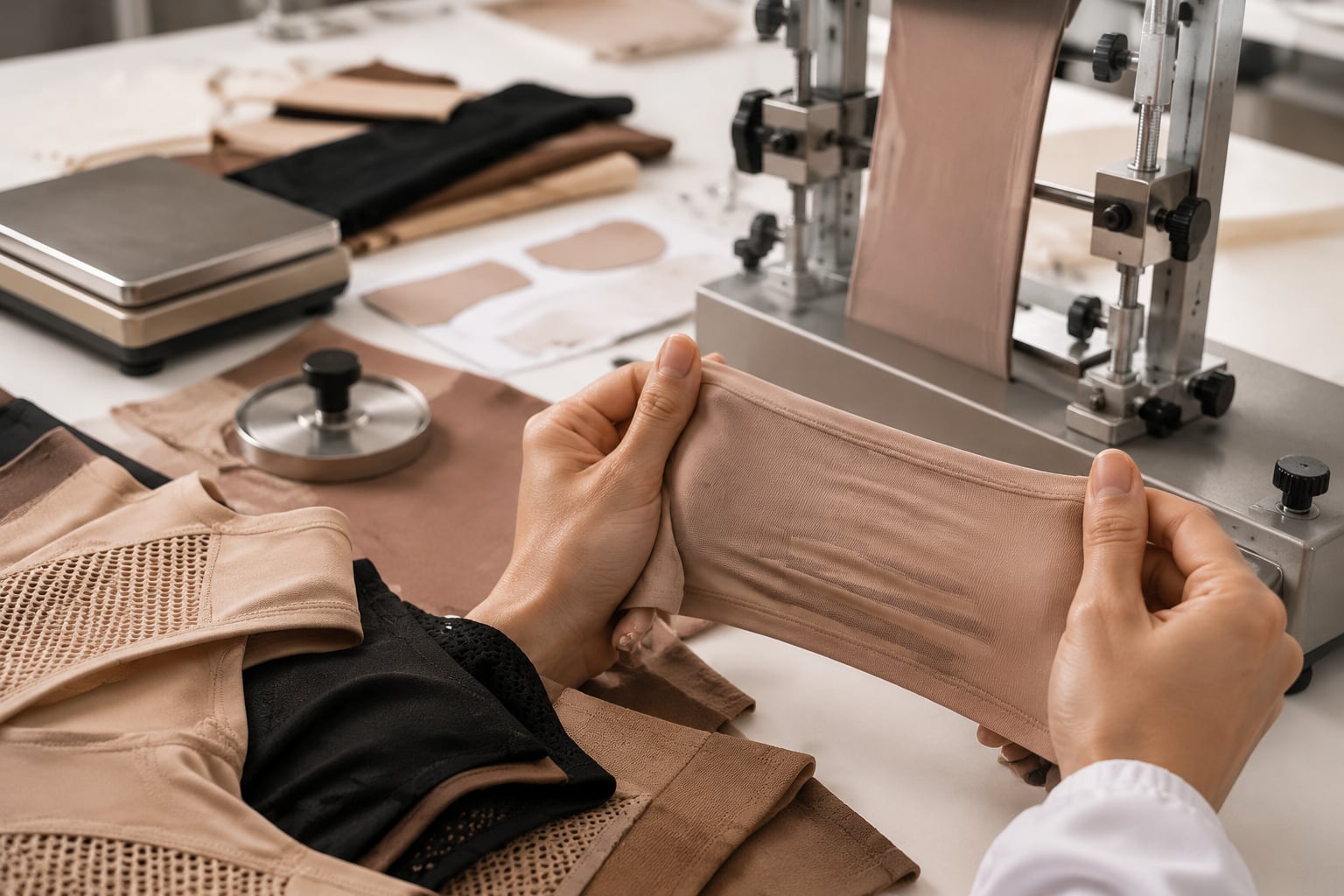
A fabric can stretch easily during a quick swatch test and still perform poorly over time. The key question is not simply “does it spring back?” but “how much residual growth remains after an agreed extension, duration and recovery period?”
Measure immediate and delayed recovery
A practical development test should assess at least:
- Original specimen length or width.
- Extension to the agreed percentage or load.
- Time held under extension.
- Measurement immediately after release.
- Measurement after an agreed recovery period.
- Residual growth in both directions.
For example, teams may compare results after a short recovery period and again after a longer rest period. The exact timings and extension level should be agreed for the product, then retained in the specification. A very high extension may be relevant for a pull-on bodysuit; a more moderate extension may better represent a firm waist panel.
Assess recovery after repeated cycles
One extension cycle is not enough for high-control products. Add repeat-extension checks to identify fabrics that lose stability after multiple pulls. Repeated cycling is particularly important for:
- Leg openings and hems
- Waistbands and bonded edges
- Bust support zones
- Thigh panels
- Areas joined to firmer lining or power mesh
- Seamless structures with compression zones
Also inspect the fabric visually after cycling. Recovery may look acceptable by measurement while the surface develops grin-through, shine, permanent rippling or uneven elastane response.
Common causes of poor recovery
Poor recovery does not always originate in the base fabric. Investigate the full system:
- Elastane quality or inadequate elastane proportion for the construction
- Heat-setting conditions that do not stabilise the fabric adequately
- Over-stretching during cutting, sewing or bonding
- A lining that recovers differently from the outer layer
- Incorrect elastic tension or attachment ratio
- Harsh dyeing, finishing or washing processes
- Product sizing that asks the fabric to operate beyond its intended extension range
A fabric should be judged in the finished garment, not merely as a flat swatch.
Match Fabric Behaviour to Compression Zones
Effective shapewear often combines zones with different support requirements. A single fabric throughout can simplify sourcing and production, but it may compromise either comfort or control. A zoned strategy can offer a more balanced garment when its materials are compatible.
Define support by body area and garment purpose
Start with a body map. Identify where smoothing, contouring, holding power or flexibility is needed, then specify fabric behaviour for each zone.
| Garment zone | Typical requirement | Fabric criteria to evaluate |
|---|---|---|
| Abdomen | Stable smoothing and control | Firm stretch, low growth, opacity, soft inner feel |
| Waist edge | Secure placement without digging or rolling | Elastic recovery, comfortable edge pressure, grip where required |
| Seat | Shape accommodation without flattening | Multi-directional stretch, recovery, non-sheer coverage |
| Thigh | Smoothing with freedom to walk | Lengthwise mobility, durable recovery, hem stability |
| Bust or underbust | Support appropriate to garment design | Controlled extension, lining compatibility, strap stability |
| Back | Smooth coverage and flexibility | Opacity under stretch, soft hand, balanced support |
Avoid describing every zone as “high compression”. A garment that is uniformly restrictive may be difficult to put on and uncomfortable to wear. Clear zone priorities help developers choose where to add firmer mesh, double layers, stronger elastics or engineered knitting.
Consider compression as a garment-level outcome
Fabric contributes to compression, but finished-garment performance also depends on pattern dimensions, size grading, seam placement, panel orientation, lining, elastic tension and wearer body shape.
For that reason, do not make unsupported pressure claims from fabric GSM or composition alone. If a product requires a defined compression level, establish an appropriate finished-garment test plan and confirm how the claim will be substantiated for the intended market.
For ideas on construction choices that support targeted control, review S-SHAPER’s shapewear product range. Product category should guide the fabric brief, not the other way round.
Review Opacity, Hand Feel and Breathability
A fabric can meet weight and stretch targets yet fail at the point of wear. Opacity, hand feel and thermal comfort deserve documented approval criteria.
Check opacity at realistic extension
Opacity should be examined on a skin-tone contrast board, form or stretch frame. Evaluate the fabric at relaxed state and at the extension expected in the finished garment, especially across the seat, abdomen and thighs.
Look for:
- Sheerness or visible skin tone changes
- Yarn separation or grin-through
- Colour shift as the fabric stretches
- Inconsistent opacity between production lots
- Transparency caused by a single-layer construction in high-extension areas
Dark colours are not automatically opaque, and light colours are not automatically unsuitable. Test the actual colourway, fabric finish and layer combination. If coverage is inadequate, options may include a denser knit, altered yarn selection, a lining, a strategically doubled panel or revised pattern ease. Each option should then be retested for heat, bulk and recovery.
Specify hand feel in observable terms
“Soft” is subjective, so supplement it with clear descriptors and reference swatches. Depending on the product, the desired hand may be:
- Smooth and cool against skin
- Peach-soft or lightly brushed
- Dry and matte rather than slick
- Dense and supportive without feeling board-like
- Low-friction for easy dressing
- Non-clingy under outerwear
Review both face and reverse sides. The inner face affects comfort; the outer face affects how smoothly clothing layers over the garment. Check for seam impressions, edge curl and surface snagging as well as touch.
Treat breathability as a system property
Breathability and moisture handling depend on fibre choice, yarn structure, fabric density, finishes, garment coverage and the presence of linings or bonding films. A lighter GSM does not automatically feel cooler, while a dense power mesh may be comfortable when used only in a targeted panel.
Evaluate prototypes during movement and at typical body-extension points. Pay particular attention to double-layered abdomen panels, bonded areas, gussets and broad waistband constructions, where heat and moisture may build up.
Test Fabric with Linings and Elastics
Shapewear fabrics rarely work in isolation. Linings, gussets, elastics, silicone applications, hooks, tapes, bonding films and threads all influence fit, recovery and comfort.
Test the fabric assembly before finalising the material. A suitable outer fabric can perform poorly after being joined to a lining with less stretch or slower recovery.
Key assembly compatibility checks
- Compare stretch and recovery of outer fabric and lining in both directions.
- Test whether the lining restricts the desired direction of movement.
- Check elastic attachment ratios against the fabric’s recovery.
- Inspect puckering after sewing, bonding, washing and relaxation.
- Check whether silicone or grip finishes change edge stretch, skin feel or rolling behaviour.
- Assess seam strength without creating a rigid, uncomfortable line.
- Confirm that adhesives or bonding films remain stable through the agreed care process.
- Review colour migration, print transfer or finish changes where pale linings meet dark outer fabrics.
A gusset requires particular care. Its fabric should support comfort and hygiene requirements while remaining compatible with the main body’s stretch. Do not assume a lining used successfully in a looser garment will work in a high-extension body shaper.
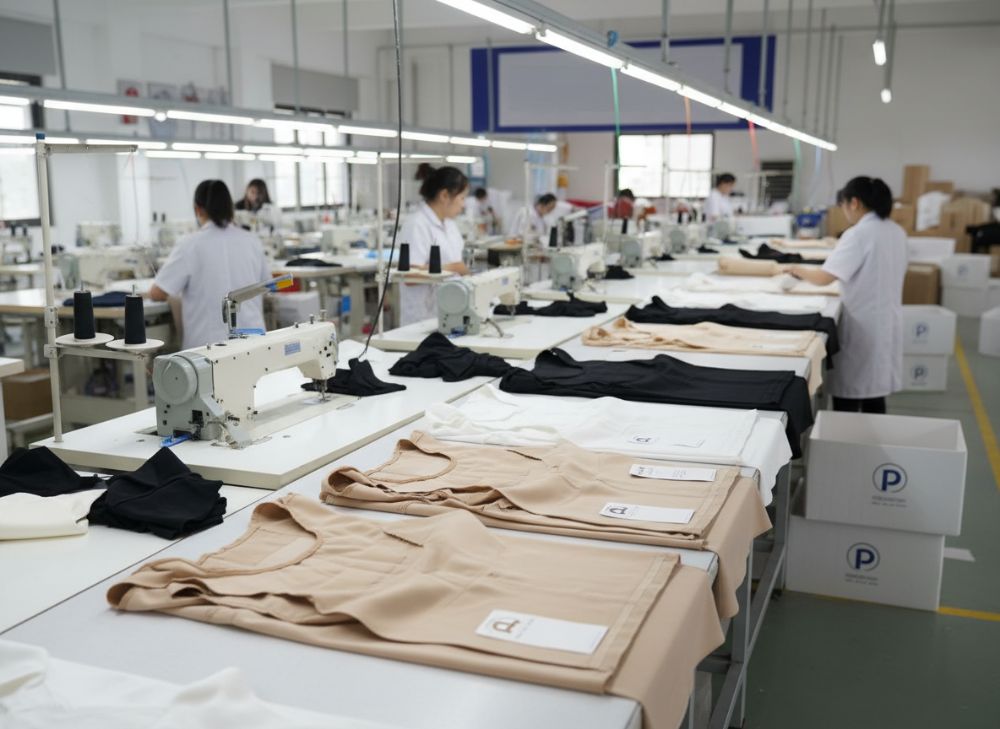
When evaluating factories, ask how they control assembly-level testing alongside raw-material inspection. S-SHAPER outlines relevant process considerations within its quality assurance approach.
Record Approved Swatches and Tolerances
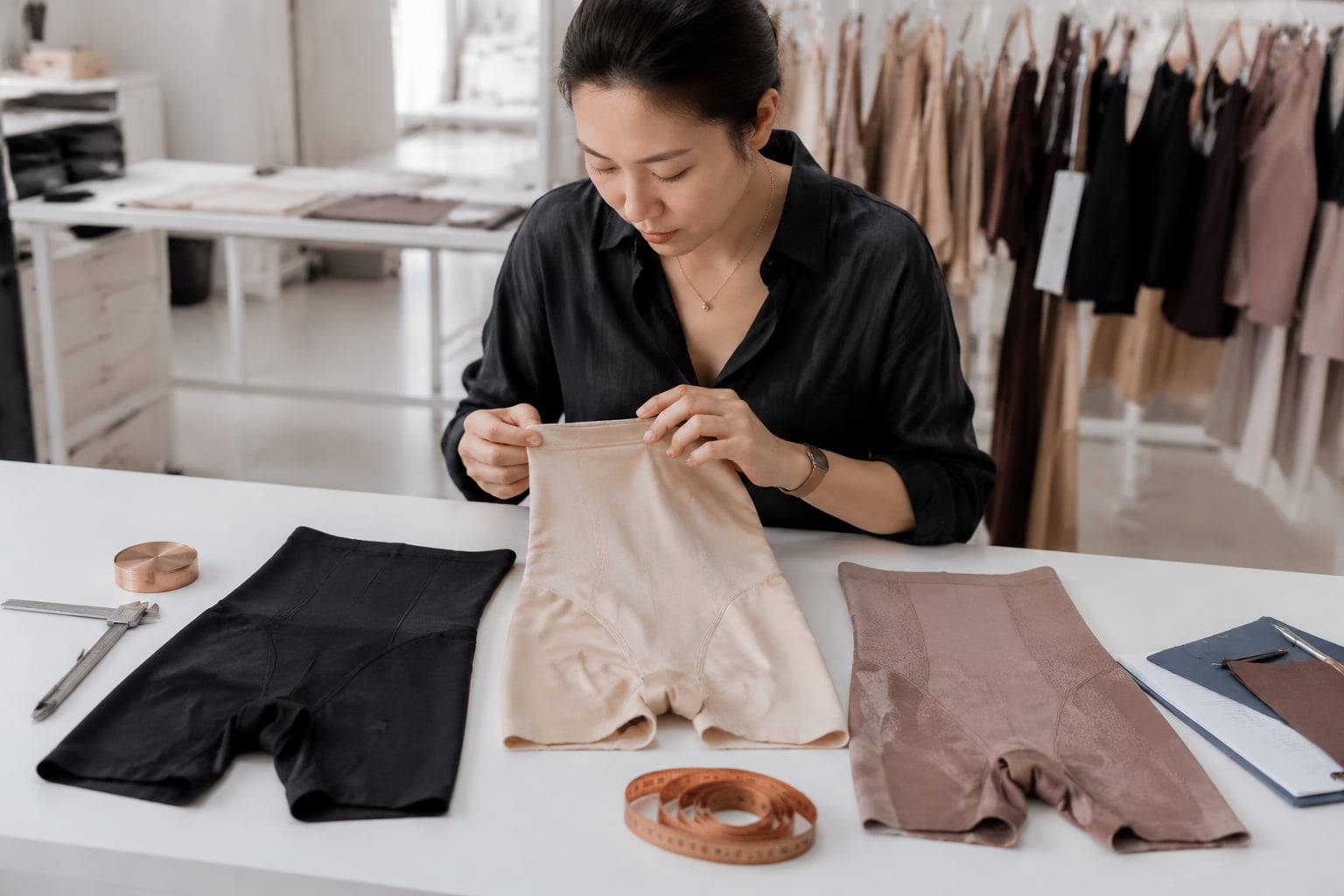
An approved swatch is useful only if everyone can identify exactly what was approved and how later fabric must compare. Keep a physical sealed swatch where possible, plus a digital record that is detailed enough for sourcing, quality and production teams to use.
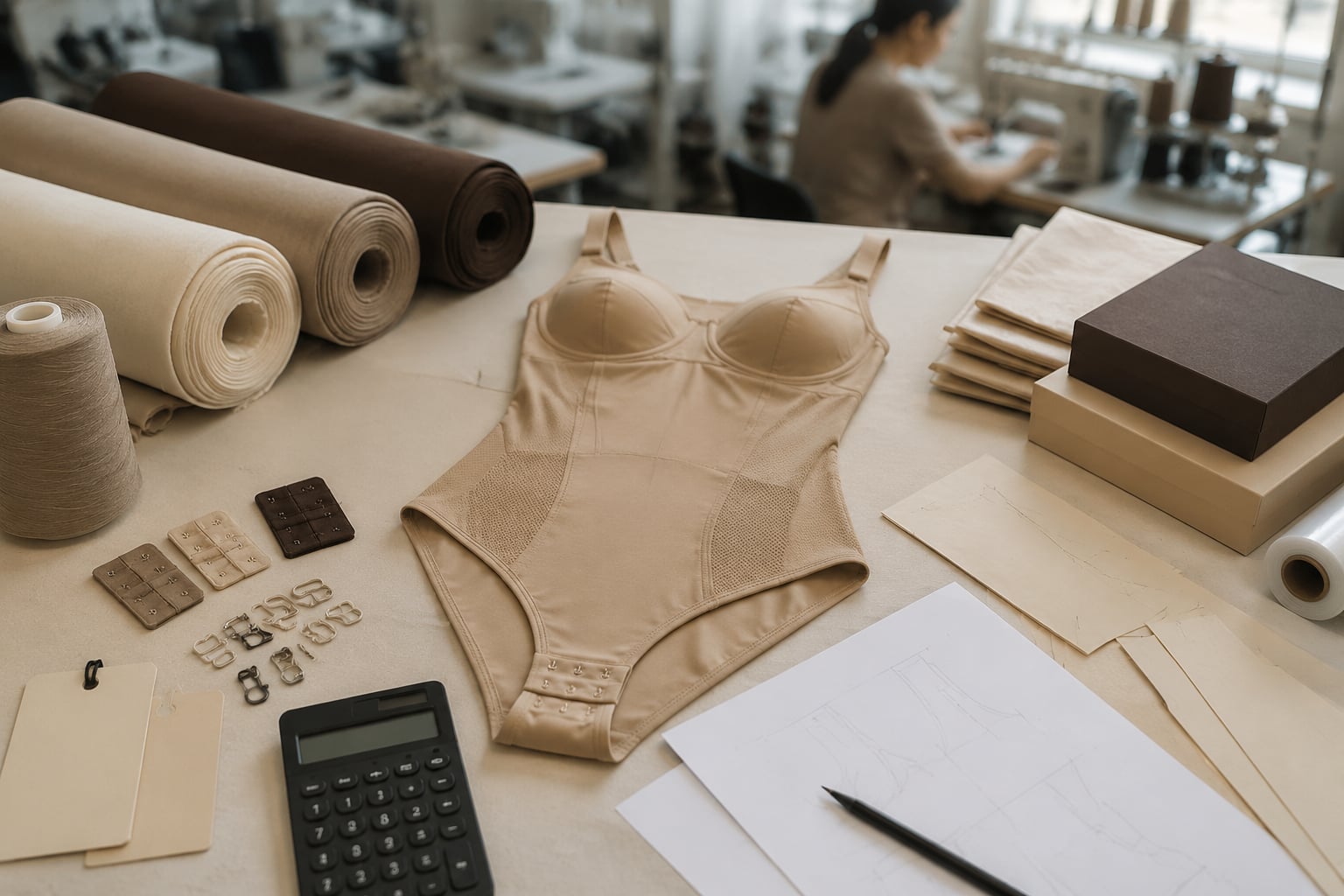
Include these details in the fabric approval record
- Supplier and fabric reference
- Fibre composition and construction description
- Colourway, dye lot where relevant, and finish
- Nominal GSM and accepted tolerance
- Fabric width and width tolerance
- Widthwise and lengthwise stretch targets
- Recovery and allowable residual growth under the agreed method
- Opacity assessment conditions and approval result
- Hand-feel descriptors with signed reference swatch
- Colour standard and colour tolerance procedure
- Surface quality criteria, such as snagging, barré, streaks or needle lines
- Required wash or care test outcomes
- Approved lining, elastic, thread, tape and bonding combinations
- Date, version number and sign-off responsibilities
Photographs can support the record, but they should not replace retained swatches because lighting and screen settings alter colour and surface appearance.
Set tolerances that protect the garment
Tolerances should be tight enough to protect fit and performance but realistic for the fabric and production process. A tolerance that is too broad can allow meaningful changes in support or opacity. One that is too narrow may create avoidable rejection without improving the finished product.
Work backwards from the garment’s critical functions. If small variation in stretch causes a body to become difficult to don or lose support, stretch tolerance needs close control. If a minor GSM shift does not affect performance, it may be less critical than recovery or width.
Confirm Bulk Fabric Against the Standard
Bulk approval should compare production fabric against the approved standard, not simply against a supplier’s internal reference. This is the point at which minor changes in yarn, dyeing, finishing or lot handling can become a costly fit issue.
Use a risk-based bulk inspection plan
Prioritise checks according to the garment’s function and the consequences of variation. For shapewear, the highest-priority checks commonly include:
- Fabric identity, composition and colour
- GSM and usable width
- Stretch and recovery in both directions
- Opacity at defined extension
- Surface appearance and consistency across the roll
- Hand feel versus the approved swatch
- Shrinkage or dimensional change after the agreed care test
- Compatibility with approved linings and elastics
- Finished-garment fit after production methods are applied
Take samples from more than one area of a roll where appropriate. Fabric can vary between the beginning and end of a roll, and performance can differ between production lots. Keep the test method, equipment settings and conditioning consistent with development records.
Avoid these common approval mistakes
- Approving by GSM alone. Weight does not confirm power, recovery or opacity.
- Testing only relaxed fabric. Shapewear must be assessed under extension.
- Using vague stretch descriptions. “Good stretch” cannot be reproduced or audited.
- Ignoring fabric direction. A rotated panel can materially alter fit.
- Approving fabric without trims. Elastics and linings may change the result.
- Comparing bulk with memory rather than a retained standard. Hand feel and colour perception are unreliable without references.
- Testing one size only. Larger sizes may place fabrics under substantially different extension.
- Treating prototype approval as bulk approval. Production finishing can change behaviour.
FAQ
Is higher GSM always better for shapewear?
No. Higher GSM may contribute to a denser, more substantial fabric, but it does not automatically create better support. Construction, elastane behaviour, stretch resistance, recovery and garment pattern all matter. Choose GSM in relation to the intended product and verify performance under extension.
What is the difference between stretch and recovery in shapewear fabric?
Stretch is how far a fabric extends under an agreed load or extension method. Recovery is how closely it returns towards its starting dimension once released. A fabric may have generous stretch but poor recovery, leading to looseness or reduced control after wear.
Should shapewear fabric stretch equally in both directions?
Not necessarily. Many products need more stretch around the body than along the body length. The important point is to specify the required stretch and recovery for each direction, based on panel orientation and garment purpose.
How should a team approve hand feel?
Use an approved physical swatch alongside written descriptors, then inspect bulk fabric under consistent conditions. Include inner-face comfort, outer-face smoothness, thickness, surface friction and perceived firmness rather than relying only on the word “soft”.
A robust shapewear fabric specification turns subjective preferences into controlled development criteria. Build the brief around GSM, directional stretch, recovery, opacity, hand feel and the complete fabric-and-trim assembly, then compare bulk production with the approved standard. For teams developing OEM, ODM or private-label collections, S-SHAPER can support this process from product development through scalable series production; its technology and innovation resources offer further context for evaluating material and construction options.