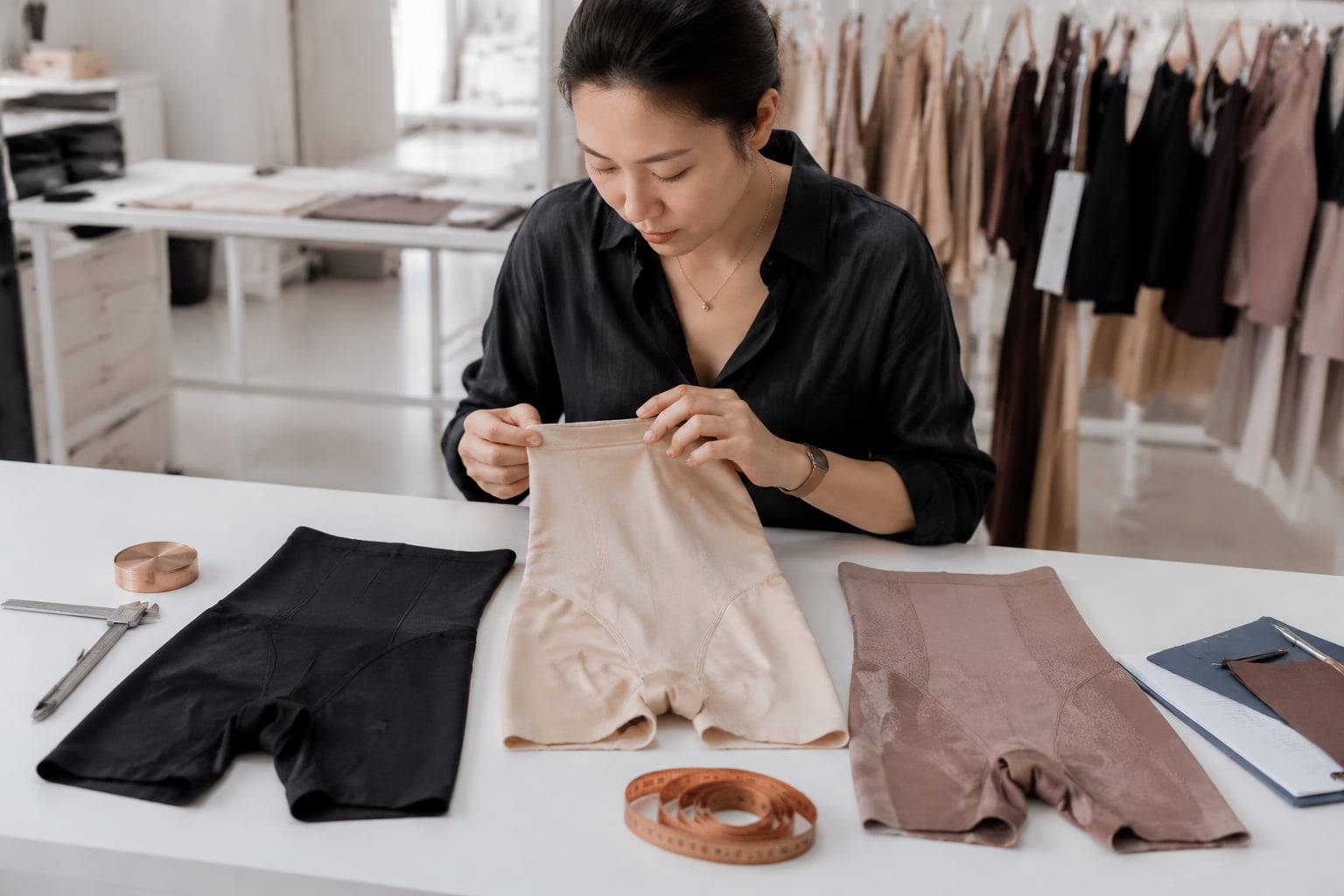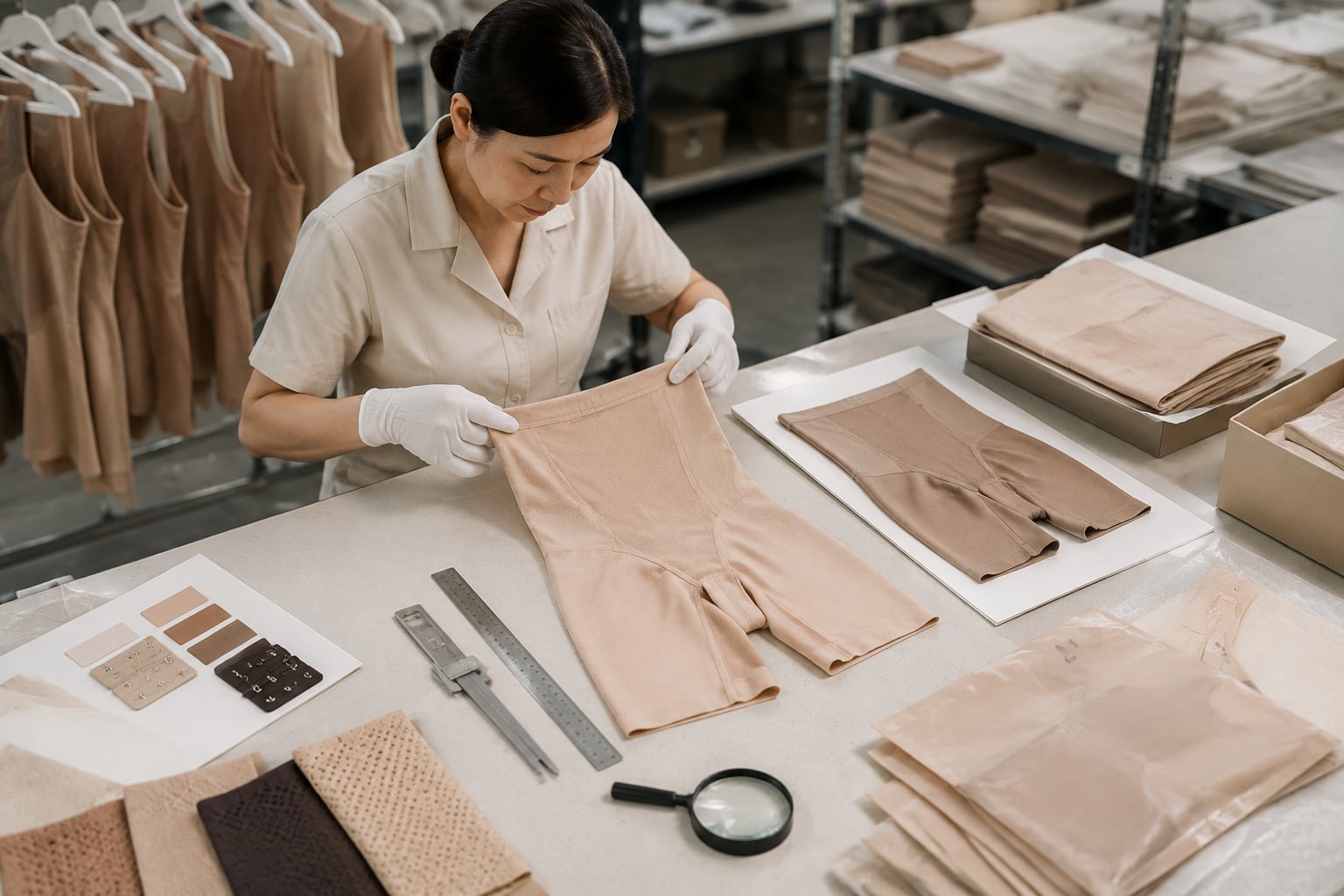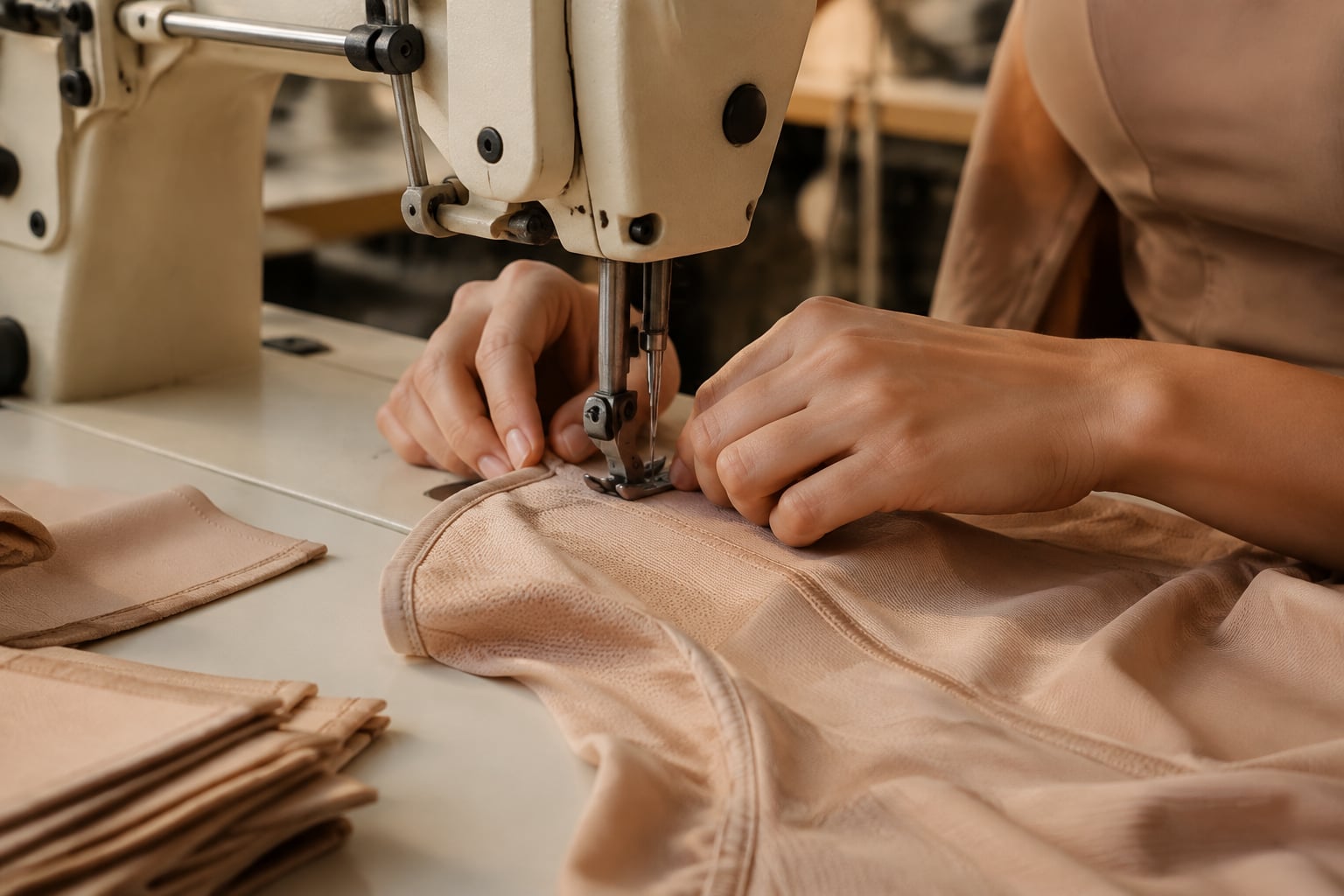
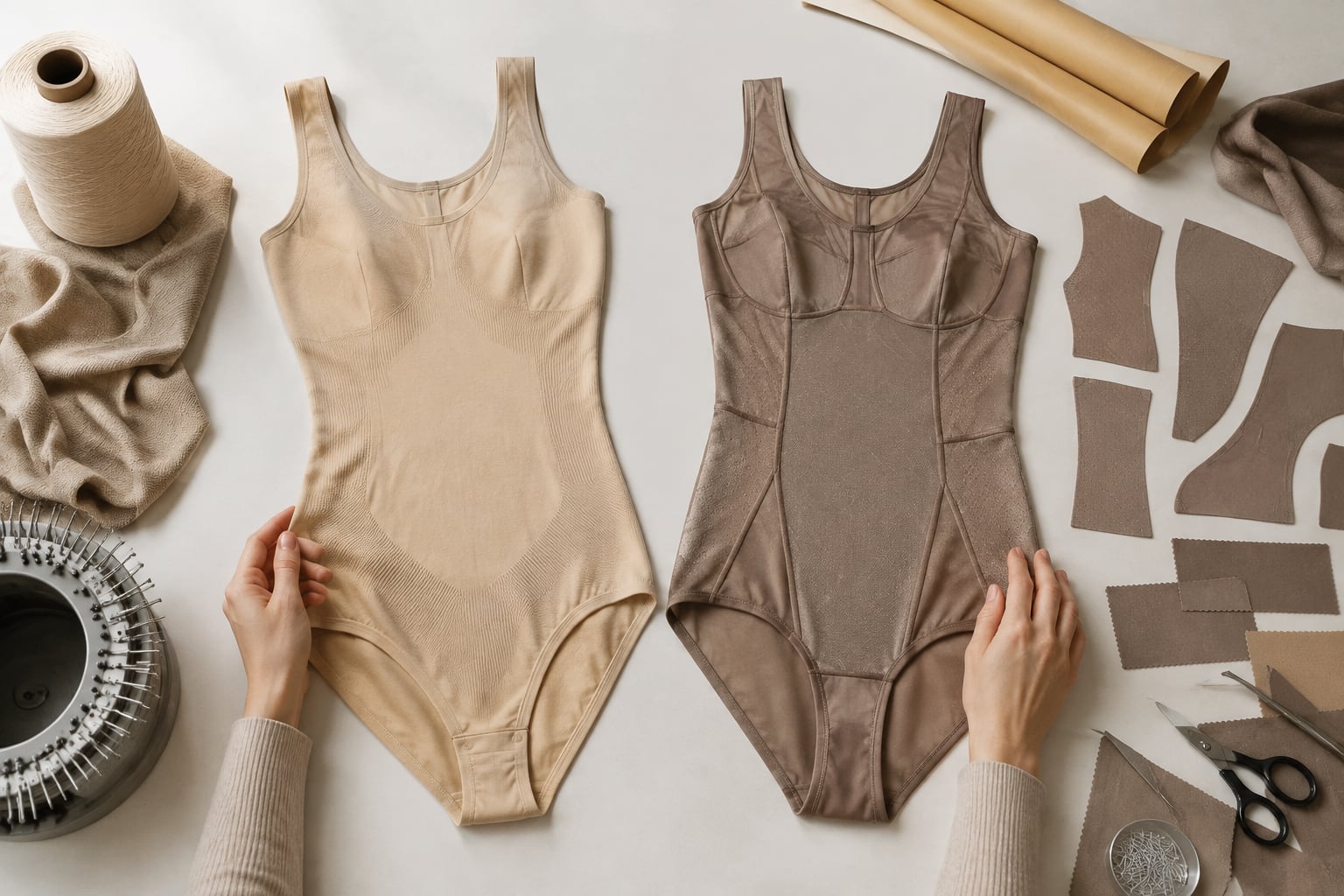
Seamless and cut-and-sew shapewear can both deliver effective shaping, but they solve different product-brief problems. Choose seamless shapewear when smoothness, fewer seams, knit-in support zones and efficient core styles are priorities. Choose cut-and-sew shapewear when your brief needs highly controlled pattern shaping, complex panels, specific fabrics, wider design freedom or precise placement of features.
For many brands, the decision is not about which method is “better”. It is about matching construction to the intended silhouette, wearer, price position, size range and development plan. A body brief with targeted abdominal support and a clean everyday finish may suit seamless knitting; a structured bodysuit with power-mesh panels, adjustable straps and engineered bust support is more likely to suit cut-and-sew construction.
Define the Product Brief Before Comparing Methods
Start with the product outcome rather than the production method. “High compression”, for example, is not a complete brief. The development team needs to know where the support belongs, how it should feel, how long the garment will be worn and how the desired effect should appear under clothing.
A useful shapewear brief should set out:
- Target body area: waist, abdomen, hips, thighs, back, bust or all-over smoothing.
- Support objective: light smoothing, medium control, firm shaping or posture-oriented support.
- Garment type: briefs, shorts, leggings, bodysuits, slips, camisoles or post-surgery-inspired styles where appropriate.
- Wear occasion: everyday, occasionwear, workwear, bridal, active use or recovery-oriented comfort.
- Outerwear compatibility: whether the garment must disappear under jersey, tailoring, a fitted dress or lightweight fabrics.
- Size architecture: intended size range, body-shape diversity, plus-size needs and inseam or torso-length requirements.
- Feature requirements: gusset opening, silicone grip, removable straps, adjustable straps, bust support, anti-roll waistband or bonded edges.
- Commercial parameters: expected retail positioning, planned order volumes, colour range and launch timetable.
The phrase seamless vs cut and sew shapewear is therefore best treated as a construction selection question. It should follow a clear product brief, not replace one.
A common mistake is asking suppliers to quote both methods against an incomplete sketch. That may produce samples that look broadly similar but have different comfort, support and cost profiles. Define the wearer benefit first, then assess which construction can deliver it consistently.
Compare Construction and Compression Zoning
The main difference lies in how the garment is formed.
Seamless shapewear is generally made on circular knitting equipment. The garment body is knitted in a tube or near-tube form, with variations in stitch structure, yarn tension and knit density used to create zones of support, ventilation or texture. It will still often require some assembly, such as attaching a gusset, straps, closures or labels.
Cut-and-sew shapewear is created from fabric panels that are cut to pattern and sewn together. The pattern pieces, fabric selection and seam placement create the garment’s shaping architecture. Bonding may also be used in place of, or alongside, stitching for selected edges and joins.
| Consideration | Seamless shapewear | Cut-and-sew shapewear |
|---|---|---|
| Core construction | Circular-knit body with integrated zones | Cut fabric panels assembled with seams or bonding |
| Compression zoning | Created through knit structure, tension and yarn choices | Created through fabric selection, panel geometry and layering |
| Surface appearance | Usually smooth with minimal seam lines | Depends on seam, bonding and panel layout |
| Anatomical shaping | Strong for rounded, body-hugging foundations | Strong for deliberate contouring and directional support |
| Style complexity | Best suited to designs compatible with knitting limitations | Supports more complex silhouettes and component combinations |
| Development emphasis | Knit programme, yarn and machine capability | Pattern engineering, fabric behaviour and sewing or bonding method |
How zoned compression differs
In seamless garments, support can be integrated into the knit. A firmer abdominal panel, ribbed side support, ventilated back zone or shaped waistband can be placed within one knitted construction. This can reduce bulk and create a continuous feel against the body.
However, a knit zone should not be assumed to perform identically to a separate firm fabric panel. Compression depends on the yarn blend, stitch construction, garment dimensions, recovery and how the garment stretches on the body. A visual zone on a sample may not translate into a meaningful difference in support.
With cut-and-sew shapewear, zoning can be more explicit. A brand might combine a high-power front panel, a softer back section, a breathable gusset and a separate inner lining. Panel direction can also be engineered to control stretch across or around the body.
That flexibility brings a trade-off: each seam and panel transition needs careful design. Poorly placed seams can show through clothing, create pressure points or distort when worn.
Do not equate firmer with better
Excessive compression can make a garment difficult to put on, uncomfortable over a full day, prone to rolling at the waist or more likely to cause sizing complaints. The goal is balanced support: firm enough to meet the shaping claim, but compatible with movement, breathing, sitting and normal wear.
For this reason, confirm compression through fit and wear evaluation rather than relying only on fabric weight, yarn denier or a supplier’s general “light/medium/firm” description.
Evaluate Fit, Size Range and Grade Control
Fit is often the deciding factor in the seamless versus cut-and-sew shapewear choice. Both methods can fit well, but they offer different forms of control.
Seamless construction has useful natural stretch and can accommodate some variation within a size. This is valuable for simple briefs, smoothing shorts and everyday control garments. It may also reduce the number of prominent seam lines around the torso and hips.
Yet high stretch does not remove the need for a robust grading strategy. If too much body variation is expected within one size, the garment may give insufficient support on one wearer and excessive constriction on another. A single “flexible” size range should be tested across the full intended body measurements, not only on a sample-size fit model.
Cut-and-sew construction offers more direct control over dimensions. Pattern pieces can be graded independently, allowing closer management of waist, hip, thigh, rise, torso length and bust area. This is particularly useful where a style includes cups, a longline torso, structured straps, closures or a complex lower-body shape.
Questions to settle during fit development
Ask the product team and supplier to agree on:
- Which body measurements govern each size.
- Whether the garment is designed around standard, curvier, taller or shorter proportions.
- How much negative ease is intended in each body area.
- Whether support must remain consistent across all sizes.
- Which areas may be allowed more comfort stretch.
- Whether leg openings, waistbands and straps need separate grading rules.
- How the garment should sit after sitting, bending and repeated wear.
For either route, fit approval should not be based solely on a garment lying flat. Evaluate it on appropriate fit models across the size range. Record issues such as rolling, leg ride-up, crotch strain, shoulder pressure, bust displacement, seam visibility and changes in support after laundering.
A frequent commercial risk is approving only the middle size, then discovering that the largest sizes feel disproportionately restrictive or that the smallest sizes lose shaping power. Grade reviews and wear trials should happen before bulk production is confirmed.
Review Materials, Seams and Edge Finishes
Material selection shapes comfort, durability, opacity, recovery and support. The construction method does not replace the need to specify the fabric or yarn system carefully.
For seamless styles, relevant considerations include:
- Fibre composition and skin feel.
- Elastane performance and recovery after repeated extension.
- Knit density in different zones.
- Opacity when stretched over the seat and thighs.
- Breathability and moisture handling for the intended use.
- Colour consistency across yarn lots.
- Potential snagging, laddering or excessive sheerness in fine structures.
For cut-and-sew styles, the team must additionally assess how each fabric behaves in relation to the others. A firm power mesh, for instance, may react differently from a soft stretch lining or a matte outer fabric. Joining materials with significantly different stretch and recovery can lead to puckering, twisting or an uneven fit.
Seams are functional design decisions
Seams in cut-and-sew shapewear can create useful shaping lines, but they must be positioned with the wearer and outerwear in mind. A centre-front seam, curved under-bust seam or inner-thigh join may be acceptable in one garment and unsuitable in another.
Review:
- Seam allowance bulk and stitch extensibility.
- Seam strength under stretch.
- Visibility beneath fitted clothing.
- Friction at the inner thigh, underarm and crotch.
- Alignment at panel intersections.
- The direction in which each seam stretches under load.
Seamless garments have fewer body seams, but they are not seam-free in every sense. Areas such as gussets, straps, leg finishes, waist treatments and labels still need inspection. Any join should retain stretch without creating irritation or a hard ridge.
Edge finishes deserve separate approval
Waistbands and leg edges heavily influence whether shapewear stays in place. Options may include self-finished knit edges, elastic bindings, silicone applications, folded fabric, bonded edges or specialist tapes. Each has a different visual, tactile and performance outcome.
For example, an anti-slip treatment can help a garment remain positioned, but it needs assessment for skin comfort, adhesion durability and compatibility with the intended wearer. A very narrow leg finish may look discreet but can cut in or roll if the recovery is poorly matched to the opening circumference.
Do not approve edges only from a mannequin view. Assess them during walking, sitting and repeated movement.
Understand Sampling, Tooling and Revision Impact
Sampling pathways differ considerably between the two methods, so development planning should reflect the chosen route.
Seamless shapewear depends on knitting equipment, yarn specifications and a programmed construction. Changes to body dimensions, zone placement, knit density or style architecture may require programme adjustments and, depending on the design, machine-specific development work. This makes early clarity valuable.
Cut-and-sew samples depend on patterns, fabric sourcing, cutting, sewing and finishing. Pattern modifications can be relatively direct when the fabric and construction are stable, but a change to one panel may affect adjoining panels, seam lengths, lining pieces and component placement.
Build revisions into the brief
Neither approach should be selected on the assumption that revisions will be effortless. Instead, identify which aspects are fixed and which may change during development.
For seamless styles, lock down early:
- Overall silhouette and body coverage.
- Primary shaping zones.
- Desired knit appearance.
- Yarn and colour direction.
- Waist and leg treatment.
- Required accessories or closures.
For cut-and-sew styles, lock down early:
- Base fabric and lining strategy.
- Panel map and directional stretch.
- Stitching or bonding approach.
- Key measurements and fit intent.
- Components, trims and closures.
- Edge-finish method.
Sampling should progress from construction validation to fit assessment, wear testing and pre-production confirmation. A sample that has not been worn and washed is not sufficient evidence of bulk-readiness.
Suppliers should be asked what changes may affect development timing, minimums, repeatability and cost. The answer will vary by style and production setup, so it should be confirmed for the specific project rather than assumed from a generic category quote.
Compare Design Flexibility and Branding
Cut-and-sew is often the broader platform for visually distinctive or technically complex shapewear. It can incorporate contrast panels, multiple fabric finishes, lace, mesh, cups, structured bust elements, adjustable components, hooks, zips and carefully placed decorative details. It is typically better suited where the garment’s visual design is as important as its smoothing function.
Seamless offers a different kind of design opportunity. Rib patterns, knit textures, contrast zones, logo integration, openwork details and body-contouring structures can be incorporated into the fabric itself. It is particularly effective for modern, minimal garments where the product should look clean, flexible and nearly invisible beneath clothing.
Brand choices should remain wearable
Branding can be added through knitted logos, printed markings, heat transfers, woven labels, care labels, packaging and colour direction. The method should be selected according to location and stretch.
A logo at a highly stretched point may distort. A stiff transfer can reduce comfort. A sewn-in label may irritate the wearer, while a printed care marking may fade if the material or application process is unsuitable. Confirm the expected wash performance and placement through physical samples.
When briefing a private-label range, separate the non-negotiable identity elements from decorative options. It is often wiser to secure fit, comfort and durability before adding complex trims that increase failure points.
Once the construction choice is clear, S-SHAPER UK can review whether the brief is better handled through OEM, ODM or private label. Its OEM and ODM shapewear development options are relevant where the required level of customisation needs to be defined before sampling.
Plan Quality Checks for Each Method
Quality control needs to reflect the construction route. A final inspection alone is not enough; many shapewear issues begin with material, pattern, programme or process variation.
Key checks for seamless shapewear
The quality plan should examine:
- Correct yarn composition and approved colour.
- Consistency of knit density and support zones.
- Accurate placement of functional zones.
- Holes, dropped stitches, snagging and visible defects.
- Waist and leg opening dimensions.
- Stretch and recovery against the approved sample.
- Colour variation between lots.
- Correct attachment of gussets, straps, labels or closures.
- Appearance after washing and repeated extension.
Because shaping is integrated into the knit, small changes in construction can influence the garment’s feel. Compare bulk pieces with the approved reference for dimensions, opacity and compression behaviour rather than checking appearance alone.
Key checks for cut-and-sew shapewear
For cut-and-sew styles, assess:
- Fabric weight, stretch direction, recovery and colour consistency.
- Correct panel cutting and grain or stretch orientation.
- Pattern dimensions and grading accuracy.
- Seam strength and seam extensibility.
- Puckering, skipped stitches, loose threads and uneven seam allowances.
- Alignment of panels, lace or printed details.
- Bonded-seam adhesion where used.
- Edge elasticity, silicone placement and finish quality.
- Hardware function and attachment security.
The principal risk is variation introduced through multiple components and operations. A garment may meet measurements yet still feel wrong if a power panel is cut in the incorrect direction or an elastic is applied with excessive tension.
A documented inspection approach helps keep approval criteria clear between brand and supplier. Review the supplier’s shapewear quality assurance approach alongside the product-specific test plan, especially where the brief includes strong support, bonding, silicone or multiple materials.
Use a Decision Matrix for Supplier Briefing
Use this matrix as a starting point when selecting a development route. It is not a substitute for sampling, but it will help your team provide a more decisive brief.
| Brief requirement | Likely stronger route | Why | What to confirm |
|---|---|---|---|
| Smooth everyday smoothing shorts | Seamless | Minimal body seams and integrated knit support suit close-to-body basics | Opacity, leg grip, waistband stability and recovery |
| Multiple targeted support panels | Cut-and-sew | Separate materials and panel shapes provide precise directional control | Seam placement, panel stretch direction and bulk |
| Clean, modern body-contouring look | Seamless | Knit-in texture and zones can create a streamlined finish | Zone performance across all sizes |
| Structured bodysuit with adjustable straps and bust support | Cut-and-sew | Greater control over components, shaping and pattern sections | Torso length, strap grading and bust fit |
| Lightweight garment under fitted dresses | Either | Both can work if edges and shaping lines are carefully engineered | Seam visibility, edge show-through and movement |
| Complex colour blocking, lace or mixed materials | Cut-and-sew | More material and trim combinations are practical | Join quality, colour matching and durability |
| Core programme with streamlined styling | Seamless | Efficient platform for repeatable briefs, shorts and tops | Machine capability, repeatability and size coverage |
| Premium technical garment with specialised construction | Often cut-and-sew, sometimes hybrid | Panel engineering and bonding can add function, while seamless may suit selected zones | Whether a hybrid design adds genuine wearer benefit |
Before requesting samples, provide the supplier with:
- A flat sketch and, where possible, front, side and back views.
- The intended support map, marked by body area.
- Target size chart and grading requirements.
- Fabric, yarn, colour and finish preferences, or the desired hand feel if these are still open.
- Required components, labels and packaging details.
- Reference garments with notes on what should be retained or avoided.
- Fit, wash and appearance criteria for approval.
- Expected order profile and whether the style is a single launch or part of an expandable range.
The best supplier brief also identifies what is negotiable. If a bonded edge is desirable but not essential, say so. If the abdominal compression and no-roll waistband are mandatory, make that explicit. This prevents effort being spent on aesthetic refinements while key functional requirements remain unresolved.
Technical innovation is also relevant to route selection: ask how a supplier proposes to achieve the required stretch, recovery, zoned support and finish, rather than requesting a method by name alone. Reviewing available shapewear technology and innovation can help product teams frame those questions.
FAQ
Can seamless shapewear provide firm compression?
Yes, it can provide substantial support through knit density, yarn selection and engineered zones. However, the exact performance should be evaluated on-body across sizes. A seamless garment is not automatically less supportive than a cut-and-sew style; its support is simply created differently.
Is cut-and-sew shapewear less comfortable because it has seams?
Not necessarily. Well-designed seams can be comfortable, durable and unobtrusive. Comfort depends on seam location, stitch type, fabric choice, bulk, fit and edge finishes. Conversely, a seamless garment can still be uncomfortable if its compression or openings are poorly engineered.
Which method is better for plus-size shapewear?
Either may be appropriate. Cut-and-sew can offer detailed control over shaping and grading, while seamless can provide adaptable stretch and a smooth finish. The priority is validating support, recovery, comfort and proportions on representative wearers in the full intended size range.
Can one style combine both methods?
Yes. Hybrid constructions may use a seamless knitted body with added panels, closures, straps or gusset components. This should be done for a clear functional reason, as extra construction steps can add complexity and quality-control requirements.
The practical choice between seamless and cut-and-sew shapewear is the route that meets the wearer promise with repeatable fit and manageable production risk. Finalise the body-area support map, size strategy and edge requirements, then ask suppliers to explain how their proposed construction will be sampled, tested and controlled in bulk.