Private-label shapewear with a small minimum order quantity (MOQ) is possible, but “small” must be defined carefully. A supplier may quote an MOQ per project, model, colour, size, packaging format or production run—and these are not interchangeable.
For a useful quotation, prepare the product type, target market, quantity, size range, colours, material direction, branding, packaging and delivery window. The supplier should then show whether its minimum applies to one controlled launch or is split across several styles and colourways.
Quick answer: Is private-label shapewear with a small MOQ possible?
Yes, provided the launch is structured around a limited assortment and the supplier confirms how the MOQ is allocated.
The most workable low-MOQ approaches usually combine:
- One proven or semi-custom shapewear model
- A controlled colour palette
- A commercially realistic size curve
- Standard or readily available fabrics
- Simple branding, such as a sewn label or printed packaging
- One pilot order before broader collection development
A small MOQ does not remove the normal cost of development, sampling, pattern adjustments, packaging preparation and quality control. It simply limits the initial production commitment. The smaller the order becomes per model, colour and size, the more likely the unit cost, sampling burden or setup cost will rise.
Before requesting quotes, define these points:
- Is the quantity total across the project or fixed per SKU?
- Can colours and sizes be mixed within the quoted MOQ?
- Does the MOQ include packaging and labels?
- Are samples, revisions and grading included or charged separately?
- Can the same approved pattern and materials be reordered later?
- What must be confirmed before production starts?
Use the following as a quotation-input checklist:
| Input | What to provide | What the supplier should confirm |
|---|---|---|
| Product | For example, bodysuit, waist shaper, shorts or slip | Available construction or development route |
| Quantity | Total units and preferred allocation | Whether MOQ is per project, style or SKU |
| Sizes | UK size range or body measurements | Size chart, grading and size mix options |
| Colours | Named colours or reference swatches | Colour availability, dyeing limits and minimums |
| Materials | Preferred fibre blend, stretch and handle | Suitable standard or custom material options |
| Branding | Label artwork, logo files and position | Label method, artwork requirements and setup |
| Packaging | Bag, box, belly band or retail-ready format | Minimums, costs and packing configuration |
| Delivery | Required delivery window and destination | Production assumptions, shipping basis and responsibilities |
MOQ by model, colour and size: understand the difference
MOQ is only meaningful when its unit of measurement is clear. A supplier stating “500 units MOQ” may mean 500 units in total, 500 units per style, or a production minimum that changes according to colour, fabric and size.
MOQ per model
A model is the underlying product design—for example, a high-waisted brief, shaping bodysuit or open-bust garment. If the MOQ applies per model, you may be able to divide the order between colours and sizes, subject to the supplier’s production rules.
This is generally easier to manage than a separate MOQ for every SKU. However, confirm whether different lengths, compression levels, closures or fabric compositions count as separate models.
MOQ per colour
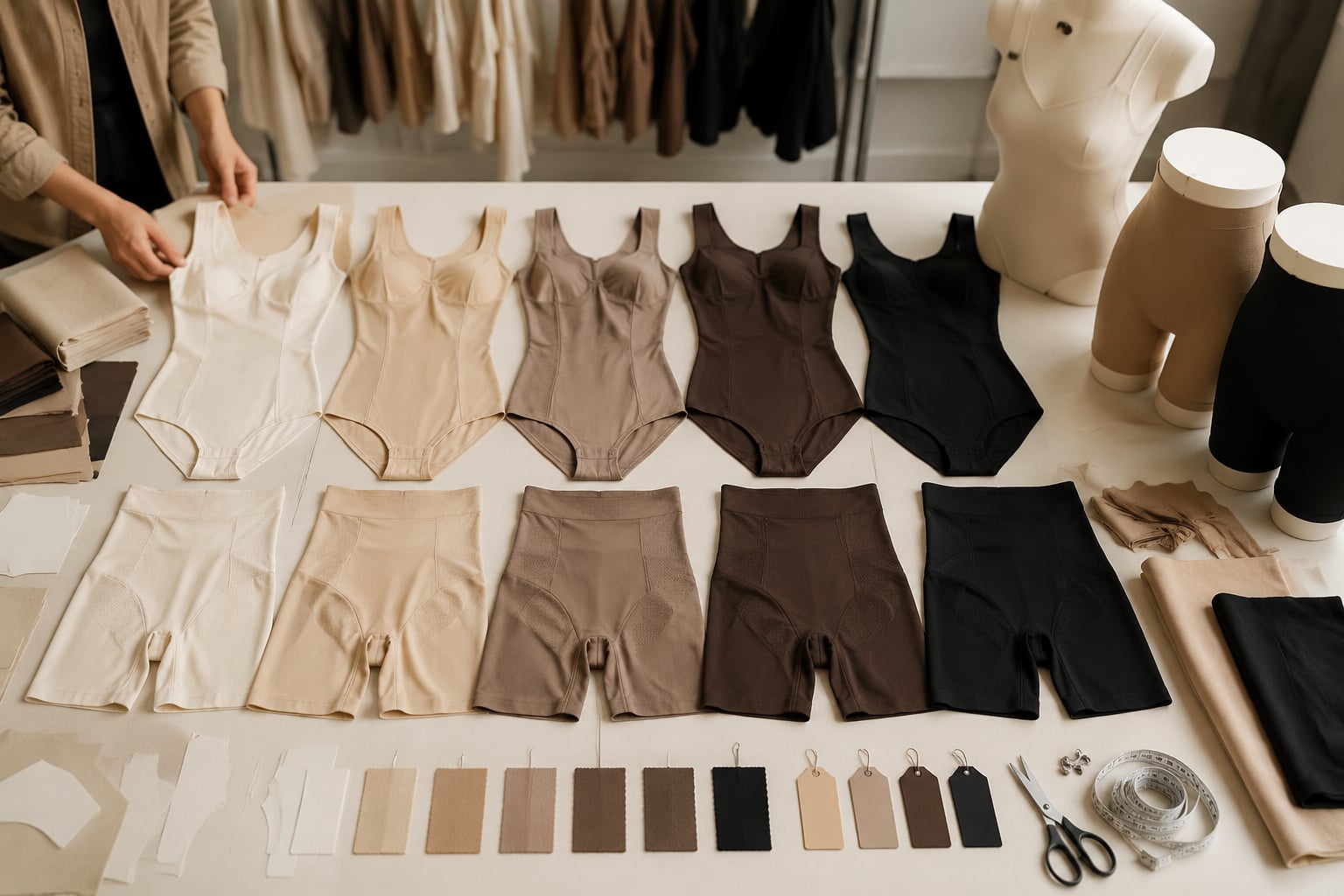
Colour may create a separate minimum when fabric is dyed or when a custom colour is developed. Black, nude and other regularly stocked shades may be easier to combine than a new colour requiring a dedicated dye lot.
Ask whether:
- The stated colour is a stock shade or a custom development
- Several colours can share the same model MOQ
- Colour approval requires a lab dip or physical swatch
- A small quantity can be produced using stock fabric
- Colour variation between production lots is controlled and documented
Do not assume that “three colours” means the same cost as “one colour with the same total units”. The production route may be different.
MOQ per size
Size-related minimums can be handled in several ways. Some suppliers accept a mixed size curve across the total order. Others may apply minimum quantities to individual sizes, particularly where grading, cutting efficiency or production planning is affected.
A mixed size curve should be agreed in writing. Do not use a simple equal split unless that reflects your expected demand. A practical starting point may prioritise core sizes while retaining enough range to avoid making the product difficult to sell—but the correct allocation depends on your market data, channel and customer profile.
A useful way to clarify the quote is to request three separate figures:
- Total project MOQ
- Minimum per colour
- Minimum per size or permitted size curve
This prevents an apparently attractive MOQ from becoming unworkable when the order is divided into sellable SKUs.
Low-MOQ private label versus bespoke OEM development
Private label, ODM and OEM are related but involve different levels of control.
| Route | Typical buyer control | Low-MOQ suitability | Main trade-off |
|---|---|---|---|
| Private label | Branding applied to an existing or adaptable product | Often the simplest starting route | Less product exclusivity |
| ODM | Supplier-supported product adapted to a commercial brief | Suitable where fit or features need refinement | Some development boundaries may apply |
| OEM | Product developed to the buyer’s own technical requirements | Possible, but more dependent on development scope | Higher sampling, tooling or setup complexity |
A private-label project may use an existing base model with changes to branding, packaging or selected details. ODM can be appropriate when you need a different neckline, panel arrangement, level of control or target fit but do not want to create every specification from the ground up. OEM is more suitable when your team has a detailed tech pack, reference sample or proprietary construction requirement.
The key question is not simply, “Which route has the lowest MOQ?” It is, “Which route gives us enough product differentiation without adding development work that the first order cannot support?”
For a wider overview of these routes, see the guide to OEM and ODM shapewear development.
Start with a hero SKU instead of a broad collection
A hero SKU is one product intended to carry the initial launch. This approach concentrates your budget, feedback and inventory rather than spreading them across multiple styles that each have limited depth.
A strong hero-SKU brief should specify:
- The customer problem the garment is intended to solve
- The coverage area and intended level of shaping
- Whether it is designed for everyday wear, occasionwear or layering
- Desired rise, length, neckline and fastening details
- Target retail positioning
- Expected sales channels
- Required size range and fit priorities
A broad first collection can create hidden costs:
- More samples and fit approvals
- More individual product pages and imagery
- Smaller quantities per colour and size
- More complex stock forecasting
- More packaging and labelling combinations
- Slower learning about which fit features customers value
A focused first order does not prevent future range expansion. It creates a clearer base for deciding whether the next product should be a new colour, a new length, a complementary style or a revised fit.
That said, a hero SKU should not be so narrowly specified that it becomes difficult to merchandise. For example, a single garment in a highly unusual colour or highly specialised construction may limit the usefulness of the test. Keep the product distinctive enough to support your proposition, but commercially understandable to the customer.
Prioritise the size curve and colours according to demand
Small-MOQ planning is largely an allocation exercise. You are deciding where limited units will provide the best information without leaving important customers unable to buy.
Start with evidence where available:
- Previous sales of similar garments
- Website searches and waitlist data
- Wholesale account feedback
- Customer body-measurement information
- Returns and fit complaints
- Market positioning and price point
- Expected demand by sales channel
For a new brand or new product category, demand is less certain. In that case, document the assumptions behind the size curve rather than treating the first split as a fact. Review whether your forecast is based on actual customer data, comparable products or only internal preference.
Colour planning should follow the same discipline. A core neutral may offer broader use, while a seasonal or fashion-led shade can help test your brand identity. However, additional colours divide stock and may create separate fabric or dyeing requirements.
Ask the supplier to show how the proposed allocation affects:
- Unit price
- Colour minimums
- Size minimums
- Packaging quantities
- Reorder continuity
- Production timing
For a more detailed planning framework, use this guide to shapewear MOQ planning by style, colour and size.
Combine standard materials, labels and packaging efficiently
Small orders are easier to control when the product uses materials and components that the supplier can source or manage efficiently. This does not mean accepting a generic product. It means deciding where customisation creates genuine customer value.
Materials
A material brief should cover more than a fibre name. Include:
- Desired stretch and recovery
- Hand feel
- Opacity
- Compression or support expectation
- Seam and edge comfort
- Moisture or breathability priorities, if relevant
- Care requirements
- Colour and finish
The supplier must confirm whether the requested composition and performance are available for the chosen construction. A fabric suitable for a brief may not be suitable for a full production garment, particularly where stretch, recovery and fit stability matter.
Labels
Decide whether you need:
- Sewn brand labels
- Printed care or composition information
- Size labels
- Hangtags
- Barcode or SKU labels
- Retailer-specific labels
Keep artwork versions controlled. A small run with several label variations can create avoidable errors and extra setup work. Confirm the exact placement, dimensions, language requirements and approval process before bulk production.
Packaging
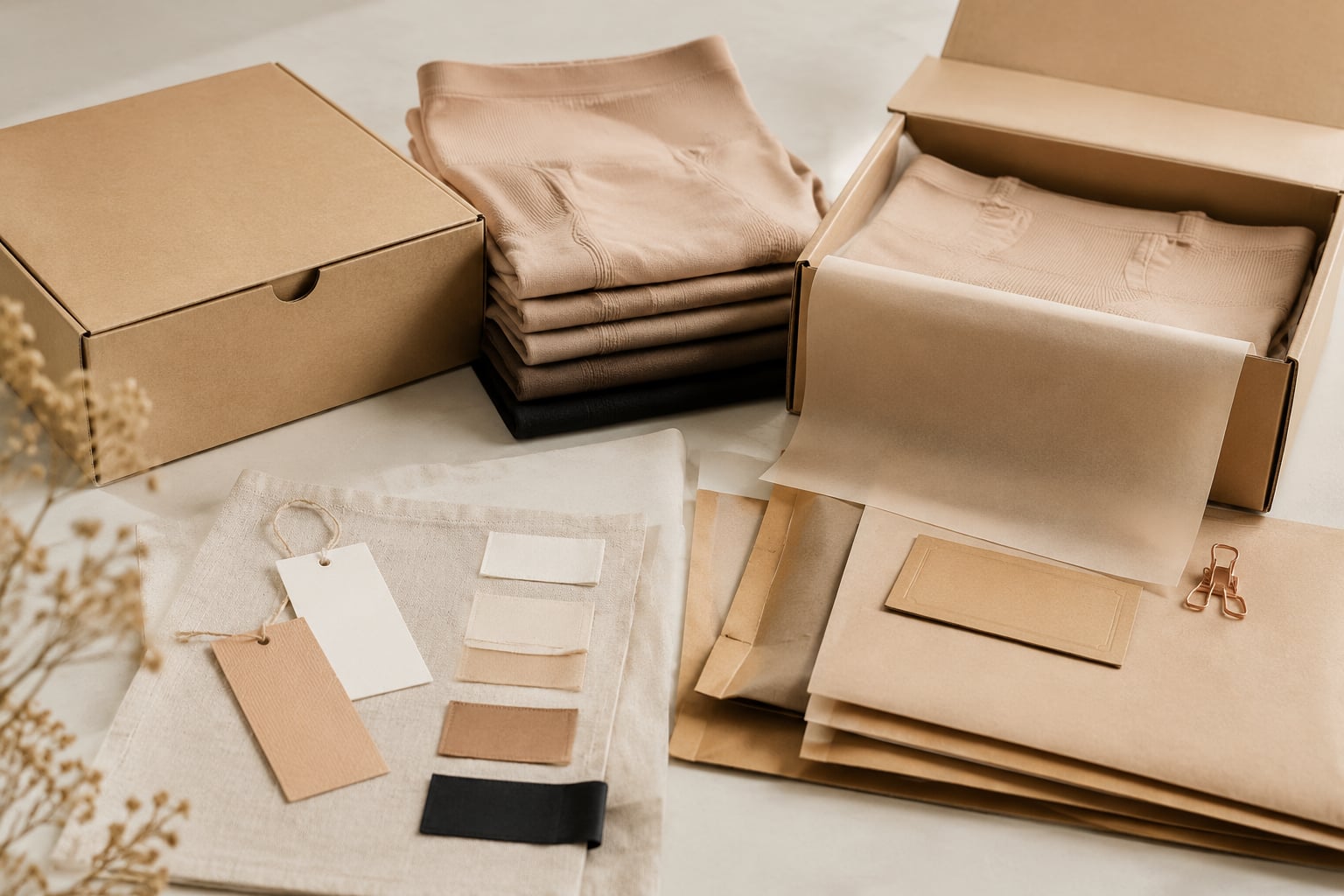
Packaging can include a simple polybag, branded bag, paper sleeve, box or retailer-ready configuration. The most efficient option is not always the cheapest item in isolation; it is the format that matches your fulfilment and sales channel without creating excess handling.
Confirm:
- Packaging dimensions
- Material and finish
- Whether packaging is supplied by the buyer or supplier
- Minimum order quantities
- Barcodes and outer-carton markings
- Packing method by size and colour
- Whether packaging can be reused for reorders
In the UK, fulfilment, VAT treatment, import arrangements and product information responsibilities may vary according to how and where the goods are sold. Treat these as project-specific commercial and compliance checks, and consult current official guidance or a qualified adviser where required. This article is general information, not legal, tax or customs advice.
Link the pilot order, samples and pre-order carefully
A pilot order should answer commercial and product questions, not merely produce a small quantity. Define the approval gates before committing.
Suggested approval gates
Gate 1: Commercial brief
Approve the target customer, selling channel, indicative retail positioning, product purpose and acceptable landed-cost range.
Gate 2: Product direction
Approve the base model or development brief, material direction, colour plan, size range and branding requirements.
Gate 3: Sample review
Check measurements against the agreed size chart, fit on suitable wearers, seam comfort, shaping effect, opacity, recovery and appearance after care testing appropriate to your product.
Gate 4: Pre-production approval
Confirm the final sample, artwork, labels, packaging, size curve, colour allocation and purchase-order details.
Gate 5: Pilot review
Record sales, returns, customer feedback, fit issues, colour performance and operational problems before placing a repeat order.
A pre-order can reduce inventory risk, but it should not be used to promise a specification that has not been approved. If the production sample changes the fit, colour or packaging, update the customer-facing information before taking orders.
Also distinguish between a development sample and a production sample. A development sample demonstrates direction. A production sample should represent the approved materials, construction, labels and packaging used for the order. Ask which sample is being approved and what changes are still permitted afterwards.
Calculate small-volume price premiums realistically
Smaller orders often have a higher unit cost because fixed work is spread across fewer units. This may include:
- Pattern or development work
- Sampling
- Colour preparation
- Label setup
- Packaging setup
- Quality control
- Cutting and production planning
- Freight or handling inefficiencies
Do not compare quotations on unit price alone. Build a landed-cost view that includes the costs relevant to your route to market:
| Cost area | Questions to include |
|---|---|
| Product cost | Is the price based on the exact model, material and size curve? |
| Development | Are samples, revisions or pattern changes charged separately? |
| Branding | Are labels, printing and artwork setup included? |
| Packaging | Is packaging supplied, packed and quoted per unit? |
| Freight | What shipping basis and destination assumptions apply? |
| Taxes and duties | Who is responsible, and what has not been included? |
| Inspection | Is independent or additional inspection required? |
| Fulfilment | Will goods need relabelling, repacking or split delivery? |
| Inventory risk | What proportion may remain unsold if the test underperforms? |
When comparing a small pilot with a larger order, model at least three scenarios:
- The minimum viable pilot
- The expected first commercial order
- The reorder quantity if the product meets its sales assumptions
Then calculate the break-even point using your actual net selling price, channel fees, fulfilment cost, returns allowance and marketing assumptions. Avoid using recommended retail price as though it were revenue available to the business.
A low MOQ can reduce cash tied up in stock, but it may also increase the cost per unit and the risk of stockouts. The right decision depends on the balance between learning value, available cash and expected reorder speed—not on MOQ alone.
Scale from a test order to an economical reorder
The objective of a pilot is to create a repeatable product and a clearer demand signal. Before ordering, agree what will remain stable if the product is reordered.
Request confirmation of:
- Approved sample reference
- Final measurement chart and tolerances
- Material composition and approved alternative policy
- Colour references
- Label and packaging artwork
- Packing instructions
- Quality-control checkpoints
- Reorder MOQ
- Whether the same materials can be used again
- How price changes are handled if quantities increase or decrease
Keep a written product file containing the quotation, technical details, sample comments, artwork approvals, purchase order and inspection records. This reduces ambiguity when different team members or suppliers handle later orders.
The reorder should also be based on more than sales volume. Review:
- Which sizes sold first
- Which sizes generated returns
- Whether customers wanted stronger or lighter shaping
- Whether the garment rolled, marked or felt restrictive
- Which colours attracted demand
- Whether packaging survived fulfilment
- Whether wholesale buyers need different pack configurations
If the product is not fully defined, S-SHAPER UK can first review whether a private-label base, ODM development or OEM specification is the most efficient route. For any route, confirm in the quotation how the quantity is divided between models, colours, sizes, packaging and commercial allocation before treating it as a launch plan.
Businesses supplying retailers or managing more complex channels may also benefit from reviewing retail business solutions for shapewear programmes, particularly where packaging, assortment and replenishment need to work across more than one sales channel.
FAQ: Private-label shapewear with a small MOQ
What is a realistic small MOQ for private-label shapewear?
There is no universal figure. The practical MOQ depends on the product route, fabric, colour, construction, branding and size allocation. A supplier may state a project-level starting point but apply different rules to each model, colour or size. Always request the allocation assumptions in writing.
Can I mix sizes and colours in one MOQ?
Often this is possible, but it must be confirmed for the specific product. Stock materials and standard colours may be easier to combine than custom fabrics or colours. Ask for the permitted size curve and colour split rather than assuming all units are freely interchangeable.
Is private label cheaper than OEM?
It can require less development work when an existing or adaptable product is used, but the total cost depends on branding, samples, packaging, materials and order quantity. OEM may be commercially sensible where proprietary fit or construction is central to the product, even if development costs are higher.
Should a new brand start with one shapewear product?
A hero SKU can make inventory, marketing and customer feedback easier to manage. It is not automatically the right choice for every business. Compare one focused product with a small complementary range, taking account of your channel, available budget and need to demonstrate a broader offer to retailers.
What should I test before approving bulk production?
Check the approved measurements, grading, fit, stretch recovery, seams, edges, opacity, closures, branding, packaging and care information. Test the product in conditions that reflect intended use, and record any changes agreed with the supplier.
Can I use a pre-order to meet the MOQ?
A pre-order may help validate demand, but it does not remove the need to approve the product and confirm production assumptions. Make sure the promised delivery window, final specification and refund or cancellation process are clear for your customers.
What information should I send with a quotation request?
Provide the product type, reference images or tech pack, target market, quantity, size range, colours, material preferences, branding, packaging requirements, delivery destination and target delivery window. Also state whether you want private label, ODM adaptation or OEM development.
What is the next step if I am unsure which route fits?
Prepare a short brief with the product purpose, target customer, quantity, size and colour plan, materials or references, packaging requirements and delivery window. S-SHAPER UK can then review the project against its OEM, ODM or private-label routes and confirm the applicable model, colour, size, packaging and commercial allocation in a quotation. This gives your team a clearer basis for approval without committing to a broad collection too early.