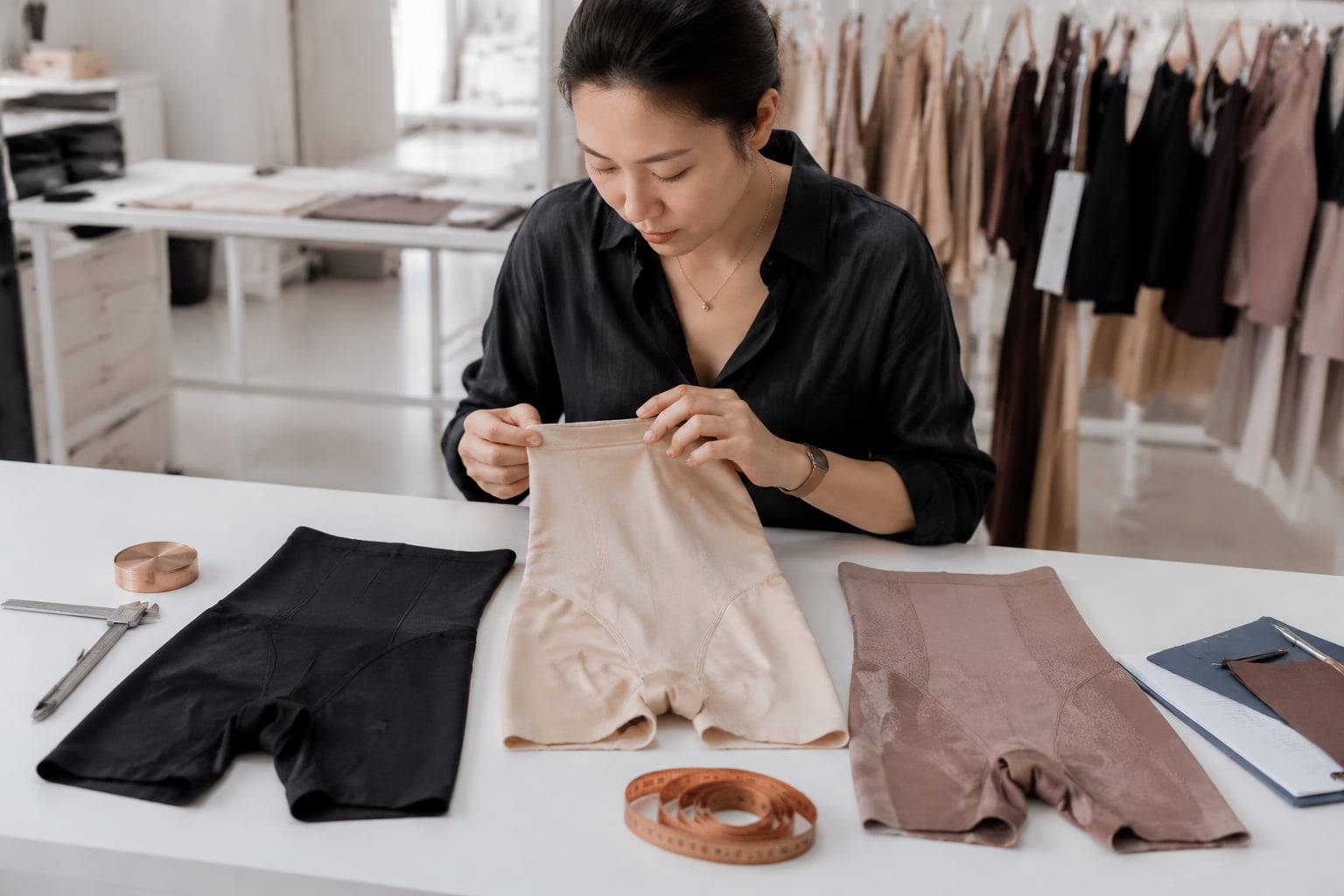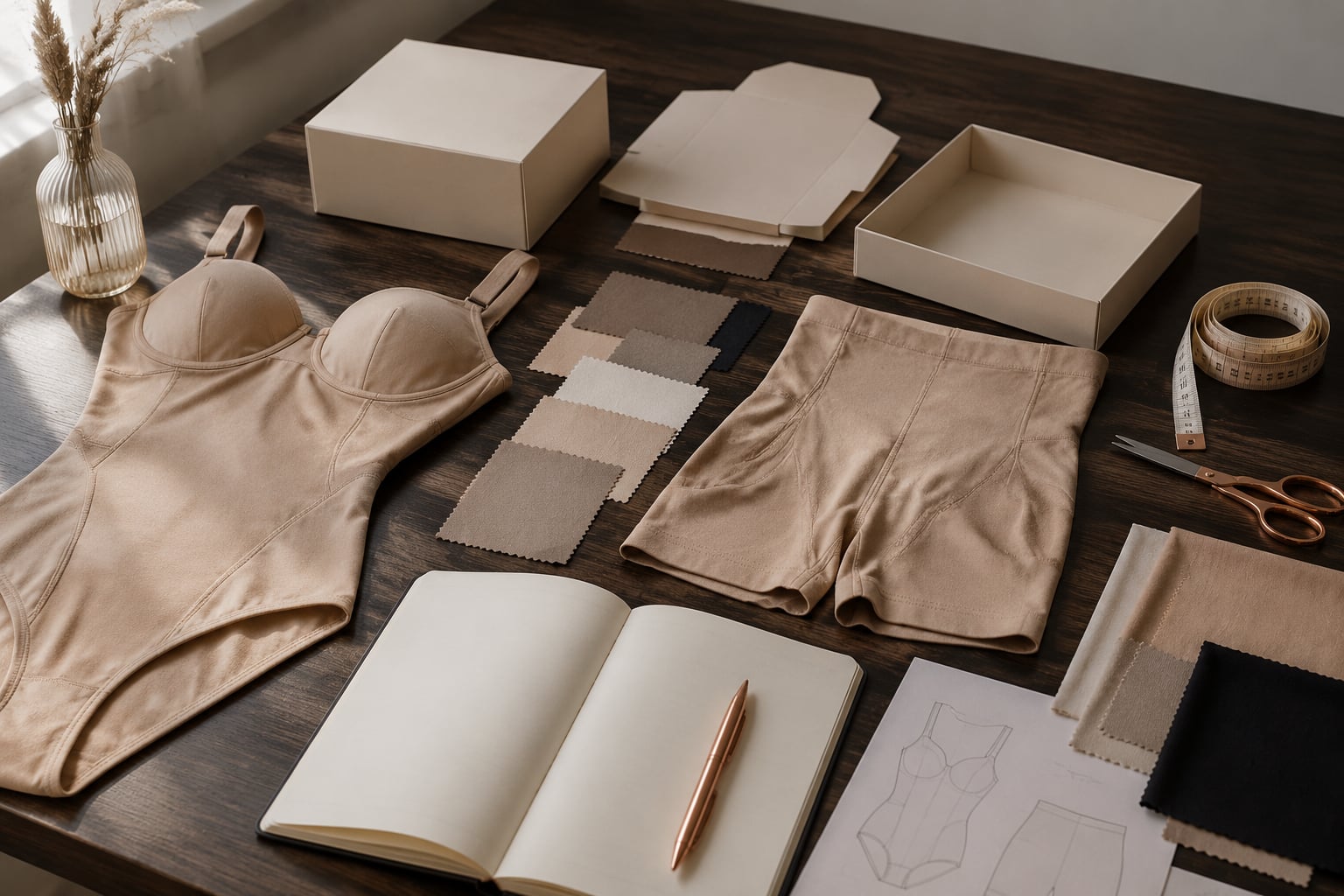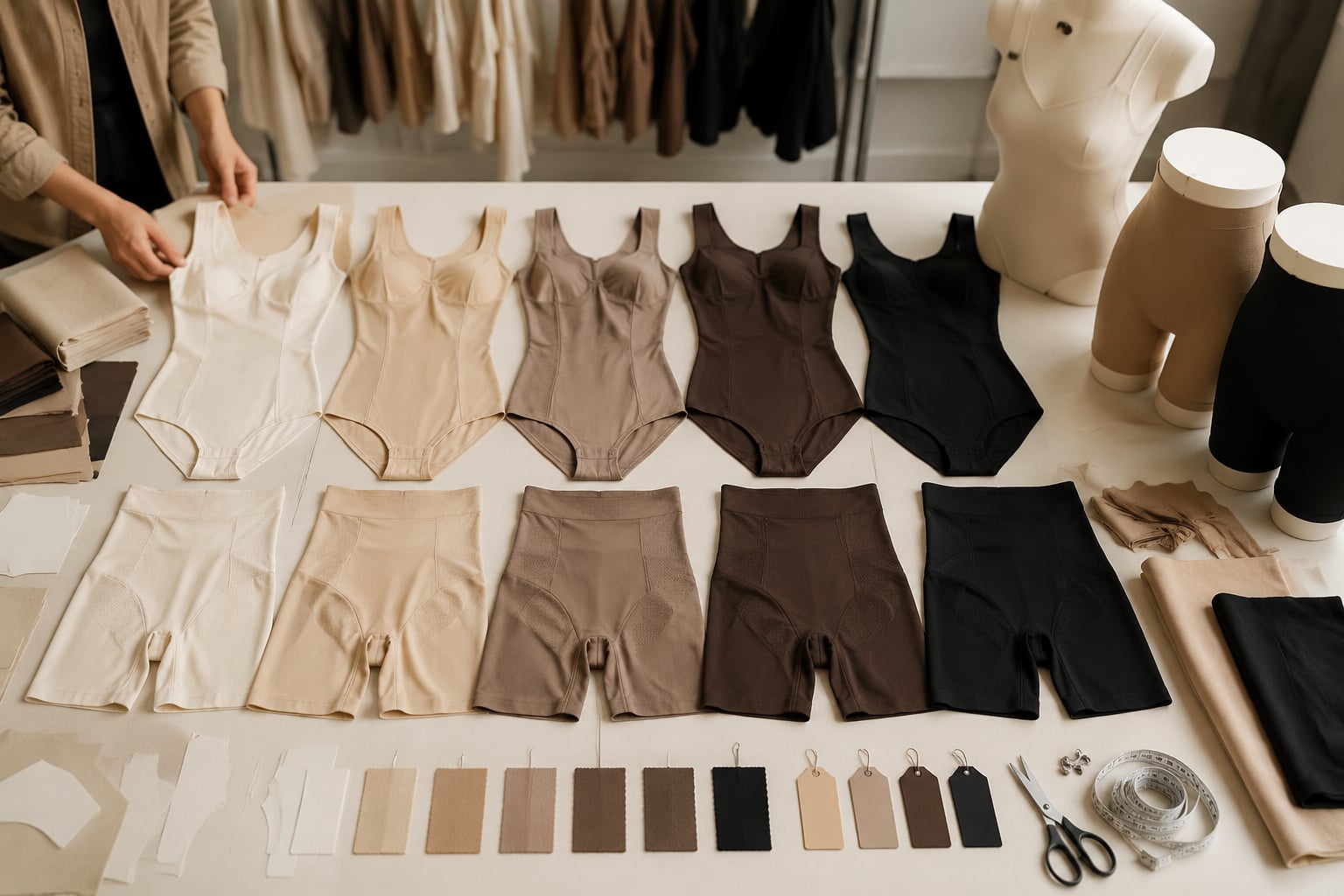
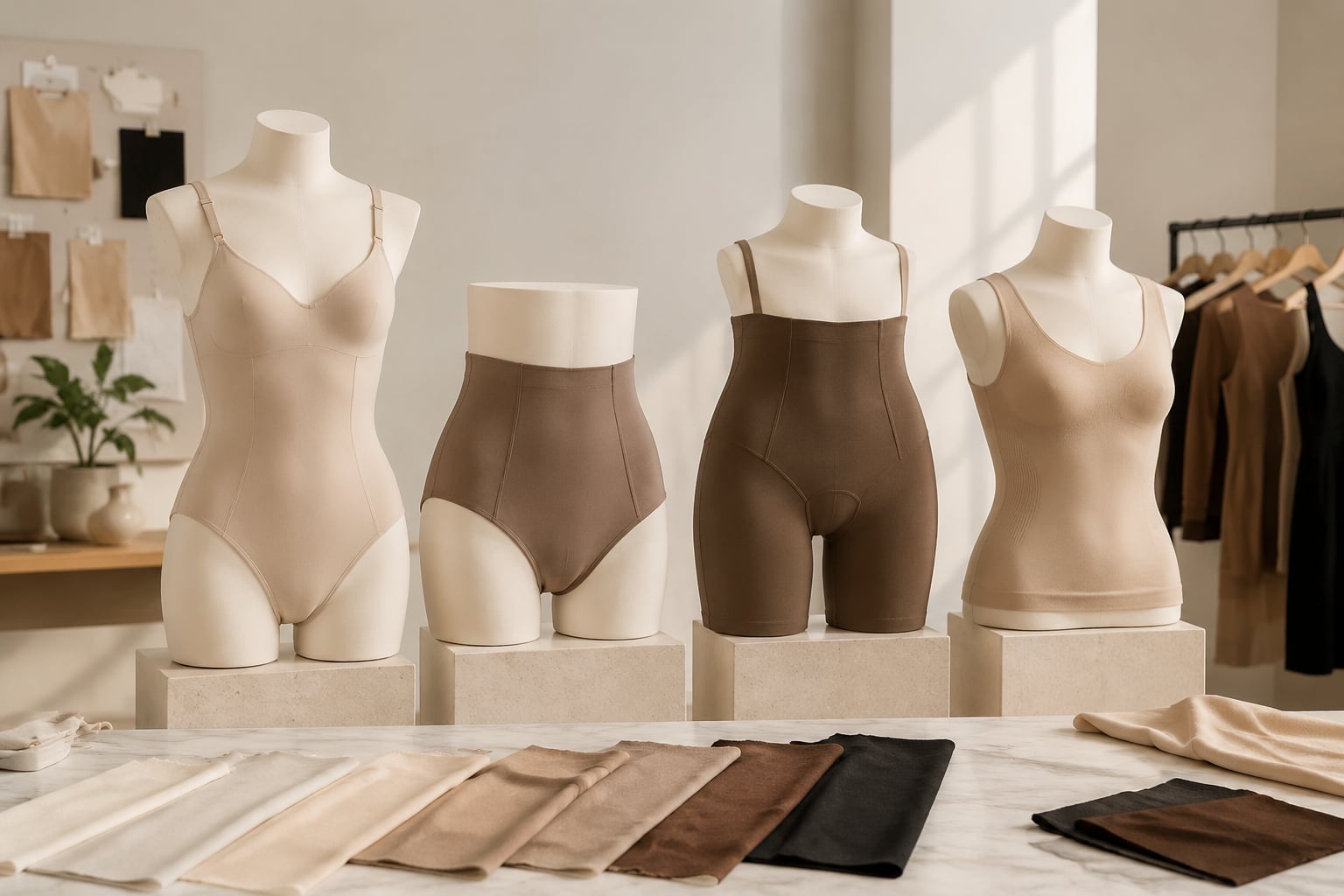
Quick answer: how do you plan your first shapewear collection?
To plan a first shapewear collection, begin with one clearly defined customer, one primary use case and a small number of products that solve it well. Most start-up ranges should be built around a hero product, supported by one complementary item and, where appropriate, a simple upsell rather than a large catalogue of untested styles.
Before requesting a quotation, define:
- target customer and selling market;
- intended use, such as everyday smoothing, occasionwear or post-partum support;
- compression level and fit objective;
- product type, fabric preferences and construction references;
- target size range and initial size curve;
- colours, packaging and labelling requirements;
- first-order quantity and expected repeat-order model;
- target launch date and delivery assumptions.
The commercial decision is not simply “how many styles can we launch?” It is “which minimum assortment gives us enough choice to test demand without tying up too much stock?” Each additional style, colour and size creates another stock-keeping unit (SKU), increasing inventory value and the risk of slow-moving stock.
This guide covers planning an OEM, ODM or private-label shapewear range for the UK market. General assortment principles are explained below; exact MOQ, construction, fabric composition, packaging, production schedule and landed cost must be confirmed for the individual project.
Choose a clear target customer and a specific use case
A first collection needs a sharper position than “shapewear for women”. That description is too broad to guide product development, sizing, content or purchasing.
Define the customer in terms that influence the product decision:
- preferred clothing sizes and body-shape considerations;
- typical outfits and occasions;
- desired level of shaping;
- tolerance for compression and restrictive construction;
- preferred price positioning;
- buying channel, such as direct-to-consumer, marketplace, boutique retail or wholesale;
- common objections, including rolling, visible seams, difficulty putting the garment on or discomfort when sitting.
Then select one primary use case. Examples include:
- everyday smoothing under workwear;
- a discreet base layer under dresses;
- firm shaping for special occasions;
- high-waisted support under trousers;
- a bodysuit designed to remain invisible beneath fitted clothing;
- a brief or short intended for light, regular wear.
A product can serve more than one use case, but the launch message should still be easy to understand. If the same garment is presented as light everyday control, firm occasion shaping and post-partum support, customers may struggle to know whether it is suitable for them.
For a broader view of how to organise a commercial range around different sales channels, see the guidance on shapewear solutions for brands and retailers.
Define a hero product, complementary product and upsell
A focused first collection commonly uses three roles:
| Product role | Purpose | Planning question |
|---|---|---|
| Hero product | The main reason customers visit and buy | Which single item best represents the brand’s promise? |
| Complementary product | Expands the use case without changing the brand direction | What second item solves a nearby problem? |
| Upsell | Increases basket value or improves the complete outfit | What add-on is easy to understand and stock? |
For example, a brand focused on smoothing under dresses might launch with a bodysuit as its hero product, a high-waisted brief as the complementary item and a second colour or matching bottom as the upsell. A brand focused on everyday comfort might choose a lighter-control short as its hero product and avoid introducing a firm-control bodysuit until customer feedback is available.
The hero product should receive the most attention during development:
- clear fit measurements;
- a defined compression objective;
- testing across the intended size range;
- careful review of leg openings, waistbands, gussets, straps and fastenings;
- photography and product education that explain how it should fit.
Do not treat an upsell as harmless just because it is a small addition. A second product still requires its own size curve, quality checks, packaging decisions and stock investment.
Separate compression levels and wearing occasions
Compression should be treated as a product decision, not just a marketing adjective. Terms such as “light”, “medium” and “firm” can be interpreted differently by customers and suppliers unless they are connected to a clear fit and use brief.
Before development, document:
- how easy the garment should be to put on;
- how long the intended wearer may use it at a time;
- whether it is designed for sitting, standing, events or everyday activities;
- the areas requiring shaping or support;
- where the garment must remain smooth and invisible;
- which fit problems would make the product unacceptable.
A first collection should normally avoid overlapping products with almost identical construction and compression. If two styles look similar online but feel nearly the same, the additional SKU may create choice without meaningful differentiation.
At the same time, do not assume that one compression level suits every customer. A firm-control style may appeal to occasionwear buyers but create more returns if shoppers expect all-day comfort. Product pages should describe the intended feel and fit accurately. Avoid implying medical, therapeutic or post-surgical benefits unless the product, claims and supporting documentation have been specifically assessed for that purpose.
Ask the supplier to explain how the proposed construction supports the intended control level. A useful response should distinguish between fabric stretch, recovery, panel construction, seams, boning, lining and garment dimensions rather than relying only on a label such as “high compression”.
Derive the size curve from the target market and test data
The initial size curve should reflect the customers you expect to serve, not an arbitrary equal split across sizes. UK shoppers may use familiar UK dress-size references, but these do not replace garment measurements. Size labels, body measurements and finished-garment measurements must be aligned before production.
Start with:
- the size range you intend to advertise;
- the body measurements associated with each size;
- expected demand by size from your sales channel;
- any existing customer or waitlist data;
- fit feedback from samples or wear testing;
- the cost and risk of extending the range later.
A useful size plan distinguishes between the range you want to offer and the quantity you buy initially. You may decide to display a broad size range while ordering a cautious first allocation in the sizes with the strongest evidence of demand. That decision should not result in excluding customers without considering the brand and customer-service implications.
Review the relationship between waist, hip, bust, torso length and height. Shapewear often fails when a customer’s measurements sit between standard size categories or when a one-dimensional size chart ignores garment length and body proportions.
For more detailed planning, use this UK shapewear size-planning guide. The URL is retained as the approved resource path, but the principles should be applied to the measurements and customer data relevant to your own market.
What to request in a fit review
For each development sample, record:
- wearer measurements and selected size;
- ease of putting on and taking off;
- waist and leg-opening comfort;
- rolling, cutting in or riding up;
- compression by body area;
- visibility beneath typical clothing;
- comfort after a realistic period of wear;
- whether the size chart would have led the wearer to choose correctly.
Do not use one successful sample on one body as evidence that the full size range is ready. A credible approval decision needs evidence across the intended sizes and body shapes.
Limit colours, materials and constructions deliberately
Every colour and material choice affects purchasing complexity. New brands often overestimate how much variety customers need and underestimate the stock value created by extra options.
For a first launch, consider:
- one core neutral suited to the target clothing wardrobe;
- one additional colour only if it has a clear commercial reason;
- one primary fabric platform where possible;
- a limited number of construction variations;
- packaging that can be used consistently across the initial range.
A neutral colour may be commercially practical, but its suitability depends on your audience, product positioning and intended clothing. The right choice should come from customer research and channel requirements rather than a generic assumption.
Material selection should cover both performance and communication. Confirm:
- fibre composition and permitted label wording;
- stretch and recovery expectations;
- opacity;
- moisture and comfort characteristics;
- colourfastness requirements;
- care instructions;
- seam and finishing compatibility;
- whether the fabric is suitable for the proposed compression and size range.
If you use a reference garment, describe what you want to retain and what must change. A reference can communicate silhouette and construction, but it does not automatically establish ownership, technical suitability or compliance for your product. Ask for a development specification or tech pack that records agreed measurements, tolerances, materials and construction details.
Optimise SKU count, MOQ and stock value together
SKU count, minimum order quantity (MOQ) and inventory risk must be considered as one decision. A collection with three styles, three colours and eight sizes already creates 72 potential SKUs before packaging or regional variants are considered.
Any published production starting point must be read alongside the allocation rules. A buyer should not assume that a project minimum automatically means one exact size-colour-style combination; the allocation and project definition need to be agreed in writing.
Use a simple stock-value model:
Initial stock value = units × unit cost + development and packaging costs + freight, duties and applicable taxes
The unit cost and commercial terms are project-specific. If importing into the UK, confirm which costs are included in the quotation and which may arise separately, such as freight, customs charges, duty or import VAT. This is general commercial guidance, not tax or customs advice; check current official guidance or use a qualified adviser for your arrangement.
Quote-input table for a first collection
Provide the following information when requesting a quotation:
| Quote input | What to specify | What the supplier should confirm |
|---|---|---|
| Product type | Bodysuit, brief, short, camisole or other | Proposed construction and development assumptions |
| Target customer | Use case, price position and sales channel | Any fit or construction implications |
| Size range | UK size references plus body measurements | Available grading and measurement requirements |
| Initial quantity | Total units and preferred allocation | MOQ basis and allocation by style, colour and size |
| Materials | Fibre preferences, hand feel and reference samples | Available materials, composition and substitutions |
| Colours | Core colours and colour references | Colour approval process and any minimums |
| Packaging | Bag, box, insert, labels and barcode needs | Packaging options, artwork files and extra charges |
| Branding | Logo placement, labels and trims | Private-label methods and artwork requirements |
| Quality requirements | Critical measurements and unacceptable defects | Inspection points, tolerances and sample approvals |
| Delivery | Required arrival window and destination | Production and shipping assumptions to verify |
A supplier response is more useful when it identifies assumptions and exclusions. Look for a clear breakdown of what is included, what remains subject to sample approval and which details could change the quotation.
A practical go/no-go gate
Move from development to a first production order only when:
- the hero product has a documented target use case;
- the measurement chart and grading have been reviewed;
- samples have been assessed on more than one body shape where possible;
- construction and material are approved;
- colours and packaging are specified;
- the size allocation is linked to evidence or a stated test assumption;
- the total landed-cost model has been reviewed;
- the expected sales route and replenishment plan are realistic;
- the quotation states the relevant MOQ and allocation assumptions.
If several of these points remain open, reduce the scope or continue development rather than compensating with a larger order.
Validate the collection with competitors, reviews and wear tests
Validation should test both customer desirability and operational risk. Competitor research is not a request to copy another range. It helps you identify how customers compare products and where your proposed collection needs clearer differentiation.
Review competing products for:
- product architecture and number of launch styles;
- size range and measurement presentation;
- compression language;
- colour selection;
- price positioning;
- packaging and claims;
- delivery and returns information;
- recurring review themes.
Customer reviews can reveal practical issues that studio images do not show. Look for repeated comments about rolling, gussets, straps, transparency, odour, washing, sizing and difficulty dressing. Treat reviews as directional evidence rather than proof that every customer will experience the same issue.
Wear testing should use a written feedback form. Ask testers to assess the garment under realistic clothing and movement, while recording their measurements and selected size. Separate comments about the product from comments about the size choice. This helps identify whether a problem requires a pattern change, a better size guide or clearer product instructions.
Also validate the commercial proposition:
- Can the product be explained in one sentence?
- Does the customer understand who it is for?
- Is the difference between the hero and complementary product obvious?
- Can customer service answer fit questions consistently?
- Are the expected returns and exchanges affordable?
- Can the range be replenished without carrying too many variants?
Set launch KPIs for replenishment and range expansion
Launch KPIs should help you decide what to reorder, what to adjust and what not to expand. Revenue alone is not enough, particularly when discounts or paid acquisition affect the result.
Track:
- sales by style, colour and size;
- conversion rate by product page;
- return and exchange rate;
- return reasons, especially fit-related reasons;
- customer-service questions before purchase;
- review themes and average feedback quality;
- stock cover and sell-through by SKU;
- gross margin after fulfilment and returns;
- repeat purchase or cross-sell behaviour;
- time required to replenish;
- percentage of stock tied up in slow-moving variants.
Set decision rules before launch. For example:
- reorder the hero product only after fit and return data are acceptable;
- adjust the size guide if repeated returns show size-selection confusion;
- revise the pattern if the same construction defect appears across sizes;
- add a colour only when demand is demonstrated or the commercial case is clear;
- delay a new style if existing inventory is not moving as planned.
Do not expand the range simply because one product sells well. A successful hero product may indicate that the use case is strong, not that customers want a completely different construction. First consider deeper stock in proven sizes, improved packaging, a new colour or a carefully related product.
FAQ: planning your first shapewear collection
How many products should a first shapewear collection include?
There is no universal number, but a focused launch usually needs fewer products than a mature brand. One hero product plus one complementary product can be sufficient if both have distinct roles. Add further styles only when they serve a different use case or provide clear commercial value.
What is the most important product to develop first?
Choose the product that most directly expresses your customer promise and has the strongest evidence of demand. It should also be practical to fit, explain, test and replenish. A complex product is not automatically a better hero product if its construction creates avoidable quality or returns risk.
How should I decide the first order quantity?
Work backwards from the number of units you can sell and replenish responsibly. Consider the number of SKUs, expected sales by size, cash available, storage, returns and the time needed for a second order. Then compare that requirement with the supplier’s MOQ structure. Do not treat the MOQ as the sales forecast.
Is 500 units enough for a first collection?
It depends on how the units are allocated across styles, colours and sizes and on your sales channels. Request the proposed breakdown rather than relying on a headline total alone.
Should I launch several colours?
Only when each colour has a clear customer or channel reason. A small colour selection can make the range easier to buy, photograph and replenish. Additional colours increase SKU count and may leave cash tied up in variants that sell more slowly.
How can I reduce shapewear returns?
Improve the product and the buying decision together. Use accurate body measurements, explain the intended compression, show how the garment fits, provide putting-on guidance and test the size chart with real users. Analyse return reasons by style and size so that pattern issues are not mistaken for customer error.
What should a private-label supplier confirm before production?
Request written confirmation of the approved construction, material composition, size measurements, tolerances, colour, branding, packaging, quantity allocation, inspection expectations, delivery assumptions and quotation exclusions. Any item described as “to be confirmed” should have an owner and approval point before bulk production.
What is the difference between OEM, ODM and private label?
The terms can vary between suppliers, so confirm the actual scope rather than relying on the label. In general, OEM projects are developed around buyer-specified requirements, ODM projects may adapt an existing or supplier-developed design, and private label usually concerns branding a product under the buyer’s brand. The quotation and development documents should state exactly what is being supplied.
How can a sourcing team prepare a better quotation request?
Send a concise product brief with the target market, product type, customer use case, size range, materials or reference garments, colours, branding, packaging, quantity allocation and delivery window. Include drawings, measurements or a tech pack where available, and list which points are fixed and which are open to supplier proposals.
Plan the next step around a defined brief
S-SHAPER UK can review a focused collection brief and advise whether each proposed item is better handled as private label, ODM or OEM. The quotation then confirms the final model, colour, size, packaging and commercial allocation for the project.
For a project-specific review, prepare the product type, target market, initial quantity, size range, material preferences or reference products, packaging requirements and delivery window. A clear brief allows the supplier to identify open decisions, confirm the applicable MOQ assumptions and prepare a quotation that can be assessed against your stock and launch plan. For broader ecommerce planning, you can also review shapewear solutions for ecommerce businesses.