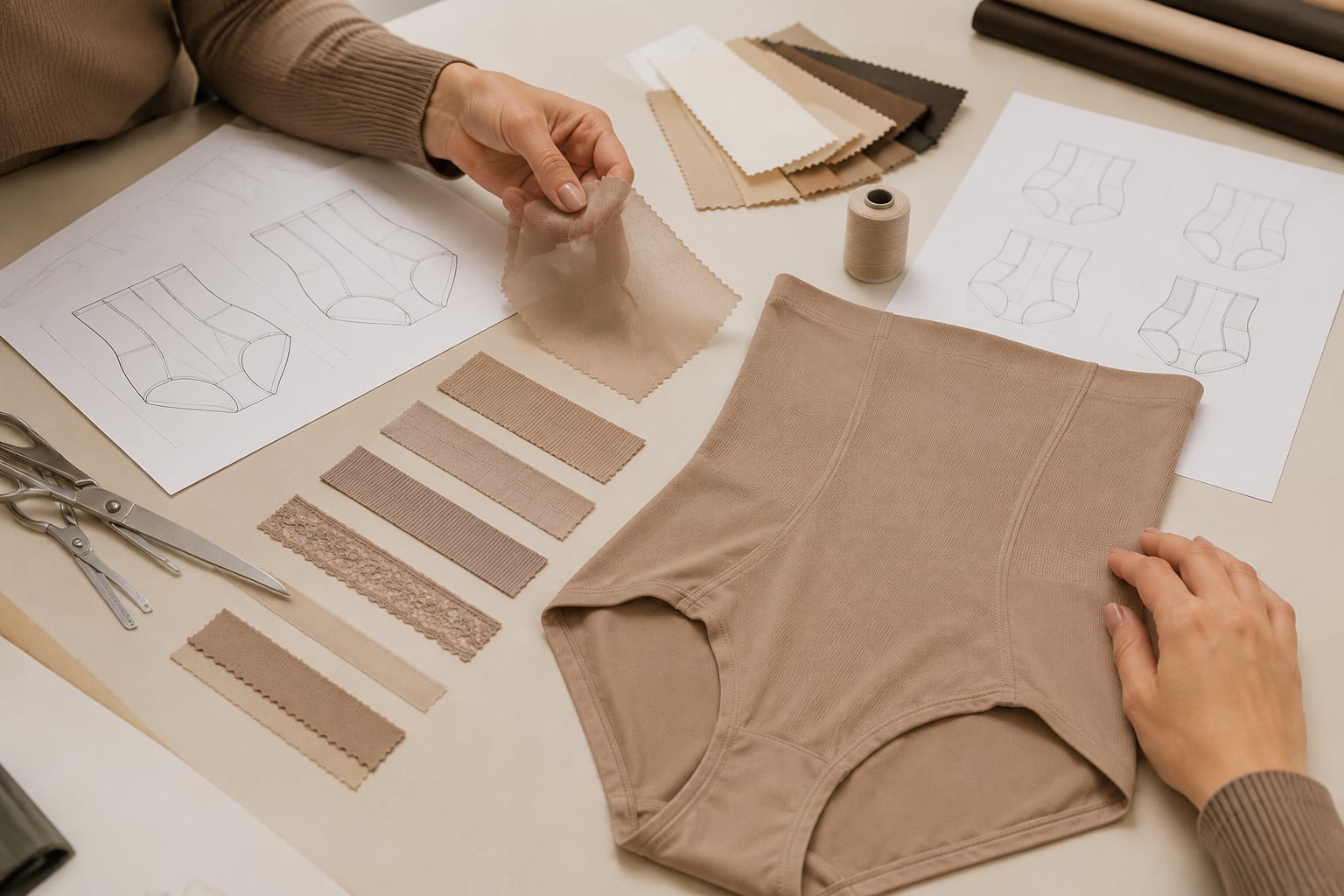
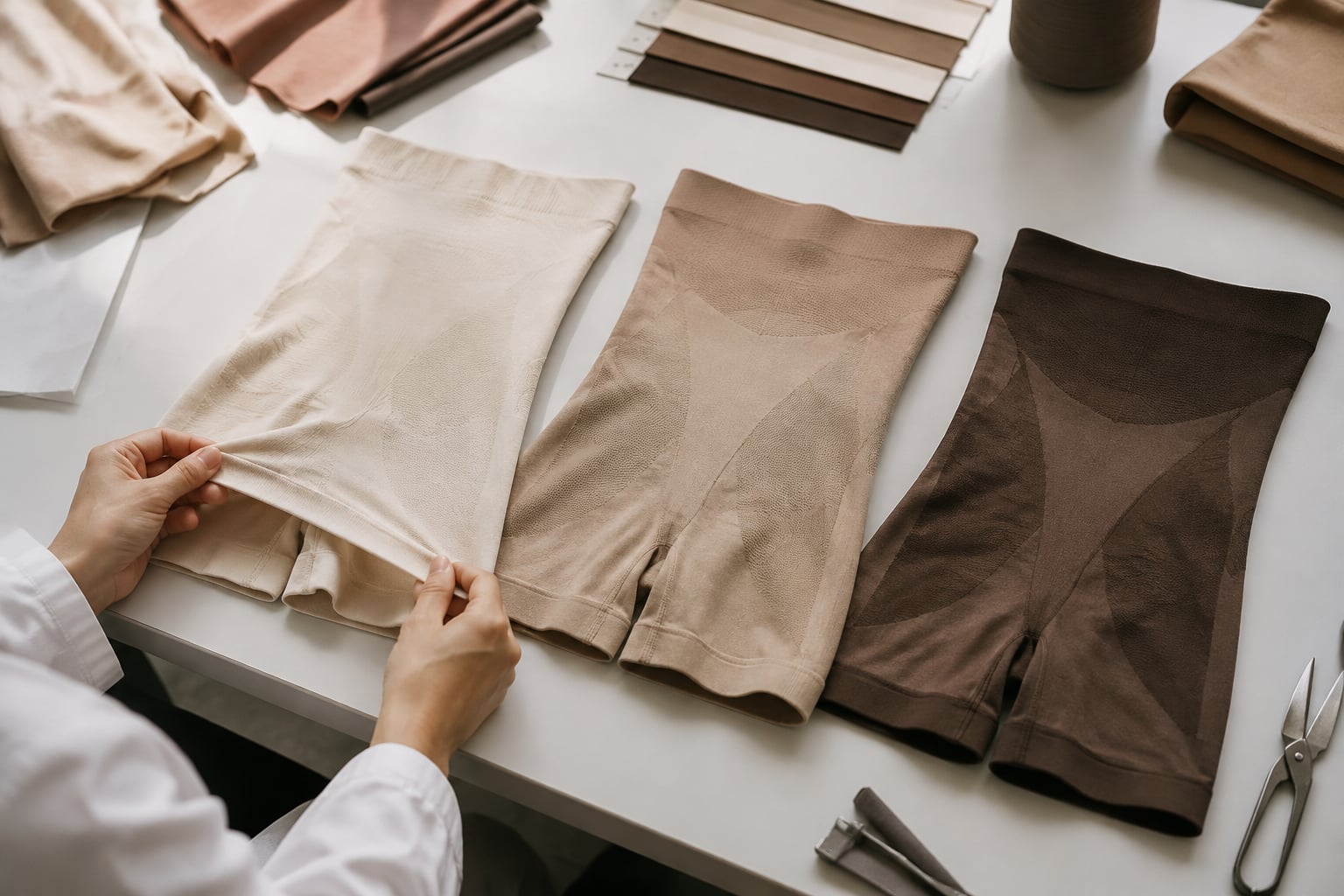
Shapewear compression levels should describe the perceived shaping support created by a specific garment—not promise a medical outcome. For most commercial shapewear ranges, the clearest approach is an internal scale such as light, medium, firm, and extra-firm shaping, supported by documented material, pattern, and fit criteria.
A reliable compression-level system helps product teams compare developments consistently, place products in the right category, and give retailers and consumers realistic expectations. It should account for the full garment system: fabric power, stretch recovery, panel placement, construction, sizing, and wear comfort.
Separate Shaping From Medical Compression
Shapewear and medical compression garments may both fit closely to the body, but they serve different purposes and must not be described interchangeably.
Commercial shapewear is generally designed to smooth, contour, support, or enhance the appearance of particular body areas under clothing. Its performance is usually communicated through terms such as:
- Light shaping
- Everyday smoothing
- Medium support
- Firm control
- Sculpting support
- Extra-firm shaping
Medical compression, by contrast, concerns garments designed for therapeutic or clinical purposes. Product claims in this area may require specific evidence, classification, testing, labelling, and regulatory review depending on the intended use and market. A garment should not be called “medical,” “therapeutic,” “circulation-improving,” “post-operative,” or similar unless the claim is properly substantiated and all relevant requirements have been assessed.
For German shapewear brands and retailers, the practical rule is straightforward: describe the garment experience and the intended styling function, not unverified effects on health.
Safer language for commercial shapewear
Use language that relates to fit and appearance:
- “Designed for smooth-looking coverage under fitted clothing”
- “Firm shaping through the waist and lower abdomen”
- “Targeted support for a more contoured silhouette”
- “High-rise construction for secure-feeling everyday wear”
- “Seamless knit structure for reduced show-through under clothing”
Avoid language that implies diagnosis, prevention, recovery, or treatment. “Support” can be appropriate in a fashion context when it refers clearly to garment hold or silhouette control, but the surrounding copy should not suggest a clinical benefit.
Identify the Variables That Affect Support
There is no single fabric number that defines shapewear compression levels. Two garments made from similar fibre blends can feel substantially different because construction and body coverage change how forces are distributed.
A practical product-development process considers the following variables together.
Fabric power and elongation
Power refers broadly to how strongly a fabric resists stretch and returns toward its original dimensions. High-power fabrics generally create more shaping force, but the final feeling depends on fabric weight, knit or weave structure, elastane content, finishing, and garment dimensions.
Useful development questions include:
- How much force is required to stretch the fabric at defined extension points?
- Does the fabric recover consistently after repeated stretch?
- Is the power equal in the lengthwise and crosswise directions?
- Does the fabric feel firm because of real support, or merely restrictive?
- Does the material remain comfortable over several hours of wear?
A dense fabric is not automatically a firm-shaping fabric. Likewise, a lightweight knit can deliver targeted control when its structure and pattern are engineered for it.
Pattern reduction and garment dimensions
Pattern reduction—sometimes called negative ease—is the difference between the body measurement and the garment measurement before the fabric stretches on the body. Greater reduction can increase body-hugging tension, but only within a workable range.
Too little reduction may cause rolling, sliding, or insufficient support. Too much can make a garment difficult to put on, uncomfortable at the waist, or prone to creating pressure marks. It may also lead to size-related returns if customers need to size up to achieve tolerable wear.
Compression should therefore be assessed on bodies or fit forms representing the intended size range, not only on a flat garment measurement.
Panel placement and zonal construction
Many shapewear products do not provide uniform support across the entire garment. A brief may call for a firmer abdominal panel, a smoother side seam area, a flexible bust zone, or a lighter seat construction.
Zonal shaping can improve comfort and fit when it is intentional. It also means a product’s overall compression label should not hide its specific shaping design. A “firm shaping” bodysuit may have firm abdominal control but lighter shaping at the thighs; a product page should make that distinction clear.
Common construction methods include:
- Double-layer panels
- Bonded reinforcement zones
- Power-mesh inserts
- Engineered circular-knit zones
- Directional knit structures
- Contoured seams and panel lines
- Elasticated waist, leg, or neckline finishes
Garment coverage and entry points
The same material can feel very different in a brief, high-waist short, bodysuit, thigh shaper, or full-body garment. More coverage can distribute tension over a wider area, while narrow hems and tight openings can concentrate it.
Evaluate:
- Waistband width and stability
- Leg opening tension
- Gusset design and comfort
- Strap adjustability
- Bust construction and cup compatibility
- Closure placement and usability
- The likelihood of rolling at the waist or thighs
- Whether seams show through typical outerwear
For a broader view of materials, knitted structures, and construction choices, explore shapewear technology and innovation.
Size grading and body diversity
A compression category is only meaningful when it remains reasonably consistent across the size range. Grading a pattern upward without reviewing tension distribution can create a garment that feels medium-support in one size and much firmer—or weaker—in another.
Fit evaluation should include multiple relevant sizes and body proportions. Teams should pay particular attention to areas where fit issues commonly occur:
- Waist rolling on shorter torsos
- Leg-band digging on fuller thighs
- Strap pressure on longer torsos
- Bust displacement in integrated bodysuits
- Excess fabric or reduced shaping on smaller frames
- Difficulty entering the garment in larger sizes
Create a Consistent Internal Scale
A named scale gives merchandising, development, quality, and marketing teams a shared vocabulary. The labels themselves can vary, but the criteria behind them must be documented.
A four-level framework is often detailed enough for a commercial shapewear range:
| Internal level | Consumer-facing description | Typical garment purpose | Key expectation |
|---|---|---|---|
| Level 1 | Light shaping | Smoothing briefs, camisoles, lightweight slips | Gentle smoothing with easy all-day wear |
| Level 2 | Medium shaping | Everyday shorts, shaping bodysuits, waist briefs | Noticeable contouring with balanced comfort |
| Level 3 | Firm shaping | High-waist shorts, targeted bodysuits, sculpting pieces | Stronger hold and visible silhouette control |
| Level 4 | Extra-firm shaping | Occasion-focused or highly structured styles | Maximum non-medical shaping within the defined range |
This is an internal commercial scale, not an industry-wide or medical classification. A “firm” garment from one brand may differ from another brand’s “firm” garment. Consistency within one collection is more valuable than implying universal comparability.
Define each level with measurable and wearable criteria
Do not define levels only by marketing wording. Each level should have a technical profile that development teams can apply consistently.
For every level, document:
-
Fabric requirements
Approved fabric families, target weight range where applicable, stretch direction, recovery expectations, and permitted reinforcements. -
Pattern approach
Expected degree of reduction, critical circumference measurements, length tolerances, and grading considerations. -
Construction options
Allowed panel types, bonding methods, seam configurations, waistband structures, and edge finishes. -
Wear-performance expectations
Desired ease of dressing, targeted body zones, acceptable movement restriction, and intended duration of wear. -
Fit boundaries
Conditions that would move a style into another category, such as a reinforced abdomen panel or a significantly tighter leg opening.
A product can be assigned a preliminary level during concept development, but its final classification should follow fit and wear evaluation of production-representative samples.
Avoid false precision
It can be tempting to assign a universal number, such as a pressure figure, to each shaping level. That approach can be misleading unless the team has an appropriate, repeatable testing method and understands its limitations.
Pressure varies across the body and changes with body shape, movement, garment position, size, and time worn. A single test result at one location does not represent the entire user experience. Unless a validated programme supports such figures, clear qualitative categories are typically safer and more useful for commercial shapewear.
Match the Scale to Product Categories
Compression labels should be relevant to the product category. A light-shaping slip and a firm-shaping waist brief should not be judged by identical construction expectations, because their coverage, use case, and fitting challenges differ.
| Product category | Suitable shaping range | Development focus |
|---|---|---|
| Shaping briefs | Light to firm | Waist stability, gusset comfort, rear coverage, no visible panty lines where required |
| High-waist shorts | Medium to extra-firm | Abdomen control, thigh-edge comfort, anti-roll performance, ease of dressing |
| Bodysuits | Light to firm | Torso length, bust accommodation, strap support, closure usability, zonal shaping |
| Camisoles and tanks | Light to medium | Smooth layering, hem stability, bust compatibility, comfort during sitting |
| Slips and dresses | Light to medium | Smooth drape, static control, neckline and hem positioning, outerwear compatibility |
| Waist shapers | Medium to extra-firm | Waistband security, targeted abdomen support, torso-length options, rolling resistance |
| Leggings or shaping tights | Light to firm | Opacity, knee recovery, waistband hold, movement comfort, consistent leg tension |
The category also influences how a brand should present the garment online. For example, a high-waist short described as firm shaping should identify its abdominal and thigh focus. A bodysuit described as medium shaping should clarify whether the shaping is concentrated at the waist, tummy, back, or all over.
Define Sample Evaluation Criteria
A repeatable sample review prevents compression labels from being assigned based on hand feel alone. Fabric hand is important, but a garment must be assessed when worn, moving, and layered under intended clothing.
Use a structured evaluation sheet for development samples, size-set samples, and pre-production samples.
Core fit and comfort checks
Assess the garment while standing, sitting, walking, bending, and raising the arms where relevant. Record both pass/fail findings and qualitative comments.
Key criteria include:
- Ease of putting on and taking off
- Waistband or upper-edge rolling
- Leg-edge rolling, pinching, or riding up
- Localised discomfort at seams, labels, closures, straps, or bonded areas
- Abdominal, waist, hip, thigh, or back smoothing in intended zones
- Bust fit and containment for bodysuits or tops
- Garment migration during normal movement
- Ability to sit and bend without excessive restriction
- Visibility under representative outerwear
- Fabric recovery after wear and laundering
- Consistency with the intended compression level
Use comparative reviews, not isolated judgments
A sample is easier to classify when compared with approved reference products from the same internal scale. Keep a physical or digital reference library that includes:
- Approved sample specifications
- Fabric and trim details
- Pattern measurements
- Construction notes
- Fit comments
- Intended shaping level
- Approved consumer-facing wording
When a new garment is reviewed next to established references, teams can identify whether its support is genuinely medium rather than simply “firmer than the last sample.”
Include wash and wear effects
Some shapewear materials change after laundering or extended wear. Recovery may improve, remain stable, or diminish; bonded areas and elastic finishes may also behave differently over time.
The evaluation plan should include the intended care process and repeat-wear checks appropriate to the product. If the support sensation changes materially after care, the compression classification and product claims may need review.
Document Material and Construction Changes
A style’s shaping level should be re-confirmed whenever a change could affect fit, tension, comfort, or recovery. Treating a material substitution as a purely commercial change is a common mistake.
Changes that can alter shapewear compression include:
- Switching the base fabric or yarn composition
- Changing fabric weight, knit density, or finishing
- Replacing elastics, power mesh, or bonding film
- Adjusting pattern measurements or grading rules
- Moving or resizing a reinforcement panel
- Changing seam type, seam allowance, or stitch construction
- Altering waistband width or leg-opening finish
- Changing a supplier’s production process
Maintain a change-control record that states the original specification, the proposed revision, reason for change, sample comparison result, and whether the shapewear compression level remains valid.
This documentation is useful for quality management as well as product continuity. A disciplined shapewear quality-assurance process can help teams connect incoming material checks, fit approvals, and finished-garment inspections.
Write Clear Customer-Facing Language
Customer-facing descriptions should explain what the garment is likely to feel like and where it is designed to shape. A compression label alone is too vague, particularly for online buyers who cannot touch or try on the product before purchase.
A useful product-page formula
Combine the level, area, use case, and fit guidance:
Firm shaping: designed to smooth and contour the waist, lower abdomen, and thighs under close-fitting outfits. The high-rise design provides a secure feel; consult the size guide for the intended fit.
For a lighter style:
Light shaping: provides gentle smoothing under everyday clothing with a flexible, less restrictive feel.
This language helps customers self-select while avoiding promises that the garment cannot reliably deliver for every body type.
Explain the trade-off honestly
Stronger shaping often involves more effort to put on and a closer feel during wear. Clear copy can reduce avoidable returns:
- Light shaping: easiest to layer and wear for longer periods
- Medium shaping: balanced smoothing and support
- Firm shaping: more contouring with a closer, more structured feel
- Extra-firm shaping: strongest commercial shaping option; correct sizing and careful dressing are especially important
Do not imply that extra-firm is automatically “better.” The best level depends on the customer’s outfit, body area of focus, comfort preference, and intended wear duration.
Provide practical fit guidance
A size guide should be specific to the style and use current garment specifications. Encourage customers to use body measurements rather than choosing a smaller size in pursuit of stronger control.
Helpful guidance may include:
- Measure the relevant body areas shown in the size chart.
- Select the recommended size for the intended shaping performance.
- Do not size down for additional shaping; this can reduce comfort and affect fit.
- Put firm garments on gradually, distributing the fabric evenly rather than pulling only from the waistband.
- Consider torso length and bust fit for bodysuits and full-body styles.
For product teams building a collection, reviewing available shapewear product categories can help align support labels with the garment’s primary function.
Confirm Claims Before Launch
Before a product launches, review every claim across packaging, product pages, marketplace listings, wholesale materials, and social content. The compression label, product description, and imagery should all describe the same intended experience.
A practical pre-launch check should confirm:
- The final approved sample matches the stated shaping level.
- The size guide reflects final measurements and grading.
- Product copy identifies the main shaping zones.
- Claims remain focused on fit, appearance, and garment function.
- Medical or therapeutic implications have not been introduced through wording, imagery, or customer-service scripts.
- Care instructions match the tested garment construction.
- Retail and wholesale partners receive the approved terminology.
- Any substantiation needed for specific performance claims has been reviewed before publication.
Common mistakes to avoid
Using “compression” without context.
The word can imply different things to different buyers. Pair it with a clear shaping level and zone description.
Classifying by fabric composition alone.
Elastane percentage does not determine final support. Pattern, construction, and fit are equally important.
Treating all sizes as identical in performance.
Review multiple sizes and body proportions before finalising the category.
Calling a garment firm because it is difficult to put on.
Dressing difficulty may indicate poor balance, unsuitable dimensions, or uncomfortable finishing rather than effective shaping.
Changing materials after approval without retesting.
Even similar-looking substitutes can alter recovery, tension, opacity, and comfort.
Making medical-sounding promises to make shaping sound stronger.
Clear, credible fashion-performance language is more sustainable than unsupported health claims.
FAQ
What are the usual shapewear compression levels?
Commercial shapewear commonly uses light, medium, firm, and extra-firm shaping. These are brand-defined retail categories rather than universal technical or medical grades, so each brand should document what every level means internally.
Is firm shaping the same as medical compression?
No. Firm shaping describes a commercial garment’s contouring and support feel. Medical compression is associated with therapeutic intent and may involve different product requirements, evidence, and regulatory considerations.
Should customers size down for stronger shaping?
Generally, no. Shapewear should be purchased according to the style-specific size guide. Sizing down can cause excessive discomfort, rolling, poor coverage, garment damage, or a less flattering result.
How can a brand make compression descriptions more consistent?
Create a documented internal scale, use approved comparison samples, evaluate garments on relevant body types and sizes, and re-test the classification whenever materials, patterns, or construction methods change.
Can one garment have different shaping levels in different areas?
Yes. Zonal construction can create firmer support at the abdomen or waist and lighter support at the bust, seat, or thighs. Product descriptions should identify these zones instead of relying only on one overall label.
A clear shapewear compression framework starts with honest commercial language, repeatable sample evaluation, and controlled product specifications. For OEM, ODM, or private-label development, S-SHAPER can support teams from product development through scalable series production while helping translate a defined shaping brief into documented garment requirements.