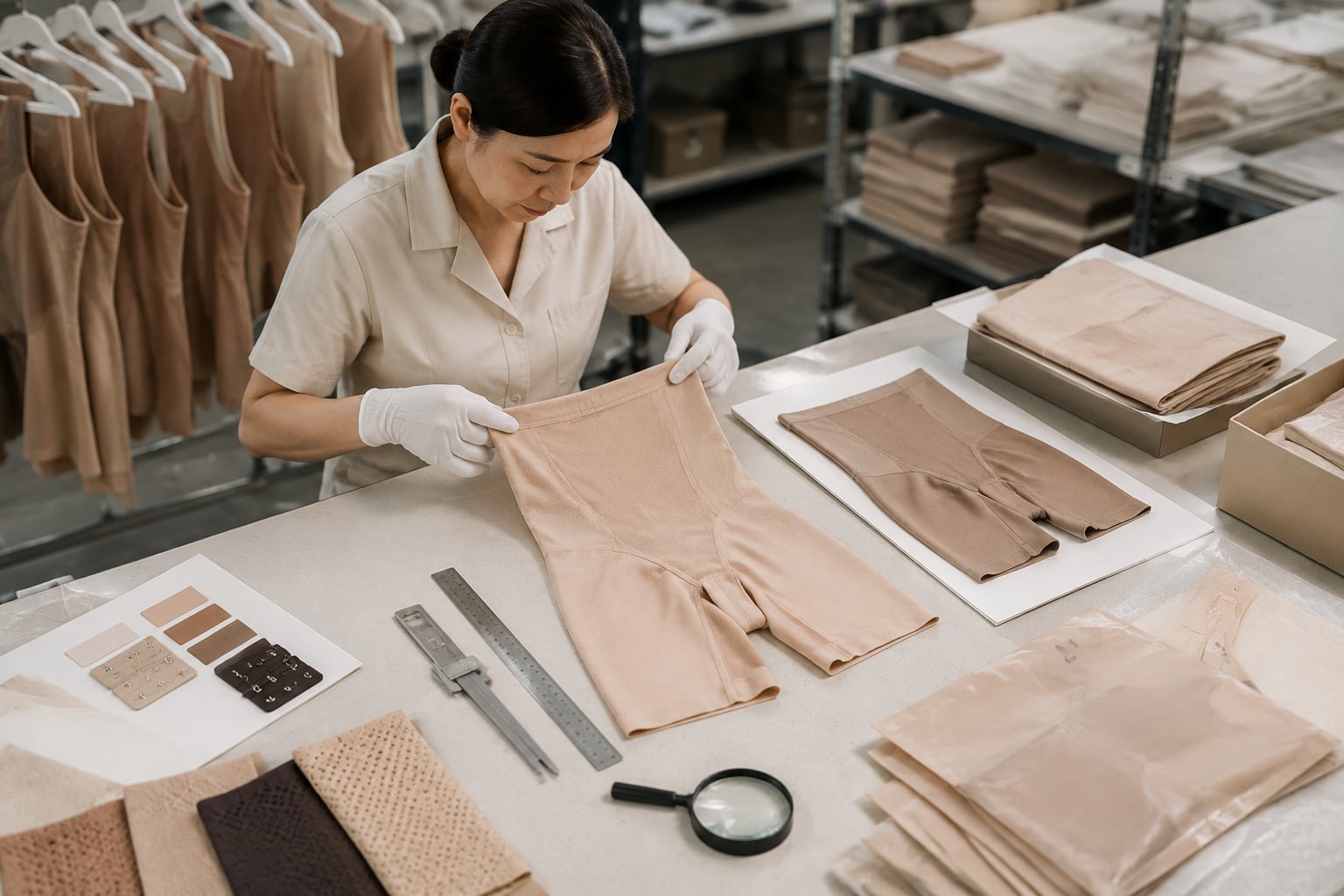

A shapewear supplier audit should establish whether a prospective factory can repeatedly make your product to the agreed fit, compression, finish and delivery requirements—not simply whether it can show an attractive sample. The most useful audit combines site evidence, document checks, product-specific questions and a scored corrective-action plan.
For OEM, ODM and private-label buyers, focus on eight areas: legal identity and scope, suitable machinery, material traceability, sample control, in-process quality, records, communication and commercial risk. Ask to see evidence as you go. A verbal “yes” is not the same as a controlled process.
Verify Company Identity and Production Scope
Start by confirming who will contract with you, who will actually make the goods, and what operations are performed at each location. This prevents a common sourcing problem: auditing a showroom, trading company or sample room while bulk production is completed elsewhere.
Request and compare:
- The registered company name, registered address and trading name
- The manufacturing site address or addresses
- The name and role of the person responsible for production and quality
- A current product range and examples of comparable shapewear
- A process map showing cutting, sewing, bonding, printing, finishing, packing and dispatch
- The normal and peak production arrangements, including any overflow plans
- A list of subcontracted processes and the suppliers used for them
Be precise about the proposed product category. “Shapewear” covers constructions with very different manufacturing demands. A factory experienced in simple seamless briefs may not be set up for a boned bodysuit, postpartum support garment, hook-and-eye waist trainer, adhesive bra or bonded high-compression short.
Ask the supplier to identify products that are genuinely comparable by:
- Compression level and stretch recovery requirements
- Fabric composition and weight
- Number of panels and seam types
- Use of power mesh, lace, silicone, foam, boning or rigid hardware
- Closure type, gusset construction and edge finish
- Sizing complexity and fit-critical zones
A supplier that clearly defines its production boundary is usually easier to manage than one that claims to make every type of garment without showing how.
For an overview of the manufacturing stages worth validating, review the supplier’s shapewear factory capabilities alongside your own process requirements.
Audit warning signs
Treat the following as issues to investigate, rather than automatic rejection points:
- The business name on quotations differs from the proposed contract party.
- The supplier will not disclose production addresses or subcontractors.
- Sample development is presented as in-house, but no comparable bulk production can be shown.
- Staff give inconsistent answers about capacity, lead times or responsibility.
- “OEM” is used to describe a catalogue product with only a label change available.
Match Equipment to Product Construction
Equipment should match the garment’s construction, not merely exist on a factory list. During a shapewear factory audit, follow the proposed product route from fabric inspection to packed garment and identify the machine, operator skill and inspection point needed at every critical stage.
For example, a high-waisted shaping short may require controlled fabric spreading and cutting, appropriate stretch-stitch machines, specialist attachment methods for elastic and waistbands, reliable gusset construction, flat or low-profile seams, and finishing equipment that avoids damaging delicate knit fabrics.
Use the audit to ask: Can this machine produce the specified result consistently at bulk speed?
| Product feature | Capability to verify | What to inspect or ask |
|---|---|---|
| High-stretch knit fabric | Fabric handling, cutting accuracy and tension control | How fabric is relaxed, laid and cut; how cut-panel distortion is prevented |
| Flat, low-profile seams | Appropriate seam machinery and operator competence | Sample seam appearance, extension under stretch and seam recovery |
| Bonded edges or panels | Bonding equipment and controlled parameters | Bond width, peel performance criteria, wash validation and rework controls |
| Silicone grip strips | Application process and curing or handling control | Placement consistency, adhesion checks and contamination prevention |
| Hook-and-eye closures | Attachment equipment and secure stitching method | Alignment, pull resistance criteria and smoothness against the body |
| Boning or support structures | Safe insertion, channel construction and end finishing | Sharp-edge prevention, movement after wear and wash, end-securement |
| Printed branding or care marks | Print process and colour control | Legibility after stretching and washing, placement tolerance and artwork approval |
Do not assume a machine determines quality on its own. Operator training, machine maintenance, correct thread or adhesive selection, calibrated settings and line-level checks matter equally.
Where a supplier uses seamless knitting, clarify whether it owns or operates the relevant knitting capability, whether styles are programmed internally, and how yarn, knit density and size grading are controlled. Where garments are cut-and-sewn, inspect how pattern revisions reach the cutting room and sewing lines.
Confirm practical limits early
Every production method has limits. Ask the supplier to state, in writing where possible:
- Minimum and maximum workable fabric weights and stretch ranges
- Construction features it does not recommend
- Likely risks with your proposed fabric, trim or finish
- Tolerances it can realistically control for measurements and placement
- Which details require additional sampling or wear testing
- Whether a requested feature changes the order quantity, cost, sampling route or production sequence
A credible supplier should be able to explain technical trade-offs. For instance, more compression can affect ease of dressing, seam stress, fit across sizes and customer comfort. A supplier that flags these issues early may be a lower risk than one that agrees to every request.
Trace Material and Subcontractor Controls
Shapewear performance depends heavily on the consistency of fabrics, elastics, trims and finishes. The audit should trace these components from approved specification to receiving, storage, issue to production and finished-garment records.
Ask to see how the supplier controls:
- Fabric supplier approval and purchase specifications
- Fabric composition, colour, width, weight and stretch verification
- Batch or lot identification on rolls and cut parts
- Incoming inspection and disposition of failed material
- Storage conditions for fabrics, elastics, adhesives and silicone components
- Segregation of approved, unapproved and rejected materials
- Trim approval for labels, hooks, lace, boning, packaging and hangtags
- Subcontracted dyeing, printing, bonding, embroidery, washing or packing
The point is traceability, not paperwork for its own sake. If a customer reports waistband degradation, colour variation or a faulty closure, the supplier should be able to identify the affected production lot and associated material batch.
Treat subcontracting as a managed risk
Subcontracting is not inherently a problem. Specialist processes can be sensible and commercially necessary. Risk arises when subcontracting is undisclosed or lacks controls.
For each outsourced process, establish:
- What is sent out and why.
- Which named party performs the work.
- How specifications and approved samples are communicated.
- Who performs quality checks before and after the process.
- How goods are labelled and tracked while off site.
- What happens if an external processor misses quality or delivery requirements.
If your product relies on a subcontracted process, include it in your sampling, testing and approval plan. Do not restrict the audit to the final assembly site.
Review Sampling and Change Management
A bulk order should be built from a controlled, approved version of the product. The audit must reveal how a supplier turns a concept, tech pack or reference sample into repeatable production instructions.
Check the route from development sample to pre-production sample. It should normally establish a clear record of approved details, including:
- Tech pack revision, pattern version and grading rules
- Bill of materials and approved component specifications
- Colour and trim standards
- Construction sequence and seam or stitch requirements
- Measurement chart and permissible tolerances
- Branding artwork, label content and placement
- Packaging specification
- Approved sample reference and date
- Required test or wear-review outcomes, where applicable
The most important control is change management. Changes happen: a fabric becomes unavailable, a label is corrected, a pattern is adjusted, or a buyer changes packaging. The supplier should have a method to assess and approve changes before they reach bulk production.
Ask who can authorise a change, how it is recorded, how affected teams are notified, and whether new samples are required. A casual message in a chat group is not a sufficient change-control system for fit-critical products.
Common sampling mistakes
Avoid these frequent errors:
- Approving a sample without marking the exact revision or retaining a reference.
- Assuming one size represents all graded sizes.
- Reviewing fit only on a mannequin rather than considering wear, movement and recovery.
- Approving colour from a screen image instead of an agreed physical standard where colour is important.
- Allowing substitutions of elastics, lining or closures without written approval.
- Treating a photoshoot sample as proof of bulk manufacturability.
A pre-production sample should reflect the intended bulk materials, construction and branding as closely as feasible. Where a material or component will differ in bulk, identify that difference and assess its likely effect before releasing production.
Inspect In-Process and Final Quality Systems
Final inspection alone cannot reliably correct defects created earlier in the line. The stronger approach is to identify quality-critical points throughout cutting, sewing, finishing and packing, then verify that checks happen at the right time.
For shapewear, inspect controls around the issues most likely to affect fit, comfort and durability:
- Incorrect fabric orientation or panel mix-up
- Uneven compression between left and right sides
- Skipped stitches, broken threads or seam puckering
- Uneven elastic tension and twisted waistbands
- Misaligned gussets, closures, labels or silicone strips
- Rough seam ends, exposed boning or uncomfortable hardware
- Stains, oil marks, holes, snags and contamination
- Measurement variation beyond the agreed tolerance
- Incorrect size, colour, barcode, label or packaging combination
Ask to see the inspection plan used for your product type, not a generic quality poster. It should state what is checked, when, by whom, against which standard and what happens when a defect is found.
Review defect handling, not just inspection
A meaningful audit follows a failed item through the system. Check whether the factory:
- Separates rejected or suspect goods from approved goods
- Records defect type, quantity, production line and date
- Re-inspects after repairs or rework
- Identifies recurring defects and investigates root causes
- Makes corrective actions visible to production teams
- Confirms whether the action actually reduced recurrence
Request examples of internal quality records with commercially sensitive details removed if necessary. You are looking for evidence that findings become actions, not simply that checks are recorded.
Agree the final inspection method in the purchase agreement or quality manual. Define the sampling method, defect classification, acceptance criteria, measurement process, pack-out checks and whether inspection occurs before shipment. If you use an independent inspection partner, ensure its criteria match the supplier’s internal standards so disputes do not arise from two different definitions of “acceptable”.
For a useful benchmark of the sort of controls to discuss, see quality assurance for shapewear production.
Check Documentation Claims and Records
Documents are useful only when they are current, relevant and connected to actual practice. During the audit, compare records with what you can see on the production floor and what staff explain.
Review, where relevant to your product and target market:
- Company registration and contractual details
- Quality procedures and inspection records
- Material specifications and supplier records
- Product specifications, measurement charts and pattern controls
- Training and machine-maintenance records
- Calibration or verification records for measurement equipment
- Batch, lot and dispatch traceability records
- Test reports or declarations provided for specific materials or finished goods
- Documentation needed for labelling, packaging or market-entry requirements
Do not accept a certificate, report or logo as proof that every product is compliant. Check its scope, issuing body, date, product or material covered, site named and expiry or renewal status. Most importantly, determine whether it applies to the components and construction you plan to buy.
For the UK market, buyers should independently confirm the product safety, fibre-content labelling, chemical, packaging, customs and consumer-information obligations that apply to their specific product and route to market. A supplier can provide supporting information, but the importer, brand owner or retailer may retain responsibilities that cannot be delegated simply by asking for a document.
Evaluate Communication Capacity and Risk
A technically capable manufacturer can still be difficult to work with if communication, ownership and escalation are weak. Assess the supplier’s ability to manage your project after the audit, especially when specifications change or quality concerns emerge.
Evaluate:
- Whether there is a named account contact, merchandiser, developer and quality contact
- Their understanding of your technical questions and written specifications
- The clarity and completeness of written replies
- The process for sharing sample comments, approvals and production updates
- The escalation route for delays, material issues and non-conformities
- The working language used for technical documents
- The supplier’s approach to intellectual property, patterns, artwork and customer data
- Payment terms, pricing validity, minimum order quantities and freight responsibilities
- Its contingency arrangements for supply interruptions
Communication quality can be tested before you place an order. Send a structured technical query with a few deliberate points requiring clarification. A strong response identifies missing information, flags risks and assigns responsibility. A weak response simply confirms every request without discussing feasibility.
Assess commercial fit separately from factory competence
An audit may show that a supplier can make the garment but is still not a good commercial fit. Consider whether it suits your:
- Order volumes and seasonal demand profile
- Product-development pace
- Required level of customisation
- Quality expectations and inspection model
- Payment and currency arrangements
- Packaging, labelling and fulfilment needs
- Ability to manage replenishment or size-ratio changes
Do not force a supplier into a project that falls outside its preferred operating model. A mismatch often becomes visible later as slow development, avoidable minimum-order disputes or inconsistent support.
Score Findings and Define Corrective Actions
A practical shapewear supplier audit checklist needs a scoring method so decisions are based on evidence rather than the overall impression of a site visit. Score each area, weight the issues that matter most to your product, and distinguish between fixable gaps and unacceptable risks.
A simple four-point approach works well:
| Score | Meaning | Buyer response |
|---|---|---|
| 3 | Controlled and evidenced | Accept, with normal ongoing monitoring |
| 2 | Generally workable, with minor gaps | Request an action owner and completion date |
| 1 | Significant weakness or inconsistent evidence | Require corrective action and verify before bulk approval |
| 0 | No evidence, undisclosed practice or unacceptable risk | Pause, reject or escalate before proceeding |
Weight the categories according to the project. For a bonded, high-compression body shaper, material control, bonding validation and fit management may deserve greater weighting than simple packaging capability. For a retailer with strict traceability requirements, subcontractor disclosure and records may carry more weight.
Your audit report should include:
- The audited legal entity and production sites
- Date, attendees and products reviewed
- Evidence observed and documents checked
- Findings classified by severity
- A score for each audit area
- Required corrective actions
- A named responsible person for each action
- Target completion date
- Verification method and decision gate
- Any open commercial assumptions or exclusions
Define non-negotiables before the visit
Set your red lines in advance. Examples may include undisclosed subcontracting, inability to trace materials, refusal to provide product-relevant records, lack of control over approved specifications, or failure to separate rejected goods. Your own thresholds will depend on product risk, brand position and route to market.
Be careful not to confuse a tidy factory with a capable quality system. Equally, a supplier should not be rejected solely because an administrative document needs improvement if the underlying process is controlled and it can correct the gap promptly. The key question is whether the supplier understands the issue, owns the remedy and can demonstrate sustainable improvement.
A practical next step for OEM buyers
Turn this checklist into a product-specific audit form before supplier meetings. Attach your draft tech pack, construction drawings, measurement chart, material requirements and proposed inspection criteria, then ask each supplier to respond against the same questions.
If you are comparing OEM, ODM and private-label routes, clarify development ownership, customisation limits and approval stages at the outset. S-SHAPER supports OEM, ODM and private-label shapewear projects from product development through scalable series production; its OEM and ODM shapewear options provide a relevant starting point for framing those discussions.