
A strong shapewear RFQ template gives every supplier the same technical and commercial brief. It should describe the product, target customer, materials, measurements, order quantities, quality expectations, branding and delivery terms clearly enough that a factory does not need to make costly assumptions.
The aim is not simply to get a unit price. It is to receive quotations that can be compared on a like-for-like basis, identify open questions early and establish whether a supplier can meet your product requirements. Use the template below for OEM, ODM or private-label shapewear enquiries, adapting it for each product category.
State the Product Scope and Target Market
Start every shapewear request for quotation with a concise product summary. Suppliers need to understand what they are being asked to develop or manufacture before they can recommend construction, fabrics, machinery or pricing assumptions.
Include:
- Product type: for example, high-waist shaping shorts, bodysuit, shaping leggings, waist trainer, open-bust slip or postpartum support garment.
- Intended shaping level: light smoothing, medium control, firm control or maximum compression.
- Primary body areas: tummy, waist, hips, thighs, buttocks, bust or back.
- Wear occasion: everyday wear, occasionwear, bridal, active use, postnatal use or recovery use.
- Target customer: including typical size range, fit priorities and expected retail positioning.
- Target market: United Kingdom, Europe, North America or another defined sales region.
- Project type: OEM production from your technical pack, ODM adaptation of an existing supplier style, or private-label branding of a standard product.
- Reference target: the expected retail price bracket can help suppliers propose suitable material and construction options. State that it is a positioning guide, not a requested factory price.
For the UK market, specify whether garments will be sold only in Great Britain or also into other territories. Labelling, packaging language, fibre declarations, testing expectations and import arrangements may differ by destination. Suppliers should quote to the requirements you provide rather than assume a universal specification.
A useful opening statement might read:
We require a high-waist shaping short for everyday wear in the UK market. The garment should provide firm tummy and thigh control while remaining comfortable for extended wear. It will be sold under our own brand in sizes UK 8–22. Please quote for OEM development and bulk production based on the specifications below.
Also state what is not included. For example, if you are not asking for photography, retail fulfilment, barcode registration or garment development from a rough concept, say so. This prevents mismatched quotations.
Attach Drawings, Measurements and Reference Samples
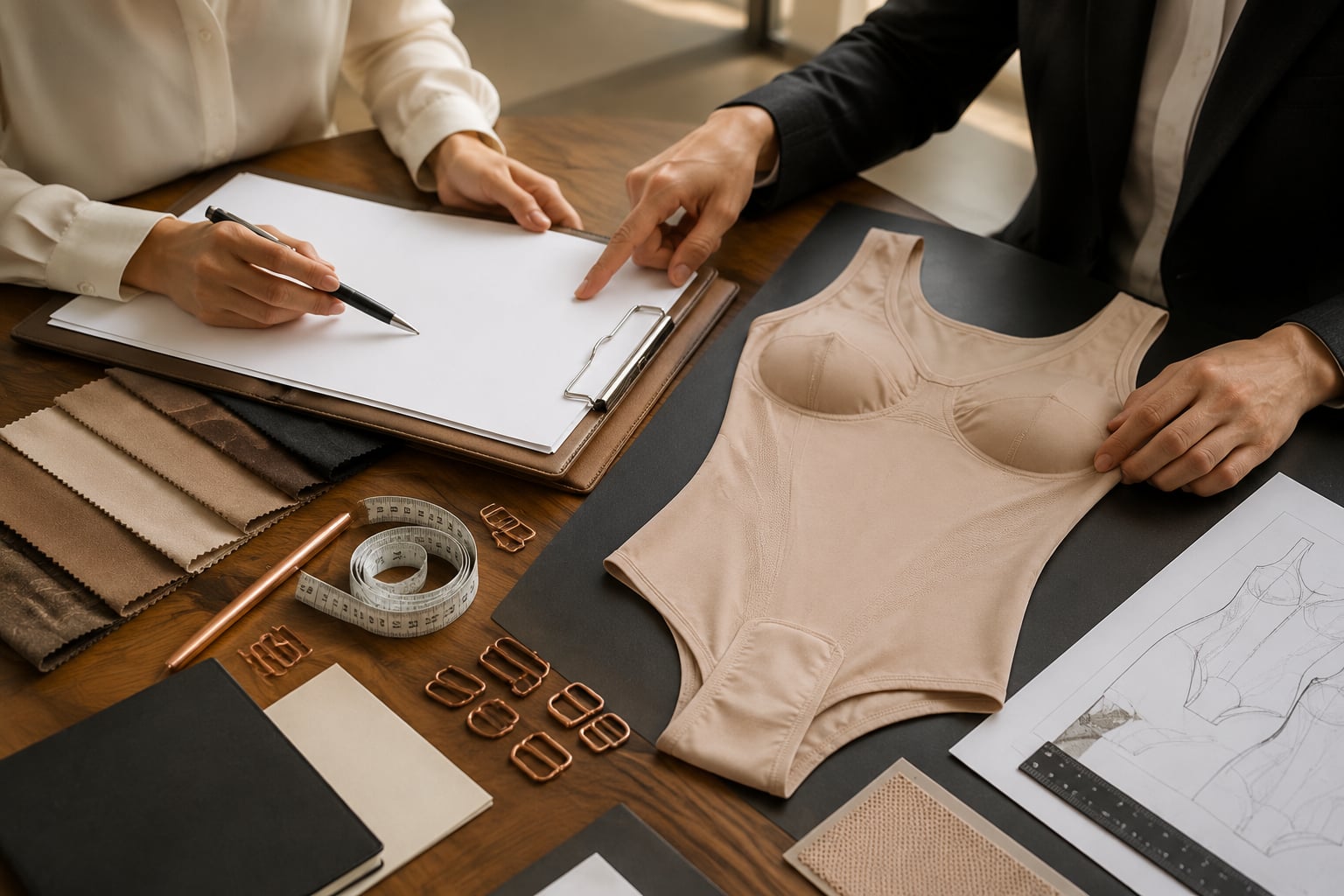
A written description alone rarely gives enough detail for shapewear. Fit, compression and comfort depend on a combination of pattern engineering, stretch direction, panel placement, seam type and component selection.
Attach the best information available, ideally in the following order:
- Technical flats: front, back and inside views, with seams, panels, openings, boning, hooks, gussets, silicone treatments and labels marked.
- Measurement specification: a graded measurement chart covering every requested size.
- Bill of materials: all fabrics, elastics, trims, labels and packaging components.
- Construction notes: stitch types, seam allowances, edge finishes and critical placement dimensions.
- Reference photographs or physical samples: clearly identify what should be copied, adapted or avoided.
- Fit comments: explain known issues with a reference garment, such as leg rolling, a waistband that digs in, insufficient bust support or inadequate opacity.
Do not ask a supplier to “match this sample exactly” unless you own the design rights and can provide a lawful, reproducible specification. A reference sample is more useful when you identify its individual features:
- Desired: bonded waistband finish, high recovery fabric, cotton-lined gusset.
- Not desired: visible panty line, narrow shoulder straps, restrictive leg hem.
- To review: shaping strength and length of torso.
Include a workable measurement chart
Measurements should identify the garment position, method and tolerance, not just a list of dimensions. For example, “front rise, measured along curve from top edge to crotch seam” is clearer than “front rise”.
State:
- Base size and full grading range.
- Measurements in centimetres or millimetres.
- Whether the garment is measured relaxed, extended or both.
- Permitted manufacturing tolerance by measurement point.
- Whether measurements apply before or after washing.
- Fit sample size and fit model assumptions, if available.
For highly elastic products, a finished-garment measurement chart is only one part of the fit requirement. Ask suppliers to explain their assumed fabric stretch and recovery properties, because two garments with identical relaxed measurements can fit very differently.
Specify Materials, Components and Alternatives
Material choices determine much of a shapewear garment’s comfort, durability, opacity and shaping performance. Name required materials where you have them, but allow suppliers to propose alternatives when they cannot source the exact fabric.
For each fabric or component, specify:
- Fibre composition, where required.
- Fabric construction: knit type, mesh, powernet, rib, seamless circular knit or bonded laminate.
- Fabric weight, if known.
- Required stretch direction and approximate stretch or recovery expectations.
- Surface finish: matte, sheen, brushed, cooling, seamless or textured.
- Colour and colour-matching standard.
- Skin-contact requirements, such as a soft inner face or cotton gusset lining.
- Approved supplier or nominated material, if applicable.
- Whether substitutions need written approval before sampling or bulk use.
List all components, not only the main fabric:
- Waistband elastic, silicone grip tape or anti-roll construction.
- Leg elastic and edge binding.
- Hook-and-eye closures, zips, snaps or adjustable straps.
- Boning, support stays, foam cups or underwires.
- Gusset materials and fasteners.
- Sewing threads.
- Heat-transfer logos, care labels, size labels and woven labels.
- Hangtags, polybags, cartons and inserts.
Ask for alternatives in a controlled format
An RFQ should not force a supplier to guess whether a lower-cost alternative is acceptable. Instead, request separate options:
- Option A: quote to the specified material and component list.
- Option B: quote a technically comparable alternative, with full composition and performance differences.
- Option C: quote a value-engineered alternative, stating every change that affects hand feel, shaping, durability, appearance or minimum order quantity.
This approach can reveal practical routes to the target cost without allowing unapproved substitutions to disappear into the bulk quotation.
If you need support with custom product development, an OEM and ODM shapewear project should begin with the same disciplined exchange of specifications, materials and approval points.
Define Colours, Sizes and Order Scenarios
Suppliers cannot provide a meaningful price without a quantity breakdown. A total annual forecast is helpful, but it is not a substitute for the quantity per colour, style and size in each purchase order.
Provide:
- Number of styles.
- Colour names and colour standards, such as Pantone references or approved swatches.
- Size range and anticipated size ratio.
- Units per colour and size.
- Total units per style and per order.
- Number of deliveries or production drops.
- Expected first order and repeat-order scenarios.
- Forecast volume, clearly labelled as indicative unless contractually committed.
For example:
| Scenario | Colours | Sizes | Total quantity | Purpose |
|---|---|---|---|---|
| Development | 1 | Sample size only | 1–3 samples | Fit and construction approval |
| Pilot order | 2 | UK 8–22 | 1,000 units | Initial launch |
| Repeat order | 3 | UK 8–22 | 3,000 units | Replenishment planning |
| Volume option | 4 | UK 8–24 | 10,000 units | Annual-scale pricing review |
Ask for prices at each scenario rather than assuming that one quoted unit price applies at all volumes. Costs for fabric procurement, dyeing, setup, packaging and labour can change substantially with colour count and order quantity.
Do not hide size-range complexity
Extended size ranges may require different grading, panel proportions, elastic tensions or fit blocks. Ask whether the supplier expects a separate pattern, additional sampling or a different material consumption for larger sizes.
Likewise, do not assume nude shades are simple colour variations. Depending on the fabric and dye process, colour matching and minimum quantities may affect feasibility and cost. Request confirmation of the supplier’s colour approval process and the minimum quantity for custom colours.
List Testing, Quality and Inspection Needs
Testing and quality requirements should be written as acceptance criteria, not broad statements such as “premium quality”. Define what the product must withstand, how it will be assessed and who is responsible for the cost.
Your shapewear RFQ template can ask suppliers to confirm which tests they recommend for the specified garment and sales market. The final test programme should be agreed against the actual material, intended use and applicable obligations.
Typical categories to discuss include:
- Fibre composition verification.
- Colour fastness to washing, perspiration, rubbing or light where relevant.
- Dimensional stability after care washing.
- Stretch, growth and recovery.
- Seam strength and seam slippage.
- Pilling, abrasion or snagging risk.
- Restricted-substance requirements for materials, dyes, prints and trims.
- Skin-contact suitability for components such as silicone, coatings and adhesives.
- Performance of hooks, snaps, zips and other closures.
- Bond durability for bonded seams or heat-applied decorations.
Be precise about the test method, standard, sample selection, pass/fail threshold and responsible party where these are already known. If they are not known, ask the supplier to identify its assumptions rather than implying that a generic test certificate covers the finished product.
Define quality expectations before bulk production
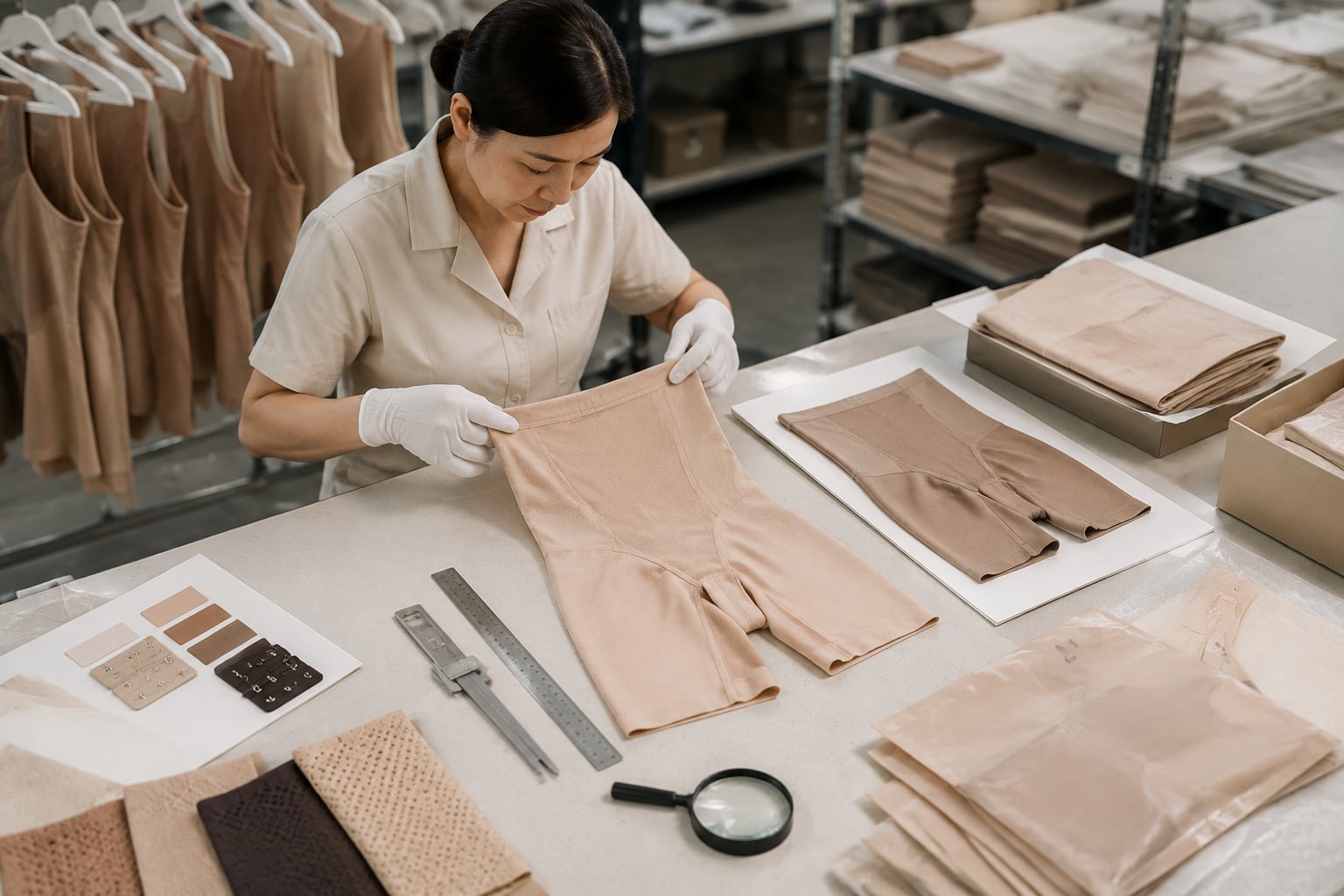
Set out the quality-control process you require at each stage:
- Pre-production sample approval.
- Size-set approval across the agreed range.
- Bulk fabric and trim approval.
- Production-line checks.
- Final random inspection, including the sampling level and defect classification if your business uses one.
- Measurement checks against the approved specification.
- Packing and assortment checks.
- Retained sample requirements.
- Process for reporting, segregating and resolving non-conforming goods.
A supplier’s quality assurance approach is relevant, but it does not replace your own written product acceptance criteria. Confirm what documents, reports, photographs or inspection records will be shared for each order.
Common shapewear defects to define in advance include uneven compression, twisting seams, skipped stitches, loose threads, inconsistent dye shade, leg hems that roll, incorrect label placement, defective closures and visible fabric marks. Not every issue can be eliminated entirely, but the quotation should make clear how defects are classified and handled.
Detail Branding, Packaging and Delivery Terms
Branding and packing can materially alter the unit price, lead time, minimum order quantity and import process. Supply artwork in the requested file format where possible, and clarify whether branding is provisional or production-ready.
Your RFQ should cover:
- Brand logo application method: woven label, print, heat transfer, embroidery or silicone badge.
- Size labels, care labels and fibre-content information.
- Required languages and destination-market information.
- Hangtags, inserts, stickers and barcode labels.
- Individual garment folding method.
- Polybag requirements, warnings or suffocation notices where required.
- Carton dimensions, maximum gross weight and carton markings.
- Assortment ratio by colour and size.
- Sustainability or material requirements for packaging, if applicable.
Avoid simply stating “eco-friendly packaging”. Describe the acceptable material, recycled content claim, recyclability requirement, ink limitation or plastic-reduction objective you want the supplier to quote against.
Make delivery terms unambiguous
State the requested Incoterm and named place, for example whether you need collection at origin, freight to a UK port or delivery to a UK warehouse. If you are unsure which term to use, ask suppliers to quote two clearly labelled logistics options.
Request separate line items for:
- Product unit price.
- Tooling, moulds or development charges.
- Sample charges.
- Custom colour or dye charges.
- Branding setup charges.
- Packaging charges.
- Testing and inspection charges.
- Freight, insurance, duty and import-related costs, if included.
- Payment terms and currency.
A delivered figure is only comparable if all suppliers are quoting to the same destination, delivery basis, order quantity and packaging configuration. Confirm whether VAT, customs duty, clearance, inland delivery and storage are included or excluded.
Request Assumptions, Exclusions and Validity
Every quotation contains assumptions. The problem is not that assumptions exist; it is that they are often undisclosed. Make disclosure a mandatory part of your quotation request.
Ask each supplier to state:
- Quote currency and exchange-rate assumptions, if any.
- Validity period for pricing.
- Material price assumptions and any price-adjustment mechanism.
- Minimum order quantities by style, colour and fabric.
- Sample and bulk-production lead-time assumptions.
- Capacity assumptions relevant to the requested delivery window.
- Payment terms.
- Included tooling, pattern work and development support.
- Excluded tests, certifications, freight, duties or local taxes.
- Permitted production tolerance for measurements, colour shade and quantity.
- Ownership terms for patterns, tooling, artwork and developed materials.
- Conditions that would trigger a price change.
This section is particularly important for an ODM project. A supplier may quote an existing block or existing material basis unless you state that a bespoke pattern, exclusive material or custom packaging is required.
A quote should also distinguish between an estimate, a firm offer and a price subject to sample approval. Treat an early indicative price as a planning input, not a final landed cost.
Compare Responses with a Quote Matrix
A quote matrix prevents the lowest visible unit price from becoming the automatic winner. It helps the sourcing team compare total cost, technical fit, commercial risk and unanswered questions in one place.
Use a simple scoring system, such as 1–5, and retain links to the original quotations and technical files. Do not score unsupported statements as confirmed capability; mark them as “evidence required” until documentation, samples or a technical review supports them.
| Evaluation area | What to compare | Why it matters |
|---|---|---|
| Product interpretation | Compliance with drawings, measurements and construction notes | Reveals whether the supplier understood the brief |
| Materials | Exact specification, proposed alternatives and sourcing risk | Affects fit, feel, recovery and cost |
| Unit and total cost | All charges, quantity breaks and delivered-cost basis | Prevents misleading price comparisons |
| Minimum order quantity | Per style, colour, size and custom component | Determines commercial feasibility |
| Sampling | Cost, iterations, approval stages and timing assumptions | Indicates development practicality |
| Quality plan | Testing, inspection, tolerances and defect process | Reduces ambiguity before bulk production |
| Branding and packaging | Setup charges, artwork process and packing detail | Avoids late-stage cost additions |
| Delivery terms | Incoterm, destination, freight inclusions and timing assumptions | Makes landed-cost comparison possible |
| Commercial terms | Payment, quote validity and price-change clauses | Identifies financial exposure |
| Open points | Missing data, deviations and exclusions | Shows what must be resolved before selection |
Questions to ask when a quote is unusually low
A low quote can be a good opportunity, but it should trigger a technical check rather than an immediate award. Ask:
- Is the quoted fabric composition and weight exactly as requested?
- Does the price include all panels, linings, closures, labels and packaging?
- Is the price based on your full colour and size breakdown?
- Are testing, inspection and sampling included or excluded?
- Is the quote based on an existing pattern rather than a custom fit block?
- Which assumptions could change after sample development?
- Is freight included, and under which delivery term?
- Is the supplier proposing a different construction, elastic or compression level?
Conversely, a higher quotation may be justified by a more complete materials list, a lower MOQ, stronger quality controls, better packaging detail or more realistic delivery assumptions. The quote matrix makes those differences visible.
Common RFQ Mistakes That Create Unusable Quotes
The most common problem is requesting “your best price” before defining the product. Other frequent mistakes include:
- Sending only inspiration images without measurements or construction notes.
- Omitting the target market and intended end use.
- Providing a total quantity without colour and size splits.
- Failing to distinguish mandatory specifications from preferred features.
- Accepting “similar material” without receiving the composition and performance differences.
- Leaving Incoterms, delivery location and freight inclusions undefined.
- Treating sample approval as proof that bulk production will meet every requirement.
- Comparing ex-works, FOB and delivered prices in the same spreadsheet.
- Forgetting to request price validity and price-change conditions.
- Adding packaging, labelling or testing requirements after the supplier has quoted.
A complete RFQ cannot remove every development risk. It can, however, ensure that deviations are surfaced early enough to make an informed sourcing decision.
A Practical Shapewear RFQ Checklist
Before issuing your request, confirm that it includes:
- Product scope, target customer and target market.
- Technical drawings and a graded measurement specification.
- Reference samples with clear “keep”, “change” and “avoid” notes.
- Material and component requirements.
- Approved alternative process.
- Colour, size and quantity scenarios.
- Testing, inspection and quality acceptance requirements.
- Branding, labelling, packaging and carton specifications.
- Delivery destination, Incoterm and requested delivery window.
- Separate request for tooling, sample, testing, packaging and freight costs.
- Assumptions, exclusions, MOQ, payment terms and quotation validity.
- A response deadline and named contact for technical questions.
Once the first quotations arrive, use the matrix to identify missing information before narrowing the supplier list. For teams considering product directions before issuing an RFQ, reviewing available shapewear product categories can also help define the right product format and construction brief.
S-SHAPER supports OEM, ODM and private-label shapewear projects from product development through scalable series production. A well-structured RFQ is the most useful starting point for any supplier discussion: send the same complete brief to each shortlisted factory, then resolve deviations before approving samples or placing an order.