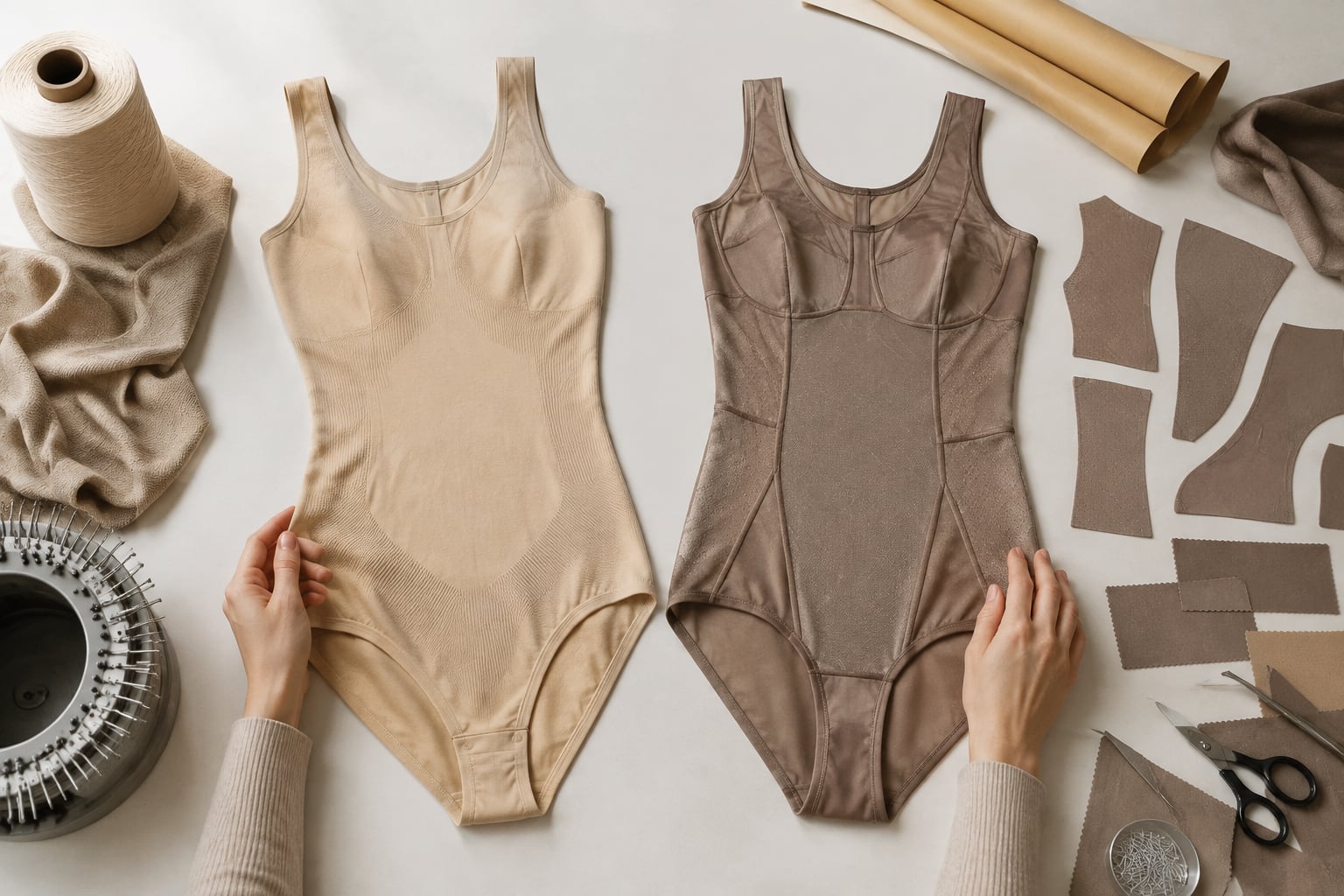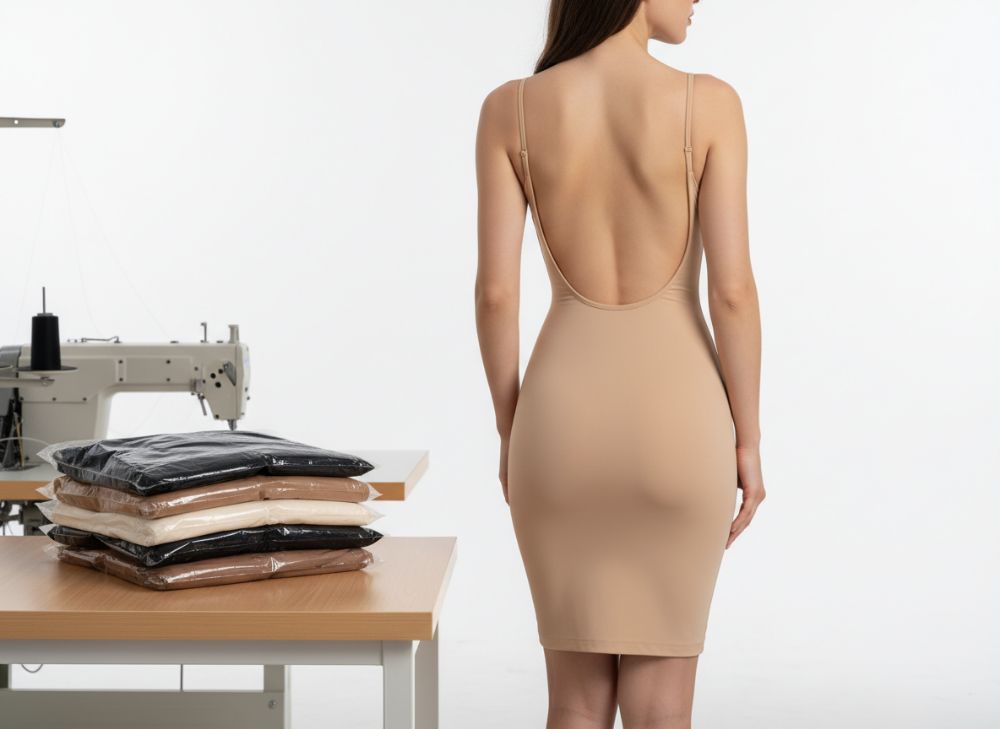

Shapewear manufacturing cost is driven less by a single “factory price” than by the specification behind it. Fabric composition, garment construction, trims, colourways, size range, order quantity, testing, packaging and delivery terms can each change a quotation materially.
For a meaningful comparison, give every supplier the same costed product brief and ask them to separate one-off development charges, unit product cost and logistics. The lowest initial quote is not necessarily the lowest landed cost or the most suitable option for the product you intend to sell.
Start with a Costed Product Specification
A supplier can only quote accurately when the product is defined. A vague request such as “high-compression bodysuit in recycled fabric” leaves major cost variables open to interpretation. One factory may allow for a simple single-layer garment; another may include bonded edges, a gusset opening, reinforced tummy panels and branded packaging.
Your specification should identify the commercial and technical requirements that affect cost:
- Product type and intended function: shorts, bodysuit, brief, waist trainer, slip, post-surgical-style garment or another category; targeted shaping zones; compression expectation; and intended wear occasion.
- Technical sketch or tech pack: front and back views, panel lines, seam placement, length, neckline, leg opening and closure positions.
- Fabric requirements: fibre content, knit or weave type, target weight, stretch and recovery expectations, opacity, surface finish and any recycled or certified-material requirement.
- Components: elastics, hook-and-eye closures, zips, boning, silicone grip, gusset fabric, labels, heat-transfer logos and care labels.
- Colour and branding: standard or custom-dyed colour, Pantone reference where applicable, logo method and placement.
- Sizing: size range, measurement chart, grading rules and whether a plus-size range needs separate fit development.
- Packaging: polybag, paper sleeve, box, inserts, barcode labels, hangtags, security labels and carton requirements.
- Quality and testing requirements: inspection level, performance expectations and tests required for your selling market.
- Commercial assumptions: expected order quantity per style, colour and size; delivery destination; and preferred Incoterms.
A complete brief reduces quotation assumptions. It also makes later changes visible: if you add a bonded waistband after sampling, the supplier can identify the effect on both cost and lead time rather than quietly substituting another construction.
A bill of materials (BOM) is especially useful. It lists every item used in the garment, its specification, unit of measure and supplier where nominated. Ask the factory to flag any items it has estimated rather than confirmed.
Understand Fabric and Component Costs
Fabric is commonly one of the largest contributors to shapewear manufacturing cost because shaping performance depends on stretch, recovery, density and durability—not simply on weight per metre.
Fabric choices affect both price and performance
A lightweight seamless knit, a power-mesh lining and a dense double-layer compression fabric may all create a shaping effect, but they have different material consumption, cutting behaviour and sewing requirements. Cost can change with:
- Fibre blend: nylon, elastane, polyester, cotton and regenerated or recycled fibres each have different availability and performance characteristics.
- Elastane content and quality: higher stretch performance or recovery requirements can increase material cost, but reducing elastane without validating fit may compromise the garment.
- Fabric weight and density: more substantial materials often use more yarn or provide greater coverage, though the relationship is not always linear.
- Width and usable yield: a narrow fabric or a layout with inefficient pattern placement increases consumption per garment.
- Custom colour: dyeing to a specific shade may involve minimums, development work and colour-approval rounds.
- Special finishes: anti-slip treatments, brushed surfaces, cooling claims or other functional finishes should be specified and validated rather than assumed.
Consumption matters as much as the quoted fabric price. A factory should calculate estimated fabric usage per unit, including reasonable cutting wastage. Long-leg shorts, extended bodysuits and styles with wide panels naturally use more fabric than a brief.
Small components can become meaningful costs
Trims are often overlooked during early budgeting. Yet a garment with several hook-and-eye rows, shaped boning, silicone tape, custom jacquard elastic, branded woven labels and retail-ready packaging has a more complex BOM than a plain pull-on style.
Before approving a quote, clarify:
- Whether components are standard stock items or custom developments.
- Any minimum order quantity for each trim or label.
- Whether unused custom components remain your property and how they will be stored.
- Whether component costs are included in the unit price or quoted separately.
- What happens if a nominated trim supplier cannot meet the required delivery date.
Do not assume that substituting a lower-cost component is harmless. For instance, elastic recovery, hook durability, coating quality and silicone adhesion can materially affect customer comfort and garment longevity.
Compare Construction Complexity
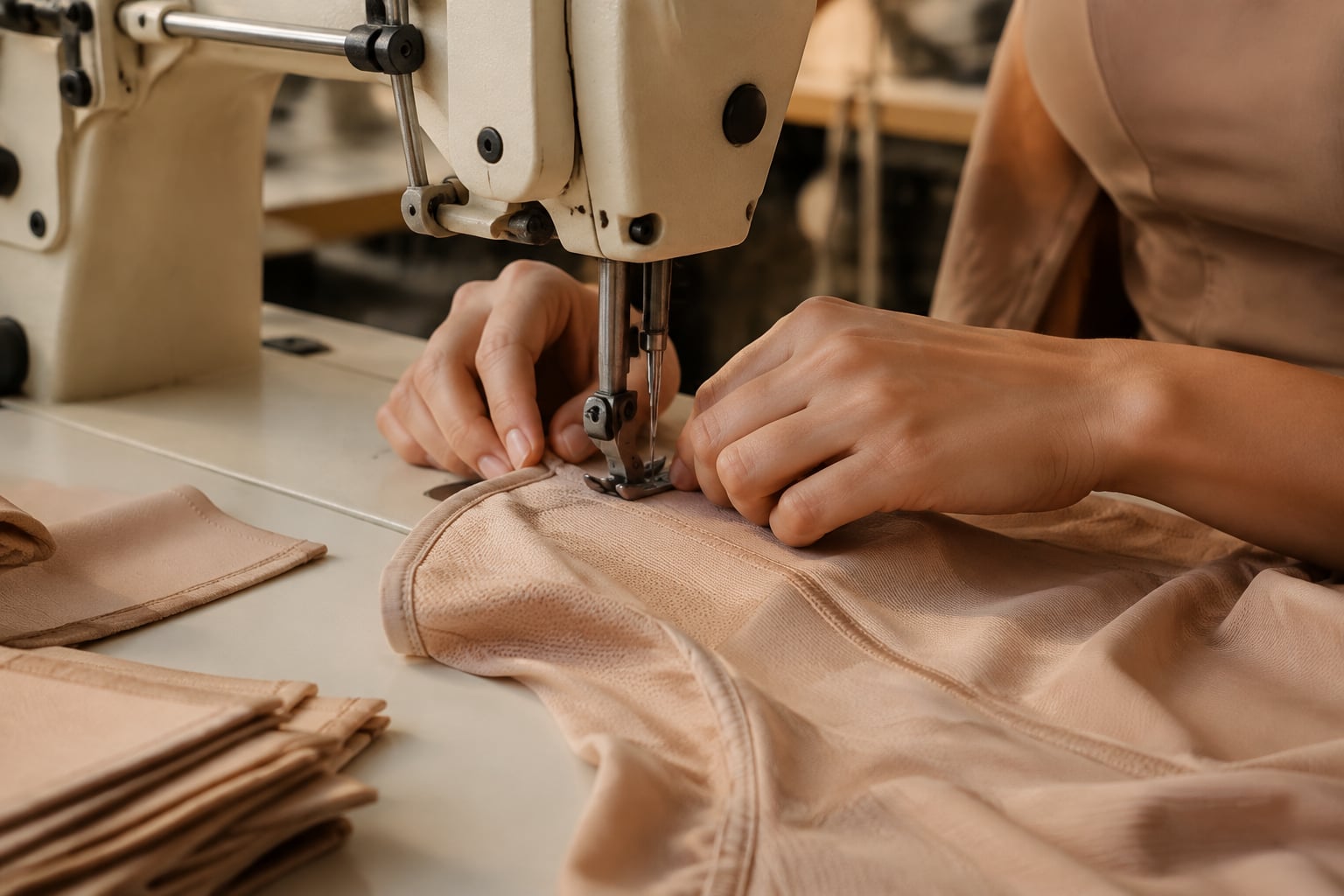
Two shapewear styles with similar fabric can have very different labour costs. Construction complexity is determined by the number of operations, the specialist machinery needed, the skill required and the time needed to maintain consistent quality.
Features that usually add manufacturing work
The following design choices often increase the cut-and-sew cost:
| Design feature | Why it affects cost | What to confirm |
|---|---|---|
| Multiple shaping panels | More pattern pieces, cutting and seams | Whether panel seams support the intended compression zones |
| Double layers or lining | Extra fabric consumption and sewing operations | Whether layers are attached throughout or only in selected areas |
| Bonded edges or seams | Specialist equipment, adhesives and process control | Wash durability, edge lifting and comfort testing |
| Hook-and-eye gusset or front closure | Additional parts and precise attachment | Closure strength, placement and size grading |
| Boning or structured support | Materials, channels and careful insertion | Flexibility, end protection and wearer comfort |
| Seamless knit construction | Specialist development and machine allocation | Available size range, compression consistency and MOQ |
| Silicone grip tape | Additional component and application step | Grip performance, skin comfort and wash retention |
| Complex colour blocking | More cutting, matching and sewing | Colour alignment and tolerance standards |
A garment does not need every premium feature to perform well. The most economical design is usually the one that delivers the intended support and fit with the fewest avoidable operations.
Consider simplification before requesting a price reduction after development. Removing a non-essential panel, using one closure system rather than two, or standardising a trim can be more productive than asking a factory to reduce labour allowances without changing the product.
Fit complexity should be priced realistically
Shapewear is sensitive to fit. A garment may look correct on a mannequin yet roll at the waistband, pinch at the leg opening or create inconsistent compression on different body shapes. Extended size ranges, high-compression designs and garments with closures often require more fitting attention.
Ask how the supplier will interpret your measurement chart, grade the pattern and manage fit approval across the range. A low quote that assumes a single base size and limited fitting rounds may not cover the development work needed for a reliable commercial range.
Account for Sampling and Development
Sampling is a separate investment from series production. It can include pattern creation, material sourcing, prototype making, fit adjustments, colour matching, component development and pre-production approval.
Treat sampling charges as a way to make risk visible, rather than as an inconvenience to eliminate. A factory may charge for work that is not efficiently recoverable through a first small order, especially where the style uses bespoke components or several iterations.
Typical development stages to define
The terminology varies by supplier, but a structured project may include:
- Development sample: checks the first interpretation of the brief, fabric direction and basic construction.
- Fit sample: assesses measurements, compression, comfort and shape on the appropriate fit model.
- Revised sample: incorporates agreed corrections.
- Salesman or photo sample: may be used for buyer review, photography or pre-launch marketing, if required.
- Pre-production sample: confirms the approved standard before bulk manufacture.
Not every project needs every stage. However, skipping fit approval can create expensive corrections during bulk production. Define the number of included sample rounds, the cost of additional changes and which changes trigger a new pattern or material charge.
Development cost rises when the brief changes after each sample. To control this, consolidate feedback from design, merchandising, quality and sales teams into one written set of comments. Conflicting feedback is a common reason for repeated rounds.
If you require OEM, ODM or private-label support, clarify which elements are supplied by the factory and which are owned or approved by your business. With S-SHAPER UK, the OEM and ODM shapewear options provide a starting point for defining that scope before the quotation is prepared.
Model Quantity, Colour and Size Effects
Order quantity affects unit cost because development, machine set-up, material handling, quality administration and packing preparation are spread across more units. The relevant quantity is not always the total order quantity.
Factories may assess minimums at several levels:
- Total quantity for the order
- Quantity per style
- Quantity per colour
- Quantity per size
- Minimums for fabric dyeing, custom elastic, labels or packaging
- Minimums for a specific production line or knitting programme
A purchase order for 2,000 units across one style, one colour and four sizes is operationally different from 2,000 units across four styles, five colours and eight sizes. The total is the same, but smaller production runs and component quantities can raise unit cost or create surplus material.
Build a realistic size and colour plan
A broad range can be commercially important, but it needs a credible initial buy plan. Factories may be able to produce low-volume sizes, yet the cost and availability of materials, labels and packaging still need consideration.
Ask suppliers to explain:
- The quantity assumption behind each price tier.
- Whether the quoted price applies to every colour and size.
- Whether a surcharge applies to extended sizes because of greater material use or modified construction.
- The minimum quantity for custom colours.
- Whether stock colours are available and whether shade continuity can be maintained across repeat orders.
- How fabric or trims purchased for the order are handled if size sales mix changes.
Avoid calculating the target order quantity from a single optimistic sales forecast. A staged launch using a smaller colour palette and core size assortment can reduce early complexity while preserving room for later expansion.
Include Testing, Quality and Packaging
A factory quotation should state what quality work is included. “Quality control included” is too broad to compare meaningfully because it might refer to routine in-line checks, final inspection, a defined inspection standard, third-party inspection or none of these.
Define the quality standard before bulk production
For shapewear, quality planning may need to cover:
- Measurement tolerances and how they are measured
- Stitch appearance, seam strength and skipped-stitch controls
- Elastic stretch and recovery
- Closure functionality and attachment strength
- Fabric defects, shade variation and colour matching
- Print, label and logo placement
- Bonded seam durability where applicable
- Cleanliness, packing presentation and carton markings
Agree the approved sample and written specification as the reference standard. The supplier should also explain when inspections take place, how defects are classified and what corrective action is expected if results do not meet the agreed standard.
For more detail on building controls into a sourcing project, review S-SHAPER UK’s quality assurance approach.
Testing should match the product and sales market
Testing can be charged separately and is not interchangeable across products. The appropriate test programme depends on the garment, materials, product claims, destination market and retailer requirements.
Potential areas to clarify include fibre composition, colour fastness, dimensional stability, seam strength, restricted substances and component safety. If you make claims about compression, recycled content, cooling, odour control or another performance attribute, establish in advance how that claim will be substantiated and who pays for any relevant validation.
For UK sales, also confirm your own responsibilities as brand owner, importer or distributor. Product labelling, fibre-content information, care instructions, chemical controls and packaging obligations may affect the specification and documentation needed. A factory’s willingness to provide a test report does not remove the need to check that its scope, sample and standard are appropriate for your product.
Packaging is part of the product cost
Retail packaging often receives attention late in development, when changes are more costly. Include it in the initial quotation request and specify:
- Retail pack format and materials
- Branding, artwork and barcode requirements
- Language requirements for labels and inserts
- Individual packing method
- Master-carton dimensions, packing ratio and markings
- Whether carton design needs to accommodate e-commerce fulfilment
A heavier box may improve shelf presentation but add material cost, carton volume and freight cost. Conversely, minimal packaging may be economical but unsuitable for the retail environment or product protection required.
Separate Product Cost from Logistics
The factory unit price is not your total acquisition cost. To understand the commercial picture, separate the product quotation from freight, insurance, customs-related charges, destination handling, duty where applicable, import VAT cash-flow implications, warehousing and onward fulfilment.
Ask every supplier to quote on the same named Incoterm and destination basis. Without this, one quote might cover goods only at the factory gate while another includes transport to a port or delivery to a named location. They are not directly comparable.
Build a landed-cost view
A practical landed-cost worksheet can include:
- Ex-works or agreed product price
- One-off sampling, pattern, tooling or artwork charges
- Packaging and labels not included in the unit price
- Origin handling and export documentation where applicable
- Main freight and cargo insurance
- Import duty and customs clearance costs, where relevant
- UK destination handling and delivery
- Inspection, testing and compliance documentation
- Warehousing, pick-and-pack or retailer preparation costs
- Expected allowance for rejects, shortages or rework
Freight is affected by carton volume as well as weight. Compression garments may be lightweight, but boxed retail packs can increase cubic volume quickly. Request carton dimensions and gross weight once packaging is confirmed; an early estimate based only on garment weight can be misleading.
Do not compare delivery promises without confirming the starting point. Production time, material lead time, sample approval, booking capacity, port movement and customs clearance are separate stages. A quotation should make clear which stages are included in the proposed timetable and which remain outside the supplier’s control.
Compare Supplier Quotations Fairly
A fair comparison is a like-for-like exercise. Build a quotation comparison sheet with identical specifications, quantity tiers and delivery assumptions for every supplier.
| Comparison point | What a clear quotation should show |
|---|---|
| Product basis | Style code, revision date, fabric, construction and approved assumptions |
| Quantity | Total units and breakdown by style, colour and size |
| Unit price | Currency, Incoterm and what is included or excluded |
| Development charges | Pattern, samples, tooling, colour matching and revision costs |
| Materials | Fabric and trim specifications, minimums and substitution process |
| Quality | Inspection scope, standard, defect handling and testing exclusions |
| Packaging | Retail pack, labels, carton packing ratio and artwork assumptions |
| Timing | Sample stages, material readiness, bulk production and shipment basis |
| Payment terms | Deposit, balance point, currency exposure and any stated conditions |
| Ownership | Treatment of patterns, custom moulds, labels and unused materials |
Questions that expose hidden differences
When quotes vary widely, ask targeted questions rather than simply requesting a lower number:
- Is the fabric exactly the specified composition, weight and finish?
- Is the quoted garment single-layer, lined or reinforced in the same areas?
- Are all closures, elastics, labels and packaging included?
- Does the price include the requested size range and colourway count?
- Which materials are stock, and which require custom production?
- How many sample revisions are included?
- What inspection activities are included in bulk production?
- Which tests, freight charges, duties and destination costs are excluded?
- What changes would trigger a revised unit price or minimum order requirement?
- Can the supplier provide a version-controlled BOM and specification for approval?
The cheapest quotation may be valid if it uses a simpler, fit-for-purpose construction and a more efficient supply chain. It becomes a risk when differences are unclear. Conversely, a higher quote may include better-defined materials, more development support or more complete packing and quality scope—but those inclusions must be documented, not assumed.
Common mistakes to avoid
- Comparing prices quoted under different Incoterms.
- Sending each factory a different or incomplete product brief.
- Treating a development sample as proof that bulk production will match it.
- Adding custom colours, labels or boxes after the factory has priced the order.
- Ignoring size-level and colour-level minimums.
- Assuming testing and third-party inspection are automatically included.
- Selecting a lower fabric weight without rechecking opacity, recovery and compression.
- Failing to allow for import, freight and destination handling in margin calculations.
- Approving bulk production without a signed-off specification and pre-production reference.
A well-managed shapewear project begins with a clear specification, a transparent BOM and comparable quotations. Once you know which elements are fixed and which are negotiable, you can reduce cost through sensible design and order planning rather than compromising fit, quality or customer experience.
For a practical next step, prepare a one-page product brief and quotation comparison sheet, then use it to evaluate potential manufacturing partners and their production capabilities through an overview of the factory.